Event submissions
Published
This submission belongs to the session S1. Environmental and Green Processes of the event The 5th International Electronic Conference on Processes
Published date
15 Oct, 2026
Academic Editor
'%3e%3cpath%20d='M12.6657%2010.9104C12.4185%2010.325%2012.0599%209.79327%2011.6097%209.34482C11.1609%208.89508%2010.6293%208.5365%2010.0442%208.28888C10.0389%208.28626%2010.0337%208.28495%2010.0285%208.28233C10.8446%207.69279%2011.3752%206.73249%2011.3752%205.64904C11.3752%203.8542%209.92103%202.39999%208.1262%202.39999C6.33136%202.39999%204.87715%203.8542%204.87715%205.64904C4.87715%206.73249%205.40774%207.69279%206.22393%208.28364C6.21869%208.28626%206.21345%208.28757%206.20821%208.29019C5.62129%208.5378%205.09463%208.89284%204.64265%209.34613C4.1929%209.79493%203.83432%2010.3266%203.58671%2010.9117C3.34345%2011.4845%203.21226%2012.0987%203.20023%2012.7209C3.19988%2012.7349%203.20233%2012.7488%203.20744%2012.7619C3.21255%2012.7749%203.22022%2012.7867%203.22998%2012.7968C3.23975%2012.8068%203.25142%2012.8147%203.26431%2012.8202C3.2772%2012.8256%203.29105%2012.8284%203.30504%2012.8284H4.09109C4.14874%2012.8284%204.19459%2012.7825%204.1959%2012.7262C4.2221%2011.7148%204.62823%2010.7676%205.34617%2010.0497C6.08899%209.30683%207.0755%208.89808%208.1262%208.89808C9.17689%208.89808%2010.1634%209.30683%2010.9062%2010.0497C11.6242%2010.7676%2012.0303%2011.7148%2012.0565%2012.7262C12.0578%2012.7838%2012.1037%2012.8284%2012.1613%2012.8284H12.9474C12.9613%2012.8284%2012.9752%2012.8256%2012.9881%2012.8202C13.001%2012.8147%2013.0126%2012.8068%2013.0224%2012.7968C13.0322%2012.7867%2013.0398%2012.7749%2013.0449%2012.7619C13.0501%2012.7488%2013.0525%2012.7349%2013.0522%2012.7209C13.0391%2012.0947%2012.9094%2011.4855%2012.6657%2010.9104ZM8.1262%207.9024C7.52486%207.9024%206.9589%207.6679%206.53312%207.24211C6.10733%206.81633%205.87283%206.25037%205.87283%205.64904C5.87283%205.0477%206.10733%204.48174%206.53312%204.05596C6.9589%203.63018%207.52486%203.39567%208.1262%203.39567C8.72753%203.39567%209.29349%203.63018%209.71927%204.05596C10.1451%204.48174%2010.3796%205.0477%2010.3796%205.64904C10.3796%206.25037%2010.1451%206.81633%209.71927%207.24211C9.29349%207.6679%208.72753%207.9024%208.1262%207.9024Z'%20fill='%235D1EE1'/%3e%3c/g%3e%3c/svg%3e) Juan Francisco García Martín
Juan Francisco García MartínCitation
Fares Fenniche, Ramlia Bensaha, Khane Yasmina, Electrochemically fabricated Polyaniline/Reduced Graphene Oxide nanocomposite films for enhanced photocatalytic and antibacterial applications, in Proceedings of The 5th International Electronic Conference on Processes, 20 October–22 October 2026, MDPI: Basel, Switzerland
Share
Email
Facebook
Twitter
LinkedIn
Electrochemically fabricated Polyaniline/Reduced Graphene Oxide nanocomposite films for enhanced photocatalytic and antibacterial applications

Fares Fenniche 1,2
'%3e%3cpath%20d='M12.6647%2010.9104C12.4176%2010.325%2012.0589%209.7933%2011.6088%209.34485C11.16%208.89511%2010.6283%208.53653%2010.0432%208.28891C10.038%208.28629%2010.0327%208.28498%2010.0275%208.28236C10.8437%207.69282%2011.3743%206.73252%2011.3743%205.64907C11.3743%203.85423%209.92005%202.40002%208.12522%202.40002C6.33038%202.40002%204.87618%203.85423%204.87618%205.64907C4.87618%206.73252%205.40677%207.69282%206.22296%208.28367C6.21772%208.28629%206.21248%208.2876%206.20724%208.29022C5.62031%208.53783%205.09365%208.89287%204.64167%209.34616C4.19192%209.79496%203.83334%2010.3266%203.58573%2010.9117C3.34247%2011.4846%203.21128%2012.0987%203.19925%2012.721C3.1989%2012.735%203.20135%2012.7489%203.20646%2012.7619C3.21157%2012.7749%203.21924%2012.7868%203.22901%2012.7968C3.23877%2012.8068%203.25045%2012.8148%203.26334%2012.8202C3.27623%2012.8256%203.29007%2012.8284%203.30406%2012.8284H4.09012C4.14776%2012.8284%204.19362%2012.7825%204.19493%2012.7262C4.22113%2011.7148%204.62726%2010.7676%205.34519%2010.0497C6.08802%209.30686%207.07452%208.89811%208.12522%208.89811C9.17592%208.89811%2010.1624%209.30686%2010.9052%2010.0497C11.6232%2010.7676%2012.0293%2011.7148%2012.0555%2012.7262C12.0568%2012.7839%2012.1027%2012.8284%2012.1603%2012.8284H12.9464C12.9604%2012.8284%2012.9742%2012.8256%2012.9871%2012.8202C13%2012.8148%2013.0117%2012.8068%2013.0214%2012.7968C13.0312%2012.7868%2013.0389%2012.7749%2013.044%2012.7619C13.0491%2012.7489%2013.0515%2012.735%2013.0512%2012.721C13.0381%2012.0947%2012.9084%2011.4856%2012.6647%2010.9104ZM8.12522%207.90243C7.52388%207.90243%206.95792%207.66793%206.53214%207.24215C6.10636%206.81636%205.87185%206.2504%205.87185%205.64907C5.87185%205.04773%206.10636%204.48177%206.53214%204.05599C6.95792%203.63021%207.52388%203.3957%208.12522%203.3957C8.72655%203.3957%209.29252%203.63021%209.7183%204.05599C10.1441%204.48177%2010.3786%205.04773%2010.3786%205.64907C10.3786%206.2504%2010.1441%206.81636%209.7183%207.24215C9.29252%207.66793%208.72655%207.90243%208.12522%207.90243Z'%20fill='%235D1EE1'/%3e%3c/g%3e%3c/svg%3e)
Ramlia Bensaha 3
Khane Yasmina 1
1. Materials, Energy Systems Technology and Environment Laboratory, Faculty of Sciences and Technology, University of Ghardaia, 47000 Ghardaia, Algeria.
2. Department of process engineering, Faculty of Sciences and Technology, University of Ghardaïa, BP 455, 47000 Ghardaïa– Algeria
3. Brahim Tirichine Public University Hospital (EPH), Ghardaia, Algeria.
Abstract
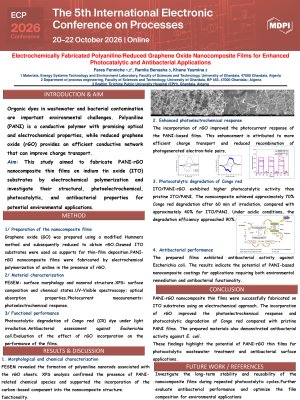
In this work, hybrid nanocomposite thin films composed of polyaniline (PANI) and reduced graphene oxide (rGO) were successfully fabricated on indium tin oxide (ITO) substrates through an electrochemical polymerization approach. Reduced graphene oxide was prepared from graphene oxide using a modified Hummers method and subsequently incorporated into the growing PANI matrix during electropolymerization. The structural, morphological, optical, and photoelectrochemical characteristics of the obtained nanocomposites were investigated using field-emission scanning electron microscopy (FESEM), X-ray photoelectron spectroscopy (XPS), UV–Visible spectroscopy, and photocurrent measurements. Morphological observations revealed the formation of well-defined PANI nanorods with diameters ranging from approximately 50 to 100 nm, while XPS analysis confirmed the successful integration of rGO within the polymer framework. Consequently, the incorporation of rGO significantly enhanced the photoelectrochemical behavior of the material, leading to an increase in photocurrent density from 7 to 13 mA cm⁻² due to the efficient charge transport and reduced recombination of photogenerated charge carriers provided by the conductive graphene network. Furthermore, the photocatalytic performance of the nanocomposite films was evaluated through the degradation of Congo red dye under acidic conditions, where the PANI-rGO system exhibited superior photocatalytic activity compared with pristine PANI, achieving a dye removal efficiency close to 90%. Additionally, chitosan-modified ITO/PANI and ITO/PANI-rGO films were assessed for their antibacterial properties against Escherichia coli, demonstrating notable antibacterial activity and indicating their potential for multifunctional environmental applications. Overall, these findings highlight the synergistic effect between PANI and rGO, demonstrating the suitability of the developed nanocomposites for photocatalytic wastewater treatment and antimicrobial surface coatings.
Keywords
Polyaniline
Reduced graphene oxide
Nanocomposite films
Photocatalysis
Photocurrent
Antibacterial activity
Poster
Submission ID Sciforum-199944.pdf
Phase-Aware Takagi–Sugeno Fuzzy Predictive Control with Moving-Horizon Estimation for Beer Fermentation
Monoethanolamine-Assisted Formation of Cu/Cu2O Composites for Enhanced Electrochemical CO2 Reduction to Formate