Event submissions
Published
This submission belongs to the session S1. Environmental and Green Processes of the event The 5th International Electronic Conference on Processes
Published date
15 Oct, 2026
Academic Editor
'%3e%3cpath%20d='M12.6657%2010.9104C12.4185%2010.325%2012.0599%209.79327%2011.6097%209.34482C11.1609%208.89508%2010.6293%208.5365%2010.0442%208.28888C10.0389%208.28626%2010.0337%208.28495%2010.0285%208.28233C10.8446%207.69279%2011.3752%206.73249%2011.3752%205.64904C11.3752%203.8542%209.92103%202.39999%208.1262%202.39999C6.33136%202.39999%204.87715%203.8542%204.87715%205.64904C4.87715%206.73249%205.40774%207.69279%206.22393%208.28364C6.21869%208.28626%206.21345%208.28757%206.20821%208.29019C5.62129%208.5378%205.09463%208.89284%204.64265%209.34613C4.1929%209.79493%203.83432%2010.3266%203.58671%2010.9117C3.34345%2011.4845%203.21226%2012.0987%203.20023%2012.7209C3.19988%2012.7349%203.20233%2012.7488%203.20744%2012.7619C3.21255%2012.7749%203.22022%2012.7867%203.22998%2012.7968C3.23975%2012.8068%203.25142%2012.8147%203.26431%2012.8202C3.2772%2012.8256%203.29105%2012.8284%203.30504%2012.8284H4.09109C4.14874%2012.8284%204.19459%2012.7825%204.1959%2012.7262C4.2221%2011.7148%204.62823%2010.7676%205.34617%2010.0497C6.08899%209.30683%207.0755%208.89808%208.1262%208.89808C9.17689%208.89808%2010.1634%209.30683%2010.9062%2010.0497C11.6242%2010.7676%2012.0303%2011.7148%2012.0565%2012.7262C12.0578%2012.7838%2012.1037%2012.8284%2012.1613%2012.8284H12.9474C12.9613%2012.8284%2012.9752%2012.8256%2012.9881%2012.8202C13.001%2012.8147%2013.0126%2012.8068%2013.0224%2012.7968C13.0322%2012.7867%2013.0398%2012.7749%2013.0449%2012.7619C13.0501%2012.7488%2013.0525%2012.7349%2013.0522%2012.7209C13.0391%2012.0947%2012.9094%2011.4855%2012.6657%2010.9104ZM8.1262%207.9024C7.52486%207.9024%206.9589%207.6679%206.53312%207.24211C6.10733%206.81633%205.87283%206.25037%205.87283%205.64904C5.87283%205.0477%206.10733%204.48174%206.53312%204.05596C6.9589%203.63018%207.52486%203.39567%208.1262%203.39567C8.72753%203.39567%209.29349%203.63018%209.71927%204.05596C10.1451%204.48174%2010.3796%205.0477%2010.3796%205.64904C10.3796%206.25037%2010.1451%206.81633%209.71927%207.24211C9.29349%207.6679%208.72753%207.9024%208.1262%207.9024Z'%20fill='%235D1EE1'/%3e%3c/g%3e%3c/svg%3e) Juan Francisco García Martín
Juan Francisco García MartínCitation
Anastasia Igorevna Nechaeva, Vladislav Yuryevich Senchenkov, Inna Petrovna Solyanikova, Physiological activity and growth dynamics of isolates capable of biodegradation of petroleum products under conditions of changing pH, temperature and salinity of the environment, in Proceedings of The 5th International Electronic Conference on Processes, 20 October–22 October 2026, MDPI: Basel, Switzerland
Share
Email
Facebook
Twitter
LinkedIn
Physiological activity and growth dynamics of isolates capable of biodegradation of petroleum products under conditions of changing pH, temperature and salinity of the environment
'%3e%3cpath%20d='M12.6647%2010.9104C12.4176%2010.325%2012.0589%209.7933%2011.6088%209.34485C11.16%208.89511%2010.6283%208.53653%2010.0432%208.28891C10.038%208.28629%2010.0327%208.28498%2010.0275%208.28236C10.8437%207.69282%2011.3743%206.73252%2011.3743%205.64907C11.3743%203.85423%209.92005%202.40002%208.12522%202.40002C6.33038%202.40002%204.87618%203.85423%204.87618%205.64907C4.87618%206.73252%205.40677%207.69282%206.22296%208.28367C6.21772%208.28629%206.21248%208.2876%206.20724%208.29022C5.62031%208.53783%205.09365%208.89287%204.64167%209.34616C4.19192%209.79496%203.83334%2010.3266%203.58573%2010.9117C3.34247%2011.4846%203.21128%2012.0987%203.19925%2012.721C3.1989%2012.735%203.20135%2012.7489%203.20646%2012.7619C3.21157%2012.7749%203.21924%2012.7868%203.22901%2012.7968C3.23877%2012.8068%203.25045%2012.8148%203.26334%2012.8202C3.27623%2012.8256%203.29007%2012.8284%203.30406%2012.8284H4.09012C4.14776%2012.8284%204.19362%2012.7825%204.19493%2012.7262C4.22113%2011.7148%204.62726%2010.7676%205.34519%2010.0497C6.08802%209.30686%207.07452%208.89811%208.12522%208.89811C9.17592%208.89811%2010.1624%209.30686%2010.9052%2010.0497C11.6232%2010.7676%2012.0293%2011.7148%2012.0555%2012.7262C12.0568%2012.7839%2012.1027%2012.8284%2012.1603%2012.8284H12.9464C12.9604%2012.8284%2012.9742%2012.8256%2012.9871%2012.8202C13%2012.8148%2013.0117%2012.8068%2013.0214%2012.7968C13.0312%2012.7868%2013.0389%2012.7749%2013.044%2012.7619C13.0491%2012.7489%2013.0515%2012.735%2013.0512%2012.721C13.0381%2012.0947%2012.9084%2011.4856%2012.6647%2010.9104ZM8.12522%207.90243C7.52388%207.90243%206.95792%207.66793%206.53214%207.24215C6.10636%206.81636%205.87185%206.2504%205.87185%205.64907C5.87185%205.04773%206.10636%204.48177%206.53214%204.05599C6.95792%203.63021%207.52388%203.3957%208.12522%203.3957C8.72655%203.3957%209.29252%203.63021%209.7183%204.05599C10.1441%204.48177%2010.3786%205.04773%2010.3786%205.64907C10.3786%206.2504%2010.1441%206.81636%209.7183%207.24215C9.29252%207.66793%208.72655%207.90243%208.12522%207.90243Z'%20fill='%235D1EE1'/%3e%3c/g%3e%3c/svg%3e)
Anastasia Igorevna Nechaeva 1
Vladislav Yuryevich Senchenkov 2
Inna Petrovna Solyanikova 3
1. Department of biology, Institute of farmacy, chemistry and biology, Belgorod State National Research Univercity, Belgorod, Russia
2. Technology transfer center, Belgorod State National Research Univercity, Belgorod, Russia.
3. Regional microbiological center, Belgorod State National Research Univercity, Belgorod, Russia.
Abstract
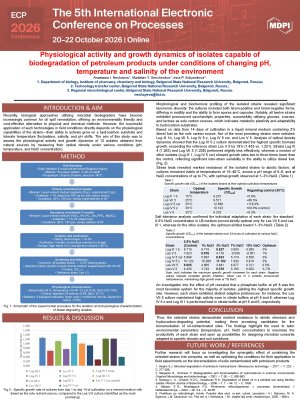
Recently, biological approaches using microbial biodegraders have become increasingly common in the cleanup of oil spills as an environmentally friendly and cost-effective alternative to physical and chemical methods. The aim of this work was to determine the physiological activity and growth dynamics of 12 isolates obtained from natural sources by measuring their optical density under various conditions (pH, temperature, NaCl concentration).
The most promising biodegraders were identified using liquid mineral medium with 2% diesel fuel (DF). Growth was monitored by optical density at 600 nm: over 14 days on DF and over 24 h in the stress tests (10–40°C, pH 5–8, 0.5–10% NaCl), with standard LB (0.5% NaCl, 30°C) as the control and the most active strain Les V 5 as the reference in the DF experiment. All measurements were performed in three biological replicates and are presented as mean ± confidence interval (Student's t-test); the relative error was mainly below 3% (considered insignificant), and inter-group differences were assessed by the Student criterion selected according to the sample distribution.
Morphological and biochemical profiling revealed diverse isolates, all capable of using glucose, sucrose and lactose. Based on 14-day cultivation with DF, five promising strains were selected (Lug III 1b, Lug VII 5, Lug IV 5z, Lug IV 5cor, Les V 5), the best specific growth increment exceeding the reference by 19% (1.453 vs. 1.221). The isolates tolerated 15–40°C, pH 5–8 and up to 7% NaCl, with the highest growth at 1–3% NaCl. 16S rRNA sequencing identified Brevundimonas diminuta (100% similarity, Lug IV 5cor) and Bacillus sp. (99.38%, Les V 5), presumably a novel strain.
Thus, the selected strains exhibit pronounced resistance to abiotic stressors and hydrocarbon-degradation potential, making them promising candidates for the bioremediation of oil-contaminated areas.
Keywords
bioremediation
diesel fuel
growth dynamics
physiological activity
16S rRNA sequencing
Poster
poster Nechaeva A.pdf
Development of a Biomimetic Quadruped Robot Control System with Real-Time Sensor-Based Process Monitoring
Multi-Horizon Forecasting of a Hybrid Wind–Solar Plant Using Machine Learning and SHAP