Event submissions
Published
This submission belongs to the session S4. Process Control, Monitoring and Machine Learning of the event The 5th International Electronic Conference on Processes
Published date
15 Oct, 2026
Academic Editor
'%3e%3cpath%20d='M12.6657%2010.9104C12.4185%2010.325%2012.0599%209.79327%2011.6097%209.34482C11.1609%208.89508%2010.6293%208.5365%2010.0442%208.28888C10.0389%208.28626%2010.0337%208.28495%2010.0285%208.28233C10.8446%207.69279%2011.3752%206.73249%2011.3752%205.64904C11.3752%203.8542%209.92103%202.39999%208.1262%202.39999C6.33136%202.39999%204.87715%203.8542%204.87715%205.64904C4.87715%206.73249%205.40774%207.69279%206.22393%208.28364C6.21869%208.28626%206.21345%208.28757%206.20821%208.29019C5.62129%208.5378%205.09463%208.89284%204.64265%209.34613C4.1929%209.79493%203.83432%2010.3266%203.58671%2010.9117C3.34345%2011.4845%203.21226%2012.0987%203.20023%2012.7209C3.19988%2012.7349%203.20233%2012.7488%203.20744%2012.7619C3.21255%2012.7749%203.22022%2012.7867%203.22998%2012.7968C3.23975%2012.8068%203.25142%2012.8147%203.26431%2012.8202C3.2772%2012.8256%203.29105%2012.8284%203.30504%2012.8284H4.09109C4.14874%2012.8284%204.19459%2012.7825%204.1959%2012.7262C4.2221%2011.7148%204.62823%2010.7676%205.34617%2010.0497C6.08899%209.30683%207.0755%208.89808%208.1262%208.89808C9.17689%208.89808%2010.1634%209.30683%2010.9062%2010.0497C11.6242%2010.7676%2012.0303%2011.7148%2012.0565%2012.7262C12.0578%2012.7838%2012.1037%2012.8284%2012.1613%2012.8284H12.9474C12.9613%2012.8284%2012.9752%2012.8256%2012.9881%2012.8202C13.001%2012.8147%2013.0126%2012.8068%2013.0224%2012.7968C13.0322%2012.7867%2013.0398%2012.7749%2013.0449%2012.7619C13.0501%2012.7488%2013.0525%2012.7349%2013.0522%2012.7209C13.0391%2012.0947%2012.9094%2011.4855%2012.6657%2010.9104ZM8.1262%207.9024C7.52486%207.9024%206.9589%207.6679%206.53312%207.24211C6.10733%206.81633%205.87283%206.25037%205.87283%205.64904C5.87283%205.0477%206.10733%204.48174%206.53312%204.05596C6.9589%203.63018%207.52486%203.39567%208.1262%203.39567C8.72753%203.39567%209.29349%203.63018%209.71927%204.05596C10.1451%204.48174%2010.3796%205.0477%2010.3796%205.64904C10.3796%206.25037%2010.1451%206.81633%209.71927%207.24211C9.29349%207.6679%208.72753%207.9024%208.1262%207.9024Z'%20fill='%235D1EE1'/%3e%3c/g%3e%3c/svg%3e) Ravendra Singh
Ravendra SinghCitation
Cheng-Wei Hung, Chung-Chieh Tai, Proximal Policy Optimization for Resilience-Oriented Process Control of Islanded Microgrids under Extreme Meteorological Disturbances, in Proceedings of The 5th International Electronic Conference on Processes, 20 October–22 October 2026, MDPI: Basel, Switzerland
Share
Email
Facebook
Twitter
LinkedIn
Proximal Policy Optimization for Resilience-Oriented Process Control of Islanded Microgrids under Extreme Meteorological Disturbances

Cheng-Wei Hung 1
'%3e%3cpath%20d='M12.6647%2010.9104C12.4176%2010.325%2012.0589%209.7933%2011.6088%209.34485C11.16%208.89511%2010.6283%208.53653%2010.0432%208.28891C10.038%208.28629%2010.0327%208.28498%2010.0275%208.28236C10.8437%207.69282%2011.3743%206.73252%2011.3743%205.64907C11.3743%203.85423%209.92005%202.40002%208.12522%202.40002C6.33038%202.40002%204.87618%203.85423%204.87618%205.64907C4.87618%206.73252%205.40677%207.69282%206.22296%208.28367C6.21772%208.28629%206.21248%208.2876%206.20724%208.29022C5.62031%208.53783%205.09365%208.89287%204.64167%209.34616C4.19192%209.79496%203.83334%2010.3266%203.58573%2010.9117C3.34247%2011.4846%203.21128%2012.0987%203.19925%2012.721C3.1989%2012.735%203.20135%2012.7489%203.20646%2012.7619C3.21157%2012.7749%203.21924%2012.7868%203.22901%2012.7968C3.23877%2012.8068%203.25045%2012.8148%203.26334%2012.8202C3.27623%2012.8256%203.29007%2012.8284%203.30406%2012.8284H4.09012C4.14776%2012.8284%204.19362%2012.7825%204.19493%2012.7262C4.22113%2011.7148%204.62726%2010.7676%205.34519%2010.0497C6.08802%209.30686%207.07452%208.89811%208.12522%208.89811C9.17592%208.89811%2010.1624%209.30686%2010.9052%2010.0497C11.6232%2010.7676%2012.0293%2011.7148%2012.0555%2012.7262C12.0568%2012.7839%2012.1027%2012.8284%2012.1603%2012.8284H12.9464C12.9604%2012.8284%2012.9742%2012.8256%2012.9871%2012.8202C13%2012.8148%2013.0117%2012.8068%2013.0214%2012.7968C13.0312%2012.7868%2013.0389%2012.7749%2013.044%2012.7619C13.0491%2012.7489%2013.0515%2012.735%2013.0512%2012.721C13.0381%2012.0947%2012.9084%2011.4856%2012.6647%2010.9104ZM8.12522%207.90243C7.52388%207.90243%206.95792%207.66793%206.53214%207.24215C6.10636%206.81636%205.87185%206.2504%205.87185%205.64907C5.87185%205.04773%206.10636%204.48177%206.53214%204.05599C6.95792%203.63021%207.52388%203.3957%208.12522%203.3957C8.72655%203.3957%209.29252%203.63021%209.7183%204.05599C10.1441%204.48177%2010.3786%205.04773%2010.3786%205.64907C10.3786%206.2504%2010.1441%206.81636%209.7183%207.24215C9.29252%207.66793%208.72655%207.90243%208.12522%207.90243Z'%20fill='%235D1EE1'/%3e%3c/g%3e%3c/svg%3e)
Chung-Chieh Tai 2
1. Department of Civil Engineering and Environmental Informatics, Minghsin University of Science and Technology, Hsinchu, 30401, Taiwan
2. Department of Semiconductor and Electro-Optical Technology,Minghsin University of Science and Technology, Hsinchu, 304001, Taiwan
Abstract
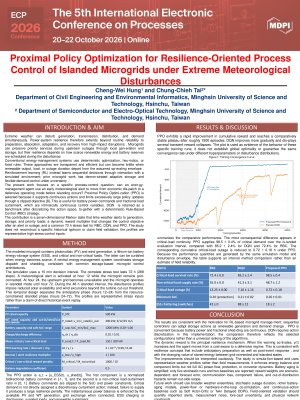
Introduction: Extreme meteorological disturbances can interrupt centralized power grids and force local microgrids to operate as islanded, safety-critical energy processes. Conventional rule-based dispatch and discrete-action learning methods often react too late to weather alerts, causing premature battery depletion and critical-load interruptions. Methods: This study proposes a resilience-oriented process-control framework based on Proximal Policy Optimization (PPO). The microgrid energy management problem is formulated as a continuous Markov Decision Process that integrates time, photovoltaic and wind generation, battery state of charge, critical and non-critical load demands, and a binary meteorological alert signal. A dynamic multi-objective reward function shifts the controller from cost-aware operation during normal conditions to defensive scheduling during disaster alerts, prioritizing critical-load continuity while limiting battery degradation and excessive load shedding. The framework is evaluated through a 72-hour typhoon-induced outage scenario using high-resolution meteorological profiles representative of northern Taiwan, with rule-based control and Deep Q-Network strategies as benchmarks. Results: The PPO controller learns a proactive pre-disaster charging policy and tactical non-critical load curtailment after islanding. Across five independent simulation runs, the proposed framework achieves a 98.5% critical-load survival rate, reduces cumulative critical-load outage to 0.72 hours, and lowers battery chattering to 18 cycles, outperforming rule-based control and DQN baselines. Conclusions: The results indicate that PPO-based continuous control can improve the resilience, stability, and operational safety of microgrid processes under extreme weather uncertainty. The proposed framework provides a practical machine-learning-based control strategy for climate-resilient energy systems and critical infrastructure protection.
Keywords
Proximal Policy Optimization
deep reinforcement learning
process control
microgrid energy management
climate resilience
extreme weather
critical infrastructure
Poster
poster_c36.pdf
Machine Learning-Driven Online Tuning of Discrete PID Controllers for Non-Linear Temperature and pH Processes in Chemical Reactors
Generative AI-Supported Spreadsheet Learning for Process Monitoring and Verification in Undergraduate Engineering Education