Event submissions
Published
This submission belongs to the session S4. Process Control, Monitoring and Machine Learning of the event The 5th International Electronic Conference on Processes
Published date
15 Oct, 2026
Academic Editor
'%3e%3cpath%20d='M12.6657%2010.9104C12.4185%2010.325%2012.0599%209.79327%2011.6097%209.34482C11.1609%208.89508%2010.6293%208.5365%2010.0442%208.28888C10.0389%208.28626%2010.0337%208.28495%2010.0285%208.28233C10.8446%207.69279%2011.3752%206.73249%2011.3752%205.64904C11.3752%203.8542%209.92103%202.39999%208.1262%202.39999C6.33136%202.39999%204.87715%203.8542%204.87715%205.64904C4.87715%206.73249%205.40774%207.69279%206.22393%208.28364C6.21869%208.28626%206.21345%208.28757%206.20821%208.29019C5.62129%208.5378%205.09463%208.89284%204.64265%209.34613C4.1929%209.79493%203.83432%2010.3266%203.58671%2010.9117C3.34345%2011.4845%203.21226%2012.0987%203.20023%2012.7209C3.19988%2012.7349%203.20233%2012.7488%203.20744%2012.7619C3.21255%2012.7749%203.22022%2012.7867%203.22998%2012.7968C3.23975%2012.8068%203.25142%2012.8147%203.26431%2012.8202C3.2772%2012.8256%203.29105%2012.8284%203.30504%2012.8284H4.09109C4.14874%2012.8284%204.19459%2012.7825%204.1959%2012.7262C4.2221%2011.7148%204.62823%2010.7676%205.34617%2010.0497C6.08899%209.30683%207.0755%208.89808%208.1262%208.89808C9.17689%208.89808%2010.1634%209.30683%2010.9062%2010.0497C11.6242%2010.7676%2012.0303%2011.7148%2012.0565%2012.7262C12.0578%2012.7838%2012.1037%2012.8284%2012.1613%2012.8284H12.9474C12.9613%2012.8284%2012.9752%2012.8256%2012.9881%2012.8202C13.001%2012.8147%2013.0126%2012.8068%2013.0224%2012.7968C13.0322%2012.7867%2013.0398%2012.7749%2013.0449%2012.7619C13.0501%2012.7488%2013.0525%2012.7349%2013.0522%2012.7209C13.0391%2012.0947%2012.9094%2011.4855%2012.6657%2010.9104ZM8.1262%207.9024C7.52486%207.9024%206.9589%207.6679%206.53312%207.24211C6.10733%206.81633%205.87283%206.25037%205.87283%205.64904C5.87283%205.0477%206.10733%204.48174%206.53312%204.05596C6.9589%203.63018%207.52486%203.39567%208.1262%203.39567C8.72753%203.39567%209.29349%203.63018%209.71927%204.05596C10.1451%204.48174%2010.3796%205.0477%2010.3796%205.64904C10.3796%206.25037%2010.1451%206.81633%209.71927%207.24211C9.29349%207.6679%208.72753%207.9024%208.1262%207.9024Z'%20fill='%235D1EE1'/%3e%3c/g%3e%3c/svg%3e) Ravendra Singh
Ravendra SinghCitation
Hassan shokry, Marwa Elkady, Novel Sensing polymeric Nano-composite materials for CO₂ Gas Detection, in Proceedings of The 5th International Electronic Conference on Processes, 20 October–22 October 2026, MDPI: Basel, Switzerland
Share
Email
Facebook
Twitter
LinkedIn
Novel Sensing polymeric Nano-composite materials for CO2 Gas Detection

Hassan shokry 1

Marwa Elkady 2
1. Environmental Engineering Department, Faculty of Engineering, Egypt-Japan University of Science and Technology (E-JUST), 21934, Alexandria, Egypt
2. Chemical and Petrochemical Engineering Department, Faculty of Engineering, Egypt-Japan University of Science and Technology (E-JUST), 21934, Alexandria, Egypt
Abstract
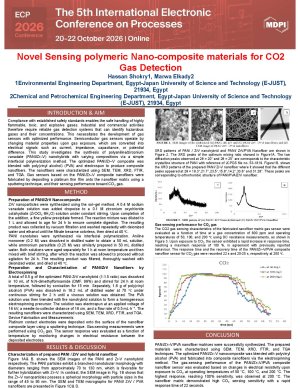
Polyaniline (PANI)/zirconium vanadate (Zr–V) hybrid nanomaterials were successfully synthesized via a sol–gel-assisted polymerization method. The resulting nanohybrid was characterized using different physicochemical characterization techniques to identify the morphological, crystalline, and chemical structures using scanning electron microscope (SEM), transmission electron microscope (TEM), X-ray diffraction (XRD), Fourier transform infrared spectroscopy (FTIR), and Thermal Gravimetric Analysis (TGA). An optimal composition of 1 PANI: 1.5 Zr–V was obtained using the first synthesis route. The nanohybrid exhibited a highly crystalline structure with a branched nanotubular morphology resembling cauliflower. An electrospun composite nanofiber matrix was fabricated by incorporating the optimized PANI/Zr–V nanocomposite into a polyvinyl alcohol (PVA) matrix. Electrospinning parameters, including flow rate, tip-to-collector distance, and applied voltage, were optimized to produce uniform nanofibers. The CO2 sensing performance of the composite nanofibers was evaluated as a function of temperature by measuring changes in resistance across sputtered platinum electrodes. The nanofiber matrix exhibited a rapid, high sensing response to CO2, achieving maximum response and recovery times of 22 s and 20-25 s, respectively, at 200 ℃. The maximum sensitivity for CO2 gas recorded was 100% at 200 ℃. Overall, the superior CO₂ sensing characteristics arise from the combined effects of surface adsorption, protonation–deprotonation dynamics in PANI, interfacial charge transfer within the heterojunction, and the high surface area nanofibrous morphology.
Keywords
Gas detection
CO2
Nanofibers
polyaniline / Zirconium vanadate Nano hybrid
Response time
Poster
Novel Sensing polymeric Nano-composite materials for CO2 Gas Detection.pdf
Optimal PID Parameter Tuning for BLDC Motor Using MRFO Algorithm
AI-Driven Medical Image Monitoring and Classification Using a Hybrid EfficientNet DyDA Swin Transformer Model