Event submissions
Published
This submission belongs to the session S4. Process Control, Monitoring and Machine Learning of the event The 5th International Electronic Conference on Processes
Published date
15 Oct, 2026
Academic Editor
'%3e%3cpath%20d='M12.6657%2010.9104C12.4185%2010.325%2012.0599%209.79327%2011.6097%209.34482C11.1609%208.89508%2010.6293%208.5365%2010.0442%208.28888C10.0389%208.28626%2010.0337%208.28495%2010.0285%208.28233C10.8446%207.69279%2011.3752%206.73249%2011.3752%205.64904C11.3752%203.8542%209.92103%202.39999%208.1262%202.39999C6.33136%202.39999%204.87715%203.8542%204.87715%205.64904C4.87715%206.73249%205.40774%207.69279%206.22393%208.28364C6.21869%208.28626%206.21345%208.28757%206.20821%208.29019C5.62129%208.5378%205.09463%208.89284%204.64265%209.34613C4.1929%209.79493%203.83432%2010.3266%203.58671%2010.9117C3.34345%2011.4845%203.21226%2012.0987%203.20023%2012.7209C3.19988%2012.7349%203.20233%2012.7488%203.20744%2012.7619C3.21255%2012.7749%203.22022%2012.7867%203.22998%2012.7968C3.23975%2012.8068%203.25142%2012.8147%203.26431%2012.8202C3.2772%2012.8256%203.29105%2012.8284%203.30504%2012.8284H4.09109C4.14874%2012.8284%204.19459%2012.7825%204.1959%2012.7262C4.2221%2011.7148%204.62823%2010.7676%205.34617%2010.0497C6.08899%209.30683%207.0755%208.89808%208.1262%208.89808C9.17689%208.89808%2010.1634%209.30683%2010.9062%2010.0497C11.6242%2010.7676%2012.0303%2011.7148%2012.0565%2012.7262C12.0578%2012.7838%2012.1037%2012.8284%2012.1613%2012.8284H12.9474C12.9613%2012.8284%2012.9752%2012.8256%2012.9881%2012.8202C13.001%2012.8147%2013.0126%2012.8068%2013.0224%2012.7968C13.0322%2012.7867%2013.0398%2012.7749%2013.0449%2012.7619C13.0501%2012.7488%2013.0525%2012.7349%2013.0522%2012.7209C13.0391%2012.0947%2012.9094%2011.4855%2012.6657%2010.9104ZM8.1262%207.9024C7.52486%207.9024%206.9589%207.6679%206.53312%207.24211C6.10733%206.81633%205.87283%206.25037%205.87283%205.64904C5.87283%205.0477%206.10733%204.48174%206.53312%204.05596C6.9589%203.63018%207.52486%203.39567%208.1262%203.39567C8.72753%203.39567%209.29349%203.63018%209.71927%204.05596C10.1451%204.48174%2010.3796%205.0477%2010.3796%205.64904C10.3796%206.25037%2010.1451%206.81633%209.71927%207.24211C9.29349%207.6679%208.72753%207.9024%208.1262%207.9024Z'%20fill='%235D1EE1'/%3e%3c/g%3e%3c/svg%3e) Ravendra Singh
Ravendra SinghCitation
Ruzimurod Jurayev, ARTIFICIAL INTELLIGENCE–GUIDED DISCOVERY OF SULFUR-RICH DIETHYL DITHIOCARBAMATE PHENOLIC ESTERS AS POTENTIAL EGFR TYROSINE KINASE INHIBITORS, in Proceedings of The 5th International Electronic Conference on Processes, 20 October–22 October 2026, MDPI: Basel, Switzerland
Share
Email
Facebook
Twitter
LinkedIn
ARTIFICIAL INTELLIGENCE–GUIDED DISCOVERY OF SULFUR-RICH DIETHYL DITHIOCARBAMATE PHENOLIC ESTERS AS POTENTIAL EGFR TYROSINE KINASE INHIBITORS
'%3e%3cpath%20d='M12.6647%2010.9104C12.4176%2010.325%2012.0589%209.7933%2011.6088%209.34485C11.16%208.89511%2010.6283%208.53653%2010.0432%208.28891C10.038%208.28629%2010.0327%208.28498%2010.0275%208.28236C10.8437%207.69282%2011.3743%206.73252%2011.3743%205.64907C11.3743%203.85423%209.92005%202.40002%208.12522%202.40002C6.33038%202.40002%204.87618%203.85423%204.87618%205.64907C4.87618%206.73252%205.40677%207.69282%206.22296%208.28367C6.21772%208.28629%206.21248%208.2876%206.20724%208.29022C5.62031%208.53783%205.09365%208.89287%204.64167%209.34616C4.19192%209.79496%203.83334%2010.3266%203.58573%2010.9117C3.34247%2011.4846%203.21128%2012.0987%203.19925%2012.721C3.1989%2012.735%203.20135%2012.7489%203.20646%2012.7619C3.21157%2012.7749%203.21924%2012.7868%203.22901%2012.7968C3.23877%2012.8068%203.25045%2012.8148%203.26334%2012.8202C3.27623%2012.8256%203.29007%2012.8284%203.30406%2012.8284H4.09012C4.14776%2012.8284%204.19362%2012.7825%204.19493%2012.7262C4.22113%2011.7148%204.62726%2010.7676%205.34519%2010.0497C6.08802%209.30686%207.07452%208.89811%208.12522%208.89811C9.17592%208.89811%2010.1624%209.30686%2010.9052%2010.0497C11.6232%2010.7676%2012.0293%2011.7148%2012.0555%2012.7262C12.0568%2012.7839%2012.1027%2012.8284%2012.1603%2012.8284H12.9464C12.9604%2012.8284%2012.9742%2012.8256%2012.9871%2012.8202C13%2012.8148%2013.0117%2012.8068%2013.0214%2012.7968C13.0312%2012.7868%2013.0389%2012.7749%2013.044%2012.7619C13.0491%2012.7489%2013.0515%2012.735%2013.0512%2012.721C13.0381%2012.0947%2012.9084%2011.4856%2012.6647%2010.9104ZM8.12522%207.90243C7.52388%207.90243%206.95792%207.66793%206.53214%207.24215C6.10636%206.81636%205.87185%206.2504%205.87185%205.64907C5.87185%205.04773%206.10636%204.48177%206.53214%204.05599C6.95792%203.63021%207.52388%203.3957%208.12522%203.3957C8.72655%203.3957%209.29252%203.63021%209.7183%204.05599C10.1441%204.48177%2010.3786%205.04773%2010.3786%205.64907C10.3786%206.2504%2010.1441%206.81636%209.7183%207.24215C9.29252%207.66793%208.72655%207.90243%208.12522%207.90243Z'%20fill='%235D1EE1'/%3e%3c/g%3e%3c/svg%3e)
Ruzimurod Jurayev 1
1. Department of Industrial Engineering and Management, Karshi state technical university, Mustakillik avenue, 225,
Karshi, Uzbekistan
Abstract
Artificial intelligence (AI)-assisted methodologies are increasingly reshaping early-stage drug discovery by integrating data-driven machine learning models with structure-based molecular modeling approaches. In the present study, seven newly synthesized sulfur-containing phenolic esters incorporating diethyl dithiocarbamate moieties were investigated as potential inhibitors of epidermal growth factor receptor (EGFR) tyrosine kinase, a clinically validated anticancer target. The compounds were synthesized via O-chloroacetylation of phenolic substrates followed by nucleophilic substitution with sodium diethyl dithiocarbamate, affording mono-, di-, and tri-substituted derivatives with increasing structural complexity. Molecular descriptors were calculated using RDKit, and a Random Forest classifier was developed based on a curated dataset of experimentally validated EGFR inhibitors and non-inhibitors. The model demonstrated strong predictive capability, achieving a cross-validated ROC-AUC of approximately 0.87, indicating reliable discrimination between active and inactive compounds. Feature importance analysis revealed that aromatic ring count, sulfur atom content, lipophilicity (LogP), and carbonyl functionality were the most influential contributors to predicted activity, underscoring the structural relevance of sulfur-rich fragments. Structure-based molecular docking against the EGFR kinase domain (PDB ID: 1M17) produced binding energies ranging from −6.8 to −8.9 kcal/mol. Tri-substituted derivatives exhibited enhanced ATP-binding pocket occupancy, favorable hydrogen bonding with hinge-region residues, and extensive hydrophobic interactions compared to mono- and di-substituted analogues. ADMET predictions suggested acceptable drug-likeness for mono- and di-derivatives, whereas tri-substituted compounds displayed slightly elevated molecular weight and lipophilicity but superior predicted affinity. Overall, the integration of machine learning prioritization with docking-based validation identifies tri-substituted sulfur-rich phenolic esters as promising lead scaffolds for further optimization toward potent and selective EGFR-targeted anticancer agents.
Keywords
Artificial intelligence
EGFR tyrosine kinase
Dithiocarbamate derivatives
Machine learning
Molecular docking
Random Forest classifier
QSAR modeling
Anticancer drug discovery
Poster
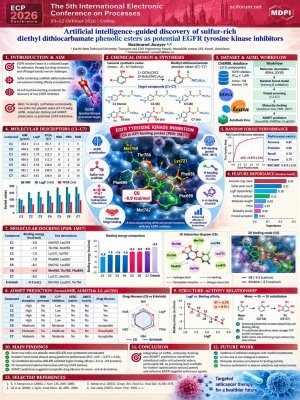
018cc02e665aecad4dc6fa98ccccfef8.pdf
Simulation-Based Verification and Bounded Repair of Adaptive Inventory Controllers
Photocatalytic ability of coatings based on carboxylated polyaniline@multi-walled carbon nanotubes dispersions deposited onto microfibrous cellulose substrate for degradation of MB dye