Event submissions
Published
This submission belongs to the session S1. Environmental and Green Processes of the event The 5th International Electronic Conference on Processes
Published date
15 Oct, 2026
Academic Editor
'%3e%3cpath%20d='M12.6657%2010.9104C12.4185%2010.325%2012.0599%209.79327%2011.6097%209.34482C11.1609%208.89508%2010.6293%208.5365%2010.0442%208.28888C10.0389%208.28626%2010.0337%208.28495%2010.0285%208.28233C10.8446%207.69279%2011.3752%206.73249%2011.3752%205.64904C11.3752%203.8542%209.92103%202.39999%208.1262%202.39999C6.33136%202.39999%204.87715%203.8542%204.87715%205.64904C4.87715%206.73249%205.40774%207.69279%206.22393%208.28364C6.21869%208.28626%206.21345%208.28757%206.20821%208.29019C5.62129%208.5378%205.09463%208.89284%204.64265%209.34613C4.1929%209.79493%203.83432%2010.3266%203.58671%2010.9117C3.34345%2011.4845%203.21226%2012.0987%203.20023%2012.7209C3.19988%2012.7349%203.20233%2012.7488%203.20744%2012.7619C3.21255%2012.7749%203.22022%2012.7867%203.22998%2012.7968C3.23975%2012.8068%203.25142%2012.8147%203.26431%2012.8202C3.2772%2012.8256%203.29105%2012.8284%203.30504%2012.8284H4.09109C4.14874%2012.8284%204.19459%2012.7825%204.1959%2012.7262C4.2221%2011.7148%204.62823%2010.7676%205.34617%2010.0497C6.08899%209.30683%207.0755%208.89808%208.1262%208.89808C9.17689%208.89808%2010.1634%209.30683%2010.9062%2010.0497C11.6242%2010.7676%2012.0303%2011.7148%2012.0565%2012.7262C12.0578%2012.7838%2012.1037%2012.8284%2012.1613%2012.8284H12.9474C12.9613%2012.8284%2012.9752%2012.8256%2012.9881%2012.8202C13.001%2012.8147%2013.0126%2012.8068%2013.0224%2012.7968C13.0322%2012.7867%2013.0398%2012.7749%2013.0449%2012.7619C13.0501%2012.7488%2013.0525%2012.7349%2013.0522%2012.7209C13.0391%2012.0947%2012.9094%2011.4855%2012.6657%2010.9104ZM8.1262%207.9024C7.52486%207.9024%206.9589%207.6679%206.53312%207.24211C6.10733%206.81633%205.87283%206.25037%205.87283%205.64904C5.87283%205.0477%206.10733%204.48174%206.53312%204.05596C6.9589%203.63018%207.52486%203.39567%208.1262%203.39567C8.72753%203.39567%209.29349%203.63018%209.71927%204.05596C10.1451%204.48174%2010.3796%205.0477%2010.3796%205.64904C10.3796%206.25037%2010.1451%206.81633%209.71927%207.24211C9.29349%207.6679%208.72753%207.9024%208.1262%207.9024Z'%20fill='%235D1EE1'/%3e%3c/g%3e%3c/svg%3e) Juan Francisco García Martín
Juan Francisco García MartínCitation
Katerina Zaharieva, Silvia Dimova, Petar D. Petrov, Petya Todorova, Maria Shipochka, Ognian Dimitrov, Hristo Penchev, Photocatalytic ability of coatings based on carboxylated polyaniline@multi-walled carbon nanotubes dispersions deposited onto microfibrous cellulose substrate for degradation of MB dye, in Proceedings of The 5th International Electronic Conference on Processes, 20 October–22 October 2026, MDPI: Basel, Switzerland
Share
Email
Facebook
Twitter
LinkedIn
Photocatalytic ability of coatings based on carboxylated polyaniline@multi-walled carbon nanotubes dispersions deposited onto microfibrous cellulose substrate for degradation of MB dye

Katerina Zaharieva 1
'%3e%3cpath%20d='M12.6647%2010.9104C12.4176%2010.325%2012.0589%209.7933%2011.6088%209.34485C11.16%208.89511%2010.6283%208.53653%2010.0432%208.28891C10.038%208.28629%2010.0327%208.28498%2010.0275%208.28236C10.8437%207.69282%2011.3743%206.73252%2011.3743%205.64907C11.3743%203.85423%209.92005%202.40002%208.12522%202.40002C6.33038%202.40002%204.87618%203.85423%204.87618%205.64907C4.87618%206.73252%205.40677%207.69282%206.22296%208.28367C6.21772%208.28629%206.21248%208.2876%206.20724%208.29022C5.62031%208.53783%205.09365%208.89287%204.64167%209.34616C4.19192%209.79496%203.83334%2010.3266%203.58573%2010.9117C3.34247%2011.4846%203.21128%2012.0987%203.19925%2012.721C3.1989%2012.735%203.20135%2012.7489%203.20646%2012.7619C3.21157%2012.7749%203.21924%2012.7868%203.22901%2012.7968C3.23877%2012.8068%203.25045%2012.8148%203.26334%2012.8202C3.27623%2012.8256%203.29007%2012.8284%203.30406%2012.8284H4.09012C4.14776%2012.8284%204.19362%2012.7825%204.19493%2012.7262C4.22113%2011.7148%204.62726%2010.7676%205.34519%2010.0497C6.08802%209.30686%207.07452%208.89811%208.12522%208.89811C9.17592%208.89811%2010.1624%209.30686%2010.9052%2010.0497C11.6232%2010.7676%2012.0293%2011.7148%2012.0555%2012.7262C12.0568%2012.7839%2012.1027%2012.8284%2012.1603%2012.8284H12.9464C12.9604%2012.8284%2012.9742%2012.8256%2012.9871%2012.8202C13%2012.8148%2013.0117%2012.8068%2013.0214%2012.7968C13.0312%2012.7868%2013.0389%2012.7749%2013.044%2012.7619C13.0491%2012.7489%2013.0515%2012.735%2013.0512%2012.721C13.0381%2012.0947%2012.9084%2011.4856%2012.6647%2010.9104ZM8.12522%207.90243C7.52388%207.90243%206.95792%207.66793%206.53214%207.24215C6.10636%206.81636%205.87185%206.2504%205.87185%205.64907C5.87185%205.04773%206.10636%204.48177%206.53214%204.05599C6.95792%203.63021%207.52388%203.3957%208.12522%203.3957C8.72655%203.3957%209.29252%203.63021%209.7183%204.05599C10.1441%204.48177%2010.3786%205.04773%2010.3786%205.64907C10.3786%206.2504%2010.1441%206.81636%209.7183%207.24215C9.29252%207.66793%208.72655%207.90243%208.12522%207.90243Z'%20fill='%235D1EE1'/%3e%3c/g%3e%3c/svg%3e)
Silvia Dimova 2

Petar D. Petrov 2
Petya Todorova 1
Maria Shipochka 3
Ognian Dimitrov 4

Hristo Penchev 2
1. Institute of Mineralogy and Crystallography “Аcad. I. Kostov”, Bulgarian Academy of Sciences, Acad. G. Bonchev St., Block 107, 1113 Sofia, Bulgaria
2. Institute of Polymers, Bulgarian Academy of Sciences, “Akad. G. Bonchev” St., Block 103A, 1113 Sofia, Bulgaria
3. Institute of General and Inorganic Chemistry, Bulgarian Academy of Sciences, “Acad. G. Bonchev” St., Bl. 11, 1113 Sofia, Bulgaria
4. Institute of Electrochemistry and Energy Systems “Acad. Evgeni Budevski”, Bulgarian Academy of Sciences, Acad. G. Bonchev St., Block 10, 1113, Sofia, Bulgaria
Abstract
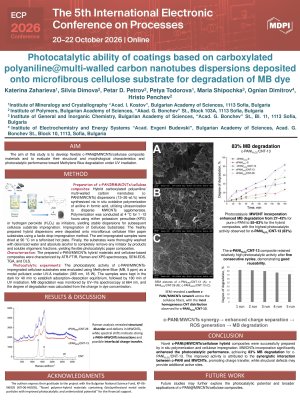
The demand for sustainable, multifunctional materials in photocatalysis, flexible electronics and biomedical applications has driven the exploration of novel composite systems. In this study, we report a novel multifunctional composite material prepared by integrating in situ synthesized carboxylated polyaniline (c-PANI) in the presence of multi-walled carbon nanotubes (MWCNTs) with the use of formic acid as reaction media. The resultant stable dispersions in volatile solvent were further used for an easy and affordable impregnation deposition onto a cellulose filter paper substrate in order to obtain flexible and electron-conductive composite scaffolds with variable CNTs content. The structural, morphological and thermal properties of the nanocomposite cellulosic substrates were characterized using FT-IR and XPS spectroscopy, SEM, DLS and TG analysis, confirming the successful integration of c-PANI@MWCNTs onto the surface of cellulose matrix. The prepared c-PANI@MWCNTs/cellulose composites are tested in the reaction of photocatalytic degradation of Methylene Blue (MB) dye under UV light. The photocatalytic results determined that c-PANI@MWCNTs impregnated cellulose substrates possess enhanced photocatalytic efficiency (up to 83% MB dye degree of degradation) in comparison with the pure c-PANI. The improved photocatalytic ability of c-PANI/MWCNTs composite materials could be due to the synergistic effect of the carbon nanotubes and conductive PANI matrix, which favor charge transport and facilitate interfacial electron charge transfer.
Keywords
composite materials
multi-walled carbon nanotubes
polyaniline
photocatalyst
dye
Poster
Poster.pdf
ARTIFICIAL INTELLIGENCE–GUIDED DISCOVERY OF SULFUR-RICH DIETHYL DITHIOCARBAMATE PHENOLIC ESTERS AS POTENTIAL EGFR TYROSINE KINASE INHIBITORS
Corrosion inhibition of mild steel by collagen derived from fish scales: Experimental and computation studies