Event submissions
Published
This submission belongs to the session S1. Environmental and Green Processes of the event The 5th International Electronic Conference on Processes
Published date
15 Oct, 2026
Academic Editor
'%3e%3cpath%20d='M12.6657%2010.9104C12.4185%2010.325%2012.0599%209.79327%2011.6097%209.34482C11.1609%208.89508%2010.6293%208.5365%2010.0442%208.28888C10.0389%208.28626%2010.0337%208.28495%2010.0285%208.28233C10.8446%207.69279%2011.3752%206.73249%2011.3752%205.64904C11.3752%203.8542%209.92103%202.39999%208.1262%202.39999C6.33136%202.39999%204.87715%203.8542%204.87715%205.64904C4.87715%206.73249%205.40774%207.69279%206.22393%208.28364C6.21869%208.28626%206.21345%208.28757%206.20821%208.29019C5.62129%208.5378%205.09463%208.89284%204.64265%209.34613C4.1929%209.79493%203.83432%2010.3266%203.58671%2010.9117C3.34345%2011.4845%203.21226%2012.0987%203.20023%2012.7209C3.19988%2012.7349%203.20233%2012.7488%203.20744%2012.7619C3.21255%2012.7749%203.22022%2012.7867%203.22998%2012.7968C3.23975%2012.8068%203.25142%2012.8147%203.26431%2012.8202C3.2772%2012.8256%203.29105%2012.8284%203.30504%2012.8284H4.09109C4.14874%2012.8284%204.19459%2012.7825%204.1959%2012.7262C4.2221%2011.7148%204.62823%2010.7676%205.34617%2010.0497C6.08899%209.30683%207.0755%208.89808%208.1262%208.89808C9.17689%208.89808%2010.1634%209.30683%2010.9062%2010.0497C11.6242%2010.7676%2012.0303%2011.7148%2012.0565%2012.7262C12.0578%2012.7838%2012.1037%2012.8284%2012.1613%2012.8284H12.9474C12.9613%2012.8284%2012.9752%2012.8256%2012.9881%2012.8202C13.001%2012.8147%2013.0126%2012.8068%2013.0224%2012.7968C13.0322%2012.7867%2013.0398%2012.7749%2013.0449%2012.7619C13.0501%2012.7488%2013.0525%2012.7349%2013.0522%2012.7209C13.0391%2012.0947%2012.9094%2011.4855%2012.6657%2010.9104ZM8.1262%207.9024C7.52486%207.9024%206.9589%207.6679%206.53312%207.24211C6.10733%206.81633%205.87283%206.25037%205.87283%205.64904C5.87283%205.0477%206.10733%204.48174%206.53312%204.05596C6.9589%203.63018%207.52486%203.39567%208.1262%203.39567C8.72753%203.39567%209.29349%203.63018%209.71927%204.05596C10.1451%204.48174%2010.3796%205.0477%2010.3796%205.64904C10.3796%206.25037%2010.1451%206.81633%209.71927%207.24211C9.29349%207.6679%208.72753%207.9024%208.1262%207.9024Z'%20fill='%235D1EE1'/%3e%3c/g%3e%3c/svg%3e) Juan Francisco García Martín
Juan Francisco García MartínCitation
Pedro Francisco Geraldo, Isabel Pestana da Paixão Cansado, From Sawdust to Clean Water: Sustainable Activated Carbons from Tectona grandis for Pesticide Removal, in Proceedings of The 5th International Electronic Conference on Processes, 20 October–22 October 2026, MDPI: Basel, Switzerland
Share
Email
Facebook
Twitter
LinkedIn
From Sawdust to Clean Water: Sustainable Activated Carbons from Tectona grandis for Pesticide Removal
'%3e%3cpath%20d='M12.6647%2010.9104C12.4176%2010.325%2012.0589%209.7933%2011.6088%209.34485C11.16%208.89511%2010.6283%208.53653%2010.0432%208.28891C10.038%208.28629%2010.0327%208.28498%2010.0275%208.28236C10.8437%207.69282%2011.3743%206.73252%2011.3743%205.64907C11.3743%203.85423%209.92005%202.40002%208.12522%202.40002C6.33038%202.40002%204.87618%203.85423%204.87618%205.64907C4.87618%206.73252%205.40677%207.69282%206.22296%208.28367C6.21772%208.28629%206.21248%208.2876%206.20724%208.29022C5.62031%208.53783%205.09365%208.89287%204.64167%209.34616C4.19192%209.79496%203.83334%2010.3266%203.58573%2010.9117C3.34247%2011.4846%203.21128%2012.0987%203.19925%2012.721C3.1989%2012.735%203.20135%2012.7489%203.20646%2012.7619C3.21157%2012.7749%203.21924%2012.7868%203.22901%2012.7968C3.23877%2012.8068%203.25045%2012.8148%203.26334%2012.8202C3.27623%2012.8256%203.29007%2012.8284%203.30406%2012.8284H4.09012C4.14776%2012.8284%204.19362%2012.7825%204.19493%2012.7262C4.22113%2011.7148%204.62726%2010.7676%205.34519%2010.0497C6.08802%209.30686%207.07452%208.89811%208.12522%208.89811C9.17592%208.89811%2010.1624%209.30686%2010.9052%2010.0497C11.6232%2010.7676%2012.0293%2011.7148%2012.0555%2012.7262C12.0568%2012.7839%2012.1027%2012.8284%2012.1603%2012.8284H12.9464C12.9604%2012.8284%2012.9742%2012.8256%2012.9871%2012.8202C13%2012.8148%2013.0117%2012.8068%2013.0214%2012.7968C13.0312%2012.7868%2013.0389%2012.7749%2013.044%2012.7619C13.0491%2012.7489%2013.0515%2012.735%2013.0512%2012.721C13.0381%2012.0947%2012.9084%2011.4856%2012.6647%2010.9104ZM8.12522%207.90243C7.52388%207.90243%206.95792%207.66793%206.53214%207.24215C6.10636%206.81636%205.87185%206.2504%205.87185%205.64907C5.87185%205.04773%206.10636%204.48177%206.53214%204.05599C6.95792%203.63021%207.52388%203.3957%208.12522%203.3957C8.72655%203.3957%209.29252%203.63021%209.7183%204.05599C10.1441%204.48177%2010.3786%205.04773%2010.3786%205.64907C10.3786%206.2504%2010.1441%206.81636%209.7183%207.24215C9.29252%207.66793%208.72655%207.90243%208.12522%207.90243Z'%20fill='%235D1EE1'/%3e%3c/g%3e%3c/svg%3e)
Pedro Francisco Geraldo 1

Isabel Pestana da Paixão Cansado 2
1. Faculty of Science and Technology, Licungo University, Quelimane, Zambézia, 1621, Mozambique
2. Chemistry and Biochemistry Department, School of Sciences and Technology, University of Évora, 7000-671 Évora, Portugal
Abstract
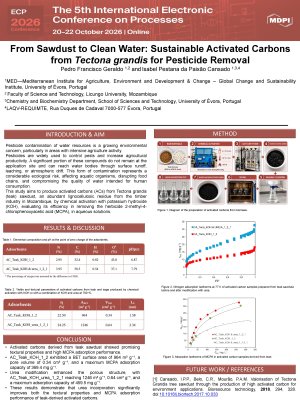
Pesticide contamination of water resources is a growing environmental concern, especially in areas with intensive agricultural activity. Although pesticides are widely used to control pests and increase agricultural productivity, a significant portion of these compounds does not remain at the application site. They may reach water bodies through surface runoff, leaching, or atmospheric drift, creating ecological risks by affecting aquatic organisms, disrupting food chains, and compromising the quality of water intended for human consumption. In intensive agricultural regions, including some areas of southern Europe, multiple pesticide residues have often been detected in surface waters, sometimes at concentrations exceeding the legal limits established by European legislation. Therefore, efficient and sustainable treatment technologies are essential to reduce pesticide pollution and protect water resources.
This study aimed to produce activated carbons from Tectona grandis sawdust, an abundant lignocellulosic residue from the timber industry in Mozambique, through chemical activation with potassium hydroxide (KOH). The materials were evaluated for the removal of the herbicide 2-methyl-4-chlorophenoxyacetic acid (MCPA) from aqueous solutions. To improve adsorption performance, the activated carbons were prepared through simultaneous KOH activation and urea modification, using precursor agent ratios of 1:2:1 and 2:2:2. This modification aimed to increase porosity, specific surface area, and nitrogen-containing functional groups in the carbonaceous matrix.
Kinetic adsorption tests were performed at 298 K and pH 3 for 48 hours, while adsorption isotherms were determined using MCPA solutions with concentrations from 25 to 500 mg L⁻¹. The KOH- and urea-modified activated carbons showed high efficiency in MCPA removal, linked to nitrogen incorporation, a porous structure of 2.34 nm, and a specific surface area of 1246 m² g⁻¹. The best material achieved an adsorption capacity of 475.57 mg g⁻¹ and 68.95% removal efficiency, confirming the potential of Tectona grandis sawdust as a sustainable adsorbent for pesticide removal.
Keywords
Activated carbon
Tectona grandis sawdust
MCPA adsorption
Pesticide removal
Water treatment
Poster
Poster Pedro The 5th International Electronic.pdf
CONTROLLING SIZE DISTRIBUTION OF SILVER NANOPARTICLES USING NATURAL REDUCTIVE AGENT IN MCM-41@Ag
Eco-Friendly Synthesis of TiO₂ Nanoparticles Using Navel Orange Leaf Extract: Characterization and Solar-Driven Photocatalytic Degradation of Malachite Green