Event submissions
Published
This submission belongs to the session S1. Environmental and Green Processes of the event The 5th International Electronic Conference on Processes
Published date
15 Oct, 2026
Academic Editor
'%3e%3cpath%20d='M12.6657%2010.9104C12.4185%2010.325%2012.0599%209.79327%2011.6097%209.34482C11.1609%208.89508%2010.6293%208.5365%2010.0442%208.28888C10.0389%208.28626%2010.0337%208.28495%2010.0285%208.28233C10.8446%207.69279%2011.3752%206.73249%2011.3752%205.64904C11.3752%203.8542%209.92103%202.39999%208.1262%202.39999C6.33136%202.39999%204.87715%203.8542%204.87715%205.64904C4.87715%206.73249%205.40774%207.69279%206.22393%208.28364C6.21869%208.28626%206.21345%208.28757%206.20821%208.29019C5.62129%208.5378%205.09463%208.89284%204.64265%209.34613C4.1929%209.79493%203.83432%2010.3266%203.58671%2010.9117C3.34345%2011.4845%203.21226%2012.0987%203.20023%2012.7209C3.19988%2012.7349%203.20233%2012.7488%203.20744%2012.7619C3.21255%2012.7749%203.22022%2012.7867%203.22998%2012.7968C3.23975%2012.8068%203.25142%2012.8147%203.26431%2012.8202C3.2772%2012.8256%203.29105%2012.8284%203.30504%2012.8284H4.09109C4.14874%2012.8284%204.19459%2012.7825%204.1959%2012.7262C4.2221%2011.7148%204.62823%2010.7676%205.34617%2010.0497C6.08899%209.30683%207.0755%208.89808%208.1262%208.89808C9.17689%208.89808%2010.1634%209.30683%2010.9062%2010.0497C11.6242%2010.7676%2012.0303%2011.7148%2012.0565%2012.7262C12.0578%2012.7838%2012.1037%2012.8284%2012.1613%2012.8284H12.9474C12.9613%2012.8284%2012.9752%2012.8256%2012.9881%2012.8202C13.001%2012.8147%2013.0126%2012.8068%2013.0224%2012.7968C13.0322%2012.7867%2013.0398%2012.7749%2013.0449%2012.7619C13.0501%2012.7488%2013.0525%2012.7349%2013.0522%2012.7209C13.0391%2012.0947%2012.9094%2011.4855%2012.6657%2010.9104ZM8.1262%207.9024C7.52486%207.9024%206.9589%207.6679%206.53312%207.24211C6.10733%206.81633%205.87283%206.25037%205.87283%205.64904C5.87283%205.0477%206.10733%204.48174%206.53312%204.05596C6.9589%203.63018%207.52486%203.39567%208.1262%203.39567C8.72753%203.39567%209.29349%203.63018%209.71927%204.05596C10.1451%204.48174%2010.3796%205.0477%2010.3796%205.64904C10.3796%206.25037%2010.1451%206.81633%209.71927%207.24211C9.29349%207.6679%208.72753%207.9024%208.1262%207.9024Z'%20fill='%235D1EE1'/%3e%3c/g%3e%3c/svg%3e) Juan Francisco García Martín
Juan Francisco García MartínCitation
Sofiane Khane, Yasmina Khane, Fares Fenniche, Djaber Aouf, Zoulikha Hafsi, Eco-Friendly Synthesis of TiO₂ Nanoparticles Using Navel Orange Leaf Extract: Characterization and Solar-Driven Photocatalytic Degradation of Malachite Green, in Proceedings of The 5th International Electronic Conference on Processes, 20 October–22 October 2026, MDPI: Basel, Switzerland
Share
Email
Facebook
Twitter
LinkedIn
Eco-Friendly Synthesis of TiO₂ Nanoparticles Using Navel Orange Leaf Extract: Characterization and Solar-Driven Photocatalytic Degradation of Malachite Green
'%3e%3cpath%20d='M12.6647%2010.9104C12.4176%2010.325%2012.0589%209.7933%2011.6088%209.34485C11.16%208.89511%2010.6283%208.53653%2010.0432%208.28891C10.038%208.28629%2010.0327%208.28498%2010.0275%208.28236C10.8437%207.69282%2011.3743%206.73252%2011.3743%205.64907C11.3743%203.85423%209.92005%202.40002%208.12522%202.40002C6.33038%202.40002%204.87618%203.85423%204.87618%205.64907C4.87618%206.73252%205.40677%207.69282%206.22296%208.28367C6.21772%208.28629%206.21248%208.2876%206.20724%208.29022C5.62031%208.53783%205.09365%208.89287%204.64167%209.34616C4.19192%209.79496%203.83334%2010.3266%203.58573%2010.9117C3.34247%2011.4846%203.21128%2012.0987%203.19925%2012.721C3.1989%2012.735%203.20135%2012.7489%203.20646%2012.7619C3.21157%2012.7749%203.21924%2012.7868%203.22901%2012.7968C3.23877%2012.8068%203.25045%2012.8148%203.26334%2012.8202C3.27623%2012.8256%203.29007%2012.8284%203.30406%2012.8284H4.09012C4.14776%2012.8284%204.19362%2012.7825%204.19493%2012.7262C4.22113%2011.7148%204.62726%2010.7676%205.34519%2010.0497C6.08802%209.30686%207.07452%208.89811%208.12522%208.89811C9.17592%208.89811%2010.1624%209.30686%2010.9052%2010.0497C11.6232%2010.7676%2012.0293%2011.7148%2012.0555%2012.7262C12.0568%2012.7839%2012.1027%2012.8284%2012.1603%2012.8284H12.9464C12.9604%2012.8284%2012.9742%2012.8256%2012.9871%2012.8202C13%2012.8148%2013.0117%2012.8068%2013.0214%2012.7968C13.0312%2012.7868%2013.0389%2012.7749%2013.044%2012.7619C13.0491%2012.7489%2013.0515%2012.735%2013.0512%2012.721C13.0381%2012.0947%2012.9084%2011.4856%2012.6647%2010.9104ZM8.12522%207.90243C7.52388%207.90243%206.95792%207.66793%206.53214%207.24215C6.10636%206.81636%205.87185%206.2504%205.87185%205.64907C5.87185%205.04773%206.10636%204.48177%206.53214%204.05599C6.95792%203.63021%207.52388%203.3957%208.12522%203.3957C8.72655%203.3957%209.29252%203.63021%209.7183%204.05599C10.1441%204.48177%2010.3786%205.04773%2010.3786%205.64907C10.3786%206.2504%2010.1441%206.81636%209.7183%207.24215C9.29252%207.66793%208.72655%207.90243%208.12522%207.90243Z'%20fill='%235D1EE1'/%3e%3c/g%3e%3c/svg%3e)
Sofiane Khane 1
Yasmina Khane 1

Fares Fenniche 1
Djaber Aouf 2
Zoulikha Hafsi 1
1. Faculty of Sciences and Technology, University of Ghardaïa, BP 455, 47000 Ghardaïa, Algeria
2. Institute of Science and Technology, University of Ali Kafi, Hay El Moustaqbal, Tindouf 37000, Algeria
Abstract
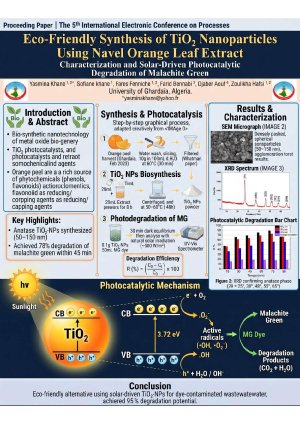
Titanium dioxide nanoparticles (TiO₂-NPs) were synthesized via an environmentally friendly co-precipitation method utilizing an aqueous extract prepared from the leaves of navel orange (Citrus sinensis L.). The choice of this bio-resource aligns with the principles of green chemistry, as the phytochemicals present in the leaf extract—including flavonoids, phenolic acids, and terpenoids—serve as effective reducing, capping, and stabilizing agents, thereby eliminating the need for hazardous chemical reagents. The structural, morphological, and crystallographic properties of the biosynthesized nanoparticles were thoroughly characterized using X-ray diffraction (XRD) and scanning electron microscopy (SEM). XRD analysis confirmed the formation of highly crystalline nanoparticles with a pure anatase tetragonal structure, while SEM imaging revealed a predominantly spherical morphology with a particle size distribution ranging from 30 to 120 nm. The photocatalytic performance of the synthesized TiO₂-NPs was subsequently evaluated under natural solar irradiation using a batch-mode experimental setup, with malachite green (MG) selected as a representative organic pollutant due to its widespread use in the textile industry and its known environmental toxicity. The degradation process was monitored by measuring the decrease in absorbance at the characteristic wavelength of MG using UV-Vis spectrophotometry. The results demonstrated that the biosynthesized TiO₂ nanoparticles exhibited remarkable photocatalytic efficiency, achieving up to 86% degradation of malachite green within 60 minutes of sunlight exposure. This enhanced activity is attributed to the small particle size, high crystallinity, and the anatase phase of the synthesized nanoparticles, which facilitate efficient electron-hole separation and radical generation under solar radiation. These findings underscore the potential of Citrus sinensis leaf extract as an effective bio-template for the sustainable production of TiO₂ nanoparticles, and highlight their promising application in the photocatalytic remediation of dye-contaminated industrial wastewater.
Keywords
Titanium dioxide nanoparticles
green synthesis
Orange leaf
malachite green
photocatalytic activity
solar irradiation
Poster
ppt italy 2026 sofiane.pdf
From Sawdust to Clean Water: Sustainable Activated Carbons from Tectona grandis for Pesticide Removal
Unsupervised Motif Discovery in Engineering Processes: A Machine Learning Approach Using Graph-Based Segment Embeddings