Event submissions
Published
This submission belongs to the session S4. Process Control, Monitoring and Machine Learning of the event The 5th International Electronic Conference on Processes
Published date
15 Oct, 2026
Academic Editor
'%3e%3cpath%20d='M12.6657%2010.9104C12.4185%2010.325%2012.0599%209.79327%2011.6097%209.34482C11.1609%208.89508%2010.6293%208.5365%2010.0442%208.28888C10.0389%208.28626%2010.0337%208.28495%2010.0285%208.28233C10.8446%207.69279%2011.3752%206.73249%2011.3752%205.64904C11.3752%203.8542%209.92103%202.39999%208.1262%202.39999C6.33136%202.39999%204.87715%203.8542%204.87715%205.64904C4.87715%206.73249%205.40774%207.69279%206.22393%208.28364C6.21869%208.28626%206.21345%208.28757%206.20821%208.29019C5.62129%208.5378%205.09463%208.89284%204.64265%209.34613C4.1929%209.79493%203.83432%2010.3266%203.58671%2010.9117C3.34345%2011.4845%203.21226%2012.0987%203.20023%2012.7209C3.19988%2012.7349%203.20233%2012.7488%203.20744%2012.7619C3.21255%2012.7749%203.22022%2012.7867%203.22998%2012.7968C3.23975%2012.8068%203.25142%2012.8147%203.26431%2012.8202C3.2772%2012.8256%203.29105%2012.8284%203.30504%2012.8284H4.09109C4.14874%2012.8284%204.19459%2012.7825%204.1959%2012.7262C4.2221%2011.7148%204.62823%2010.7676%205.34617%2010.0497C6.08899%209.30683%207.0755%208.89808%208.1262%208.89808C9.17689%208.89808%2010.1634%209.30683%2010.9062%2010.0497C11.6242%2010.7676%2012.0303%2011.7148%2012.0565%2012.7262C12.0578%2012.7838%2012.1037%2012.8284%2012.1613%2012.8284H12.9474C12.9613%2012.8284%2012.9752%2012.8256%2012.9881%2012.8202C13.001%2012.8147%2013.0126%2012.8068%2013.0224%2012.7968C13.0322%2012.7867%2013.0398%2012.7749%2013.0449%2012.7619C13.0501%2012.7488%2013.0525%2012.7349%2013.0522%2012.7209C13.0391%2012.0947%2012.9094%2011.4855%2012.6657%2010.9104ZM8.1262%207.9024C7.52486%207.9024%206.9589%207.6679%206.53312%207.24211C6.10733%206.81633%205.87283%206.25037%205.87283%205.64904C5.87283%205.0477%206.10733%204.48174%206.53312%204.05596C6.9589%203.63018%207.52486%203.39567%208.1262%203.39567C8.72753%203.39567%209.29349%203.63018%209.71927%204.05596C10.1451%204.48174%2010.3796%205.0477%2010.3796%205.64904C10.3796%206.25037%2010.1451%206.81633%209.71927%207.24211C9.29349%207.6679%208.72753%207.9024%208.1262%207.9024Z'%20fill='%235D1EE1'/%3e%3c/g%3e%3c/svg%3e) Ravendra Singh
Ravendra SinghCitation
Pavel Kyurkchiev, Anton Iliev, Unsupervised Motif Discovery in Engineering Processes: A Machine Learning Approach Using Graph-Based Segment Embeddings, in Proceedings of The 5th International Electronic Conference on Processes, 20 October–22 October 2026, MDPI: Basel, Switzerland
Share
Email
Facebook
Twitter
LinkedIn
Unsupervised Motif Discovery in Engineering Processes: A Machine Learning Approach Using Graph-Based Segment Embeddings

Pavel Kyurkchiev 1

Anton Iliev 1
1. Faculty of Mathematics and Informatics, University of Plovdiv “Paisii Hilendarski”, 24, Tzar Asen Str., 4000 Plovdiv, Bulgaria
Abstract
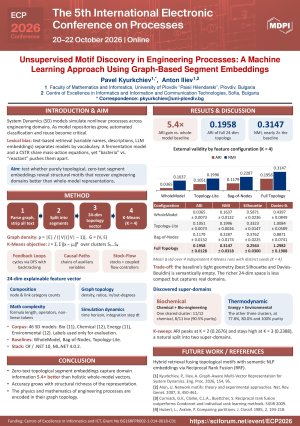
Introduction: The effective reuse of complex simulation models in process engineering requires automated methods to extract domain knowledge from their topological structure. This proof-of-concept study addresses the limitations of holistic, text-reliant model analysis by proposing an unsupervised approach for discovering structural motifs in System Dynamics models.
Methods: To mitigate lexical bias, textual metadata was removed from the dataset. Simulation models were parsed into typed structural segments (Feedback Loops, Causal Paths, and Stock-Flow Subsystems) and transformed into feature vectors representing their mathematical and graph topology. To evaluate the methodology, we used an expanded corpus of 46 engineering models across four domains. Using K-Means clustering (K=4, aligned with the target domain count), we compared our 24-dimensional topological embedding against a whole-model baseline and two intermediate representations (bag-of-nodes and topology-lite).
Results: The full topological configuration achieved an average Adjusted Rand Index (ARI) of 0.2465. While modest in absolute terms for standard clustering tasks, this zero-text performance represents a 6.6-fold improvement over the whole-model baseline (ARI = 0.0374). The intermediate baselines (bag-of-nodes ARI = 0.1244, topology-lite ARI = 0.1145) indicated that increasing structural complexity enhances domain separation. Qualitative analysis showed that chemical processes and bio-engineering models frequently clustered together, reflecting their shared mathematical foundations in mass-action kinetics.
Conclusion: By demonstrating that localized structural motifs can capture domain information more effectively than holistic representations, this study provides a foundation for automated, topology-driven knowledge discovery in systems engineering.
Keywords
System Dynamics
motif discovery
graph topology
unsupervised clustering
K-means
process engineering
feature engineering
structural decomposition
Poster
ECP2026_Poster_Kyurkchiev_Iliev.pdf
Eco-Friendly Synthesis of TiO₂ Nanoparticles Using Navel Orange Leaf Extract: Characterization and Solar-Driven Photocatalytic Degradation of Malachite Green
IoT-Enabled Precision Epigenomics for Predictive Monitoring and Intelligent Process Control in Climate-Resilient Agriculture