Event submissions
Published
This submission belongs to the session S4. Process Control, Monitoring and Machine Learning of the event The 5th International Electronic Conference on Processes
Published date
15 Oct, 2026
Academic Editor
'%3e%3cpath%20d='M12.6657%2010.9104C12.4185%2010.325%2012.0599%209.79327%2011.6097%209.34482C11.1609%208.89508%2010.6293%208.5365%2010.0442%208.28888C10.0389%208.28626%2010.0337%208.28495%2010.0285%208.28233C10.8446%207.69279%2011.3752%206.73249%2011.3752%205.64904C11.3752%203.8542%209.92103%202.39999%208.1262%202.39999C6.33136%202.39999%204.87715%203.8542%204.87715%205.64904C4.87715%206.73249%205.40774%207.69279%206.22393%208.28364C6.21869%208.28626%206.21345%208.28757%206.20821%208.29019C5.62129%208.5378%205.09463%208.89284%204.64265%209.34613C4.1929%209.79493%203.83432%2010.3266%203.58671%2010.9117C3.34345%2011.4845%203.21226%2012.0987%203.20023%2012.7209C3.19988%2012.7349%203.20233%2012.7488%203.20744%2012.7619C3.21255%2012.7749%203.22022%2012.7867%203.22998%2012.7968C3.23975%2012.8068%203.25142%2012.8147%203.26431%2012.8202C3.2772%2012.8256%203.29105%2012.8284%203.30504%2012.8284H4.09109C4.14874%2012.8284%204.19459%2012.7825%204.1959%2012.7262C4.2221%2011.7148%204.62823%2010.7676%205.34617%2010.0497C6.08899%209.30683%207.0755%208.89808%208.1262%208.89808C9.17689%208.89808%2010.1634%209.30683%2010.9062%2010.0497C11.6242%2010.7676%2012.0303%2011.7148%2012.0565%2012.7262C12.0578%2012.7838%2012.1037%2012.8284%2012.1613%2012.8284H12.9474C12.9613%2012.8284%2012.9752%2012.8256%2012.9881%2012.8202C13.001%2012.8147%2013.0126%2012.8068%2013.0224%2012.7968C13.0322%2012.7867%2013.0398%2012.7749%2013.0449%2012.7619C13.0501%2012.7488%2013.0525%2012.7349%2013.0522%2012.7209C13.0391%2012.0947%2012.9094%2011.4855%2012.6657%2010.9104ZM8.1262%207.9024C7.52486%207.9024%206.9589%207.6679%206.53312%207.24211C6.10733%206.81633%205.87283%206.25037%205.87283%205.64904C5.87283%205.0477%206.10733%204.48174%206.53312%204.05596C6.9589%203.63018%207.52486%203.39567%208.1262%203.39567C8.72753%203.39567%209.29349%203.63018%209.71927%204.05596C10.1451%204.48174%2010.3796%205.0477%2010.3796%205.64904C10.3796%206.25037%2010.1451%206.81633%209.71927%207.24211C9.29349%207.6679%208.72753%207.9024%208.1262%207.9024Z'%20fill='%235D1EE1'/%3e%3c/g%3e%3c/svg%3e) Ravendra Singh
Ravendra SinghCitation
Ioannis Adamopoulos, Antonios Valamontes, Aida Vafae Eslahi, Maad M. Mijwil, Harshit Mishra, Panagiotis Tsirkas, Guma Ali, IoT-Enabled Precision Epigenomics for Predictive Monitoring and Intelligent Process Control in Climate-Resilient Agriculture, in Proceedings of The 5th International Electronic Conference on Processes, 20 October–22 October 2026, MDPI: Basel, Switzerland
Share
Email
Facebook
Twitter
LinkedIn
IoT-Enabled Precision Epigenomics for Predictive Monitoring and Intelligent Process Control in Climate-Resilient Agriculture

Ioannis Adamopoulos 1

Antonios Valamontes 2

Aida Vafae Eslahi 3

Maad M. Mijwil 4
'%3e%3cpath%20d='M12.6647%2010.9104C12.4176%2010.325%2012.0589%209.7933%2011.6088%209.34485C11.16%208.89511%2010.6283%208.53653%2010.0432%208.28891C10.038%208.28629%2010.0327%208.28498%2010.0275%208.28236C10.8437%207.69282%2011.3743%206.73252%2011.3743%205.64907C11.3743%203.85423%209.92005%202.40002%208.12522%202.40002C6.33038%202.40002%204.87618%203.85423%204.87618%205.64907C4.87618%206.73252%205.40677%207.69282%206.22296%208.28367C6.21772%208.28629%206.21248%208.2876%206.20724%208.29022C5.62031%208.53783%205.09365%208.89287%204.64167%209.34616C4.19192%209.79496%203.83334%2010.3266%203.58573%2010.9117C3.34247%2011.4846%203.21128%2012.0987%203.19925%2012.721C3.1989%2012.735%203.20135%2012.7489%203.20646%2012.7619C3.21157%2012.7749%203.21924%2012.7868%203.22901%2012.7968C3.23877%2012.8068%203.25045%2012.8148%203.26334%2012.8202C3.27623%2012.8256%203.29007%2012.8284%203.30406%2012.8284H4.09012C4.14776%2012.8284%204.19362%2012.7825%204.19493%2012.7262C4.22113%2011.7148%204.62726%2010.7676%205.34519%2010.0497C6.08802%209.30686%207.07452%208.89811%208.12522%208.89811C9.17592%208.89811%2010.1624%209.30686%2010.9052%2010.0497C11.6232%2010.7676%2012.0293%2011.7148%2012.0555%2012.7262C12.0568%2012.7839%2012.1027%2012.8284%2012.1603%2012.8284H12.9464C12.9604%2012.8284%2012.9742%2012.8256%2012.9871%2012.8202C13%2012.8148%2013.0117%2012.8068%2013.0214%2012.7968C13.0312%2012.7868%2013.0389%2012.7749%2013.044%2012.7619C13.0491%2012.7489%2013.0515%2012.735%2013.0512%2012.721C13.0381%2012.0947%2012.9084%2011.4856%2012.6647%2010.9104ZM8.12522%207.90243C7.52388%207.90243%206.95792%207.66793%206.53214%207.24215C6.10636%206.81636%205.87185%206.2504%205.87185%205.64907C5.87185%205.04773%206.10636%204.48177%206.53214%204.05599C6.95792%203.63021%207.52388%203.3957%208.12522%203.3957C8.72655%203.3957%209.29252%203.63021%209.7183%204.05599C10.1441%204.48177%2010.3786%205.04773%2010.3786%205.64907C10.3786%206.2504%2010.1441%206.81636%209.7183%207.24215C9.29252%207.66793%208.72655%207.90243%208.12522%207.90243Z'%20fill='%235D1EE1'/%3e%3c/g%3e%3c/svg%3e)
Harshit Mishra 5
Panagiotis Tsirkas 6

Guma Ali 7
1. Hellenic Open University, School of Social Science, Public Health and Policies, Patra, Greece
2. Kapodistrian Academy of Science, Tampa, Florida, USA
3. Medical Microbiology Research Center, Qazvin University of Medical Sciences, Qazvin, Iran
4. Digital Economy Department, College of Administration and Economics, Al-Iraqia University, Baghdad, Iraq
5. Department of Agricultural Economics, College of Agriculture, Acharya Narendra Deva University of Agriculture and Technology, Kumarganj, Ayodhya, India
6. Department of Gynecological Surgery, Hatzikosta General District Hospital, Ioannina, Greece
7. Department of Computer and Information Science, Faculty of Technoscience, Muni University, Arua, Uganda
Abstract
Abstract
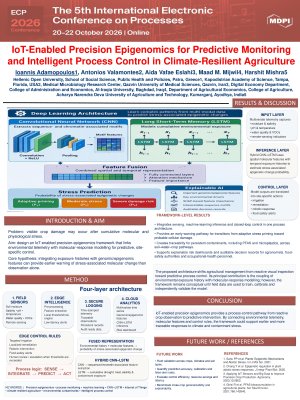
Introduction: Climate-resilient agriculture requires process-monitoring systems capable of detecting biological stress before visible crop damage occurs. This study proposes an IoT-enabled precision epigenomics framework that links real-time environmental telemetry with plant molecular-response modelling to support predictive, site-specific agricultural control.
Methods: A four-layer architecture was designed comprising field sensors, edge intelligence, secure data logging, and cloud analytics. Soil moisture, salinity, pH, temperature, water quality, volatile compounds, and remote-sensing indicators are collected as multivariate time-series inputs. A hybrid convolutional neural network–long short-term memory model combines spatial genomic and epigenomic features with temporal environmental histories. The convolutional component extracts sequence- and chromatin-associated motifs, while the long short-term memory component models cumulative drought, heat, salinity, and contaminant exposure. Their fused representation generates probabilities of stress-associated epigenetic changes. Edge-control rules translate model outputs into actions including targeted irrigation, localized remediation, robotic intervention, and food-safety alerts.
Results: The resulting framework integrates environmental monitoring, machine-learning inference, and closed-loop agricultural control within a unified process architecture. It supports early identification of transitions from adaptive stress priming to probable cellular damage while enabling traceability of persistent contaminants, including per- and polyfluoroalkyl substances and microplastics, across soil–water–crop pathways. The architecture also provides a basis for explainable risk dashboards and auditable decision records for agronomists, food-safety authorities, and occupational-health personnel.
Conclusion: IoT-enabled precision epigenomics provides a process-control pathway from reactive crop observation to predictive intervention. Future field validation should quantify prediction accuracy, control efficiency, resource savings, and cross-crop generalizability.
Keywords
Precision epigenomics
process monitoring
machine learning
CNN–LSTM
Internet of Things
climate-resilient agriculture
environmental contaminants
intelligent process control
Poster
ECP2026_IoT_Precision_Epigenomics_Poster-V2.pdf
Unsupervised Motif Discovery in Engineering Processes: A Machine Learning Approach Using Graph-Based Segment Embeddings
Landscape Transitions and Spatial Evolution of Surface Urban Heat Island in Abuja City, Nigeria: A Multitemporal Geospatial Analysis