Event submissions
Published
This submission belongs to the session S4. Process Control, Monitoring and Machine Learning of the event The 5th International Electronic Conference on Processes
Published date
15 Oct, 2026
Academic Editor
'%3e%3cpath%20d='M12.6657%2010.9104C12.4185%2010.325%2012.0599%209.79327%2011.6097%209.34482C11.1609%208.89508%2010.6293%208.5365%2010.0442%208.28888C10.0389%208.28626%2010.0337%208.28495%2010.0285%208.28233C10.8446%207.69279%2011.3752%206.73249%2011.3752%205.64904C11.3752%203.8542%209.92103%202.39999%208.1262%202.39999C6.33136%202.39999%204.87715%203.8542%204.87715%205.64904C4.87715%206.73249%205.40774%207.69279%206.22393%208.28364C6.21869%208.28626%206.21345%208.28757%206.20821%208.29019C5.62129%208.5378%205.09463%208.89284%204.64265%209.34613C4.1929%209.79493%203.83432%2010.3266%203.58671%2010.9117C3.34345%2011.4845%203.21226%2012.0987%203.20023%2012.7209C3.19988%2012.7349%203.20233%2012.7488%203.20744%2012.7619C3.21255%2012.7749%203.22022%2012.7867%203.22998%2012.7968C3.23975%2012.8068%203.25142%2012.8147%203.26431%2012.8202C3.2772%2012.8256%203.29105%2012.8284%203.30504%2012.8284H4.09109C4.14874%2012.8284%204.19459%2012.7825%204.1959%2012.7262C4.2221%2011.7148%204.62823%2010.7676%205.34617%2010.0497C6.08899%209.30683%207.0755%208.89808%208.1262%208.89808C9.17689%208.89808%2010.1634%209.30683%2010.9062%2010.0497C11.6242%2010.7676%2012.0303%2011.7148%2012.0565%2012.7262C12.0578%2012.7838%2012.1037%2012.8284%2012.1613%2012.8284H12.9474C12.9613%2012.8284%2012.9752%2012.8256%2012.9881%2012.8202C13.001%2012.8147%2013.0126%2012.8068%2013.0224%2012.7968C13.0322%2012.7867%2013.0398%2012.7749%2013.0449%2012.7619C13.0501%2012.7488%2013.0525%2012.7349%2013.0522%2012.7209C13.0391%2012.0947%2012.9094%2011.4855%2012.6657%2010.9104ZM8.1262%207.9024C7.52486%207.9024%206.9589%207.6679%206.53312%207.24211C6.10733%206.81633%205.87283%206.25037%205.87283%205.64904C5.87283%205.0477%206.10733%204.48174%206.53312%204.05596C6.9589%203.63018%207.52486%203.39567%208.1262%203.39567C8.72753%203.39567%209.29349%203.63018%209.71927%204.05596C10.1451%204.48174%2010.3796%205.0477%2010.3796%205.64904C10.3796%206.25037%2010.1451%206.81633%209.71927%207.24211C9.29349%207.6679%208.72753%207.9024%208.1262%207.9024Z'%20fill='%235D1EE1'/%3e%3c/g%3e%3c/svg%3e) Ravendra Singh
Ravendra SinghCitation
Bhukya Harishma, Lomte Anuj, Ganesh Miriyala, Graph-Guided Multi-Expert Network for Intelligent Disease Monitoring and Machine Learning-Based Chest Disease Diagnosis, in Proceedings of The 5th International Electronic Conference on Processes, 20 October–22 October 2026, MDPI: Basel, Switzerland
Share
Email
Facebook
Twitter
LinkedIn
Graph-Guided Multi-Expert Network for Intelligent Disease Monitoring and Machine Learning-Based Chest Disease Diagnosis
'%3e%3cpath%20d='M12.6647%2010.9104C12.4176%2010.325%2012.0589%209.7933%2011.6088%209.34485C11.16%208.89511%2010.6283%208.53653%2010.0432%208.28891C10.038%208.28629%2010.0327%208.28498%2010.0275%208.28236C10.8437%207.69282%2011.3743%206.73252%2011.3743%205.64907C11.3743%203.85423%209.92005%202.40002%208.12522%202.40002C6.33038%202.40002%204.87618%203.85423%204.87618%205.64907C4.87618%206.73252%205.40677%207.69282%206.22296%208.28367C6.21772%208.28629%206.21248%208.2876%206.20724%208.29022C5.62031%208.53783%205.09365%208.89287%204.64167%209.34616C4.19192%209.79496%203.83334%2010.3266%203.58573%2010.9117C3.34247%2011.4846%203.21128%2012.0987%203.19925%2012.721C3.1989%2012.735%203.20135%2012.7489%203.20646%2012.7619C3.21157%2012.7749%203.21924%2012.7868%203.22901%2012.7968C3.23877%2012.8068%203.25045%2012.8148%203.26334%2012.8202C3.27623%2012.8256%203.29007%2012.8284%203.30406%2012.8284H4.09012C4.14776%2012.8284%204.19362%2012.7825%204.19493%2012.7262C4.22113%2011.7148%204.62726%2010.7676%205.34519%2010.0497C6.08802%209.30686%207.07452%208.89811%208.12522%208.89811C9.17592%208.89811%2010.1624%209.30686%2010.9052%2010.0497C11.6232%2010.7676%2012.0293%2011.7148%2012.0555%2012.7262C12.0568%2012.7839%2012.1027%2012.8284%2012.1603%2012.8284H12.9464C12.9604%2012.8284%2012.9742%2012.8256%2012.9871%2012.8202C13%2012.8148%2013.0117%2012.8068%2013.0214%2012.7968C13.0312%2012.7868%2013.0389%2012.7749%2013.044%2012.7619C13.0491%2012.7489%2013.0515%2012.735%2013.0512%2012.721C13.0381%2012.0947%2012.9084%2011.4856%2012.6647%2010.9104ZM8.12522%207.90243C7.52388%207.90243%206.95792%207.66793%206.53214%207.24215C6.10636%206.81636%205.87185%206.2504%205.87185%205.64907C5.87185%205.04773%206.10636%204.48177%206.53214%204.05599C6.95792%203.63021%207.52388%203.3957%208.12522%203.3957C8.72655%203.3957%209.29252%203.63021%209.7183%204.05599C10.1441%204.48177%2010.3786%205.04773%2010.3786%205.64907C10.3786%206.2504%2010.1441%206.81636%209.7183%207.24215C9.29252%207.66793%208.72655%207.90243%208.12522%207.90243Z'%20fill='%235D1EE1'/%3e%3c/g%3e%3c/svg%3e)
Bhukya Harishma 1
Lomte Anuj 2
Ganesh Miriyala 3
1. Department of ECE, National Institute of Technology Warangal, Warangal, Telangana, India
2. Department of CSD, MLR Institute of Technology, Hyderabad 500043, Telangana, India
3. Department of ECE, MLR Institute of Technology, Hyderabad 500043, Telangana, India
Abstract
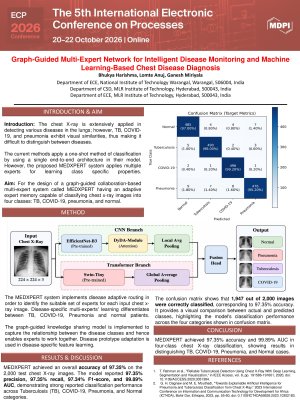
The Multi-Class Classification of diseases on thoracic area using Chest X-Ray (CXR) Images is difficult owing to visual similarities between the different diseases such as Tuberculosis (TB), COVID-19, and Pneumonia. In the existing studies, the use of End-to-end Deep Learning Networks has been made for classifying the different diseases. Such an approach would restrict the extraction of discriminatory features between the classes. In order to overcome this limitation, in this paper, MEDXPERT (Graph-Guided Collaborative Multi-Expert Framework with Adaptive Expert Memory) for explainable multi-class chest X-ray diagnosis is proposed. The concept in MEDXPERT lies in the fact that adaptive disease routing is used to select the right experts on the basis of input images. Experts learn discriminative disease features whereas the adaptive expert memory evolves disease prototypes. Graph-guided collaboration helps in modeling the relationship between disease classes and knowledge transfer among experts prior to prediction. Uncertainty estimation helps in identifying low confidence predictions while Explainability provides visual attention maps and diagnostic evidence. The evaluation of MEDXPERT is done on the publicly available Tuberculosis-tb-chest-xray-dataset, which consists of CXR images from the categories of tuberculosis, COVID-19, pneumonia, and normal. A dataset having 10,000 CXR images with a balanced number of images in each category, where 2,500 images are selected from each class and 8,000 images are used for training while the remaining 2,000 images are for testing. The performance of MEDXPERT is assessed in terms of Accuracy, Precision, Recall, F1-score, AUC, and calibration metrics, where ResNet50, DenseNet121, EfficientNet-B3, Vision Transformer, and Swin Transformer have been taken into consideration as baseline approaches. MEDXPERT obtains an Accuracy of 97.35%, Precision of 97.35%, Recall of 97.35%, F1-score of 97.34%, and AUC of 99.89%.
Keywords
Chest X-ray
Explainable Artificial Intelligence (XAI)
Graph-Guided Learning
Multi-Expert Network
Adaptive Expert Memory
Intelligent Healthcare Monitoring
Clinical Decision Support
Uncertainty Estimation
Deep Learning
Computer-Aided Diagnosis.
Poster
Sciforum-207376.pdf
Reinforcement Learning based Dynamic Traffic Time Control and Enhancing Commercial Vehicle for Emergency situation with Smart Routing Techniques
Isolation of PHB-Degrading Bacteria from Marine Plastic Waste