Event submissions
Published
This submission belongs to the session S4. Process Control, Monitoring and Machine Learning of the event The 5th International Electronic Conference on Processes
Published date
15 Oct, 2026
Academic Editor
'%3e%3cpath%20d='M12.6657%2010.9104C12.4185%2010.325%2012.0599%209.79327%2011.6097%209.34482C11.1609%208.89508%2010.6293%208.5365%2010.0442%208.28888C10.0389%208.28626%2010.0337%208.28495%2010.0285%208.28233C10.8446%207.69279%2011.3752%206.73249%2011.3752%205.64904C11.3752%203.8542%209.92103%202.39999%208.1262%202.39999C6.33136%202.39999%204.87715%203.8542%204.87715%205.64904C4.87715%206.73249%205.40774%207.69279%206.22393%208.28364C6.21869%208.28626%206.21345%208.28757%206.20821%208.29019C5.62129%208.5378%205.09463%208.89284%204.64265%209.34613C4.1929%209.79493%203.83432%2010.3266%203.58671%2010.9117C3.34345%2011.4845%203.21226%2012.0987%203.20023%2012.7209C3.19988%2012.7349%203.20233%2012.7488%203.20744%2012.7619C3.21255%2012.7749%203.22022%2012.7867%203.22998%2012.7968C3.23975%2012.8068%203.25142%2012.8147%203.26431%2012.8202C3.2772%2012.8256%203.29105%2012.8284%203.30504%2012.8284H4.09109C4.14874%2012.8284%204.19459%2012.7825%204.1959%2012.7262C4.2221%2011.7148%204.62823%2010.7676%205.34617%2010.0497C6.08899%209.30683%207.0755%208.89808%208.1262%208.89808C9.17689%208.89808%2010.1634%209.30683%2010.9062%2010.0497C11.6242%2010.7676%2012.0303%2011.7148%2012.0565%2012.7262C12.0578%2012.7838%2012.1037%2012.8284%2012.1613%2012.8284H12.9474C12.9613%2012.8284%2012.9752%2012.8256%2012.9881%2012.8202C13.001%2012.8147%2013.0126%2012.8068%2013.0224%2012.7968C13.0322%2012.7867%2013.0398%2012.7749%2013.0449%2012.7619C13.0501%2012.7488%2013.0525%2012.7349%2013.0522%2012.7209C13.0391%2012.0947%2012.9094%2011.4855%2012.6657%2010.9104ZM8.1262%207.9024C7.52486%207.9024%206.9589%207.6679%206.53312%207.24211C6.10733%206.81633%205.87283%206.25037%205.87283%205.64904C5.87283%205.0477%206.10733%204.48174%206.53312%204.05596C6.9589%203.63018%207.52486%203.39567%208.1262%203.39567C8.72753%203.39567%209.29349%203.63018%209.71927%204.05596C10.1451%204.48174%2010.3796%205.0477%2010.3796%205.64904C10.3796%206.25037%2010.1451%206.81633%209.71927%207.24211C9.29349%207.6679%208.72753%207.9024%208.1262%207.9024Z'%20fill='%235D1EE1'/%3e%3c/g%3e%3c/svg%3e) Ravendra Singh
Ravendra SinghContribution&Funding
Conceptualization,
[Said AMGHAR] ; [Abdellah AZMANI]
Methodology,
[Said AMGHAR]
Software,
[Said AMGHAR]
Validation,
[Said AMGHAR] ; [Kamal REKLAOUI] ; [Benaissa AMAMI]
Formal analysis,
[Said AMGHAR]
Investigation,
[Said AMGHAR]
Resources,
[Said AMGHAR] ; [Abdellah AZMANI]
Writing - original draft,
[Said AMGHAR]
Writing - review,
[editing] ; [Said AMGHAR]
Visualization,
[Said AMGHAR]
Supervision,
[Benaissa AMAMI] ; [Abdellah AZMANI] ; [Said AMGHAR] ; [Kamal REKLAOUI]
Project administration,
[Benaissa AMAMI] ; [Kamal REKLAOUI] ; [Abdellah AZMANI] ; [Said AMGHAR]
Funding acquisition,
[Said AMGHAR]
Funding: --
Citation
Said AMGHAR, Abdellah AZMANI, Kamal REKLAOUI, Benaissa AMAMI, Thermal Image-Based Condition Monitoring of Induction Motors: A Comparative Study, in Proceedings of The 5th International Electronic Conference on Processes, 20 October–22 October 2026, MDPI: Basel, Switzerland
Share
Email
Facebook
Twitter
LinkedIn
Thermal Image-Based Condition Monitoring of Induction Motors: A Comparative Study
'%3e%3cpath%20d='M12.6647%2010.9104C12.4176%2010.325%2012.0589%209.7933%2011.6088%209.34485C11.16%208.89511%2010.6283%208.53653%2010.0432%208.28891C10.038%208.28629%2010.0327%208.28498%2010.0275%208.28236C10.8437%207.69282%2011.3743%206.73252%2011.3743%205.64907C11.3743%203.85423%209.92005%202.40002%208.12522%202.40002C6.33038%202.40002%204.87618%203.85423%204.87618%205.64907C4.87618%206.73252%205.40677%207.69282%206.22296%208.28367C6.21772%208.28629%206.21248%208.2876%206.20724%208.29022C5.62031%208.53783%205.09365%208.89287%204.64167%209.34616C4.19192%209.79496%203.83334%2010.3266%203.58573%2010.9117C3.34247%2011.4846%203.21128%2012.0987%203.19925%2012.721C3.1989%2012.735%203.20135%2012.7489%203.20646%2012.7619C3.21157%2012.7749%203.21924%2012.7868%203.22901%2012.7968C3.23877%2012.8068%203.25045%2012.8148%203.26334%2012.8202C3.27623%2012.8256%203.29007%2012.8284%203.30406%2012.8284H4.09012C4.14776%2012.8284%204.19362%2012.7825%204.19493%2012.7262C4.22113%2011.7148%204.62726%2010.7676%205.34519%2010.0497C6.08802%209.30686%207.07452%208.89811%208.12522%208.89811C9.17592%208.89811%2010.1624%209.30686%2010.9052%2010.0497C11.6232%2010.7676%2012.0293%2011.7148%2012.0555%2012.7262C12.0568%2012.7839%2012.1027%2012.8284%2012.1603%2012.8284H12.9464C12.9604%2012.8284%2012.9742%2012.8256%2012.9871%2012.8202C13%2012.8148%2013.0117%2012.8068%2013.0214%2012.7968C13.0312%2012.7868%2013.0389%2012.7749%2013.044%2012.7619C13.0491%2012.7489%2013.0515%2012.735%2013.0512%2012.721C13.0381%2012.0947%2012.9084%2011.4856%2012.6647%2010.9104ZM8.12522%207.90243C7.52388%207.90243%206.95792%207.66793%206.53214%207.24215C6.10636%206.81636%205.87185%206.2504%205.87185%205.64907C5.87185%205.04773%206.10636%204.48177%206.53214%204.05599C6.95792%203.63021%207.52388%203.3957%208.12522%203.3957C8.72655%203.3957%209.29252%203.63021%209.7183%204.05599C10.1441%204.48177%2010.3786%205.04773%2010.3786%205.64907C10.3786%206.2504%2010.1441%206.81636%209.7183%207.24215C9.29252%207.66793%208.72655%207.90243%208.12522%207.90243Z'%20fill='%235D1EE1'/%3e%3c/g%3e%3c/svg%3e)
Said AMGHAR 1
Abdellah AZMANI 1
Kamal REKLAOUI 1
Benaissa AMAMI 1
1. Intelligent Automation and BioMed Genomics Laboratory, FST of Tangier, Abdelmalek Essaadi University, Tanger 90000, Morocco
Abstract
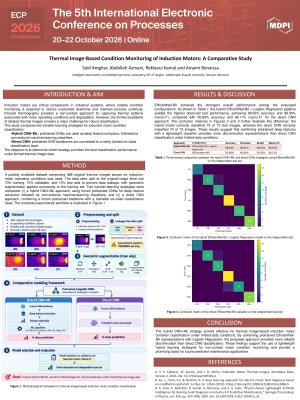
Introduction: Reliable monitoring of induction motors is essential for maintaining process continuity and reducing unplanned downtime in industrial systems. Infrared thermography provides a non-contact approach for capturing thermal patterns associated with operating conditions and motor degradation. However, the limited availability of labeled thermal images requires classification strategies that can achieve robust performance with relatively small datasets. This study investigates machine-learning-based thermal condition monitoring by comparing a hybrid CNN–ML approach with direct CNN classification.
Methods: A dataset containing 488 original thermal images was considered, covering six operating classes associated with healthy and corrosion-related motor conditions under full load, medium load, and no load. Geometric data augmentation was applied to increase the diversity of the training data while maintaining independent validation and test samples. Three ImageNet-pretrained convolutional neural networks—EfficientNet-B0, MobileNetV2, and ResNet50—were initially investigated. Two classification approaches were then compared. In the hybrid CNN–ML approach, frozen CNN architectures were used as deep feature extractors, and the extracted representations were classified using conventional machine-learning algorithms. In the direct CNN approach, the pretrained backbone was connected to a newly trained six-class neural classification layer.
Results: EfficientNet-B0 emerged as the best-performing architecture in both approaches. In the hybrid approach, EfficientNet-B0 features combined with logistic regression achieved a test accuracy of 98.63% and a macro-F1 score of 98.55%. In the direct CNN approach, EfficientNet-B0 achieved 95.89% test accuracy and a macro-F1 score of 96.11%.
Conclusion: Both strategies demonstrated strong capability for thermal condition classification. Nevertheless, the hybrid EfficientNet-B0–logistic regression approach achieved superior accuracy and class-balanced performance, indicating that combining pretrained deep features with a conventional machine-learning classifier is particularly effective for limited thermal-image datasets.
Keywords
Induction motor
infrared thermography
condition monitoring
process monitoring
machine learning
transfer learning
thermal image classification
Poster
Sciforum-207444.pdf
Isolation of PHB-Degrading Bacteria from Marine Plastic Waste
Recovery of pomegranate (Punica granatum L.) fruit or peel polyphenols using ultrafiltration and adsorption chromatography