Event submissions
Published
This submission belongs to the session S1. Environmental and Green Processes of the event The 5th International Electronic Conference on Processes
Published date
15 Oct, 2026
Academic Editor
'%3e%3cpath%20d='M12.6657%2010.9104C12.4185%2010.325%2012.0599%209.79327%2011.6097%209.34482C11.1609%208.89508%2010.6293%208.5365%2010.0442%208.28888C10.0389%208.28626%2010.0337%208.28495%2010.0285%208.28233C10.8446%207.69279%2011.3752%206.73249%2011.3752%205.64904C11.3752%203.8542%209.92103%202.39999%208.1262%202.39999C6.33136%202.39999%204.87715%203.8542%204.87715%205.64904C4.87715%206.73249%205.40774%207.69279%206.22393%208.28364C6.21869%208.28626%206.21345%208.28757%206.20821%208.29019C5.62129%208.5378%205.09463%208.89284%204.64265%209.34613C4.1929%209.79493%203.83432%2010.3266%203.58671%2010.9117C3.34345%2011.4845%203.21226%2012.0987%203.20023%2012.7209C3.19988%2012.7349%203.20233%2012.7488%203.20744%2012.7619C3.21255%2012.7749%203.22022%2012.7867%203.22998%2012.7968C3.23975%2012.8068%203.25142%2012.8147%203.26431%2012.8202C3.2772%2012.8256%203.29105%2012.8284%203.30504%2012.8284H4.09109C4.14874%2012.8284%204.19459%2012.7825%204.1959%2012.7262C4.2221%2011.7148%204.62823%2010.7676%205.34617%2010.0497C6.08899%209.30683%207.0755%208.89808%208.1262%208.89808C9.17689%208.89808%2010.1634%209.30683%2010.9062%2010.0497C11.6242%2010.7676%2012.0303%2011.7148%2012.0565%2012.7262C12.0578%2012.7838%2012.1037%2012.8284%2012.1613%2012.8284H12.9474C12.9613%2012.8284%2012.9752%2012.8256%2012.9881%2012.8202C13.001%2012.8147%2013.0126%2012.8068%2013.0224%2012.7968C13.0322%2012.7867%2013.0398%2012.7749%2013.0449%2012.7619C13.0501%2012.7488%2013.0525%2012.7349%2013.0522%2012.7209C13.0391%2012.0947%2012.9094%2011.4855%2012.6657%2010.9104ZM8.1262%207.9024C7.52486%207.9024%206.9589%207.6679%206.53312%207.24211C6.10733%206.81633%205.87283%206.25037%205.87283%205.64904C5.87283%205.0477%206.10733%204.48174%206.53312%204.05596C6.9589%203.63018%207.52486%203.39567%208.1262%203.39567C8.72753%203.39567%209.29349%203.63018%209.71927%204.05596C10.1451%204.48174%2010.3796%205.0477%2010.3796%205.64904C10.3796%206.25037%2010.1451%206.81633%209.71927%207.24211C9.29349%207.6679%208.72753%207.9024%208.1262%207.9024Z'%20fill='%235D1EE1'/%3e%3c/g%3e%3c/svg%3e) Juan Francisco García Martín
Juan Francisco García MartínCitation
SONIA GUILERA BERMELL, Remedios García Bou, ANTONIO M. INAREJOS GARCIA, Recovery of pomegranate (Punica granatum L.) fruit or peel polyphenols using ultrafiltration and adsorption chromatography, in Proceedings of The 5th International Electronic Conference on Processes, 20 October–22 October 2026, MDPI: Basel, Switzerland
Share
Email
Facebook
Twitter
LinkedIn
Recovery of pomegranate (Punica granatum L.) fruit or peel polyphenols using ultrafiltration and adsorption chromatography
'%3e%3cpath%20d='M12.6647%2010.9104C12.4176%2010.325%2012.0589%209.7933%2011.6088%209.34485C11.16%208.89511%2010.6283%208.53653%2010.0432%208.28891C10.038%208.28629%2010.0327%208.28498%2010.0275%208.28236C10.8437%207.69282%2011.3743%206.73252%2011.3743%205.64907C11.3743%203.85423%209.92005%202.40002%208.12522%202.40002C6.33038%202.40002%204.87618%203.85423%204.87618%205.64907C4.87618%206.73252%205.40677%207.69282%206.22296%208.28367C6.21772%208.28629%206.21248%208.2876%206.20724%208.29022C5.62031%208.53783%205.09365%208.89287%204.64167%209.34616C4.19192%209.79496%203.83334%2010.3266%203.58573%2010.9117C3.34247%2011.4846%203.21128%2012.0987%203.19925%2012.721C3.1989%2012.735%203.20135%2012.7489%203.20646%2012.7619C3.21157%2012.7749%203.21924%2012.7868%203.22901%2012.7968C3.23877%2012.8068%203.25045%2012.8148%203.26334%2012.8202C3.27623%2012.8256%203.29007%2012.8284%203.30406%2012.8284H4.09012C4.14776%2012.8284%204.19362%2012.7825%204.19493%2012.7262C4.22113%2011.7148%204.62726%2010.7676%205.34519%2010.0497C6.08802%209.30686%207.07452%208.89811%208.12522%208.89811C9.17592%208.89811%2010.1624%209.30686%2010.9052%2010.0497C11.6232%2010.7676%2012.0293%2011.7148%2012.0555%2012.7262C12.0568%2012.7839%2012.1027%2012.8284%2012.1603%2012.8284H12.9464C12.9604%2012.8284%2012.9742%2012.8256%2012.9871%2012.8202C13%2012.8148%2013.0117%2012.8068%2013.0214%2012.7968C13.0312%2012.7868%2013.0389%2012.7749%2013.044%2012.7619C13.0491%2012.7489%2013.0515%2012.735%2013.0512%2012.721C13.0381%2012.0947%2012.9084%2011.4856%2012.6647%2010.9104ZM8.12522%207.90243C7.52388%207.90243%206.95792%207.66793%206.53214%207.24215C6.10636%206.81636%205.87185%206.2504%205.87185%205.64907C5.87185%205.04773%206.10636%204.48177%206.53214%204.05599C6.95792%203.63021%207.52388%203.3957%208.12522%203.3957C8.72655%203.3957%209.29252%203.63021%209.7183%204.05599C10.1441%204.48177%2010.3786%205.04773%2010.3786%205.64907C10.3786%206.2504%2010.1441%206.81636%209.7183%207.24215C9.29252%207.66793%208.72655%207.90243%208.12522%207.90243Z'%20fill='%235D1EE1'/%3e%3c/g%3e%3c/svg%3e)
SONIA GUILERA BERMELL 1
Remedios García Bou 2
ANTONIO M. INAREJOS GARCIA 3
1. Nutrition Archer Daniels Midland (ADM) Health & Wellness, Biopolis S. L. Parc Cientific, Universitat de València, 46980 Paterna, Spain
2. Department of Functional Extracts, ADM® Valencia, 46740 Carcaixent, Spain.
3. Archer Daniels Midland, Nutrition, Health&Wellness, Biopolis S.L. Parc Científic Universitat de València, 46980 Paterna, Spain
Abstract
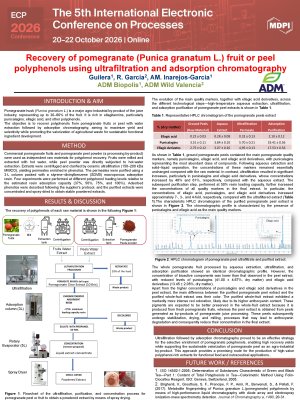
Pomegranate husk (Punica granatum L.) is a major agro-industrial by-product of the juice industry, representing up to 30–60% of the fruit. It is rich in ellagitannins, particularly punicalagins, ellagic acid, and other polyphenols. The objective is to recover polyphenols from pomegranate fruits or peel with water extraction followed by adsorption chromatography, aiming to maximize yield and selectivity while promoting the valorization of agricultural waste for sustainable functional ingredient development. Commercial pomegranate fruit or peel were used for polyphenol recovery. The extracts were clarified by ultrafiltration, purified by adsorption chromatography, and finally spray dried to obtain polyphenol-rich powders. The polyphenolic profile was characterized using HPLC analysis. Pomegranate fruits or peels powder were extracted with hot water to obtain two different extracts, which were subsequently processed by ultrafiltration and adsorption chromatography. For the fruit extract, ultrafiltration enabled partial enrichment of polyphenols, and further purification using adsorption resin achieved an ~82% recovery yield, with 78% total polyphenols in the final powder. The average polyphenolic composition of the fruit extract was 13.45 ± 1.45% ellagic acid derivatives and 41.0 ± 4.6% punicalagin derivatives, confirming that punicalagins were the dominant compounds. For the peel extract, ultrafiltration increased the total polyphenol content from 13 ± 5% in the raw material to 22 ± 1%, and up to 80 ± 5% after adsorption chromatography purification. The adsorption step achieved a ~97% polyphenol recovery, with an estimated overall yield of ~11 g of purified polyphenols per 275 g of peel. The phenolic profile of the purified peel extract was dominated by punicalagins, alongside ellagic acid derivatives. Ultrafiltration followed by adsorption chromatography proved to be an effective strategy for selective enrichment, enabling high recovery yields and confirming their strong potential for the functional valorization of pomegranate peel into polyphenol-rich extracts.
Keywords
pomegranate peel
ultrafiltration
adsorption chromatography
ellagic acid
punicallagins
HPLC
Poster
Sciforum-189372 Poster.pdf
Thermal Image-Based Condition Monitoring of Induction Motors: A Comparative Study
Robust Dual-Sequence Current Control of a Single-Stage Three-Phase EV Charger Under Unbalanced Grid Conditions and Grid Impedance Uncertainty