Event submissions
Published
This submission belongs to the session S1. Environmental and Green Processes of the event The 5th International Electronic Conference on Processes
Published date
15 Oct, 2026
Academic Editor
'%3e%3cpath%20d='M12.6657%2010.9104C12.4185%2010.325%2012.0599%209.79327%2011.6097%209.34482C11.1609%208.89508%2010.6293%208.5365%2010.0442%208.28888C10.0389%208.28626%2010.0337%208.28495%2010.0285%208.28233C10.8446%207.69279%2011.3752%206.73249%2011.3752%205.64904C11.3752%203.8542%209.92103%202.39999%208.1262%202.39999C6.33136%202.39999%204.87715%203.8542%204.87715%205.64904C4.87715%206.73249%205.40774%207.69279%206.22393%208.28364C6.21869%208.28626%206.21345%208.28757%206.20821%208.29019C5.62129%208.5378%205.09463%208.89284%204.64265%209.34613C4.1929%209.79493%203.83432%2010.3266%203.58671%2010.9117C3.34345%2011.4845%203.21226%2012.0987%203.20023%2012.7209C3.19988%2012.7349%203.20233%2012.7488%203.20744%2012.7619C3.21255%2012.7749%203.22022%2012.7867%203.22998%2012.7968C3.23975%2012.8068%203.25142%2012.8147%203.26431%2012.8202C3.2772%2012.8256%203.29105%2012.8284%203.30504%2012.8284H4.09109C4.14874%2012.8284%204.19459%2012.7825%204.1959%2012.7262C4.2221%2011.7148%204.62823%2010.7676%205.34617%2010.0497C6.08899%209.30683%207.0755%208.89808%208.1262%208.89808C9.17689%208.89808%2010.1634%209.30683%2010.9062%2010.0497C11.6242%2010.7676%2012.0303%2011.7148%2012.0565%2012.7262C12.0578%2012.7838%2012.1037%2012.8284%2012.1613%2012.8284H12.9474C12.9613%2012.8284%2012.9752%2012.8256%2012.9881%2012.8202C13.001%2012.8147%2013.0126%2012.8068%2013.0224%2012.7968C13.0322%2012.7867%2013.0398%2012.7749%2013.0449%2012.7619C13.0501%2012.7488%2013.0525%2012.7349%2013.0522%2012.7209C13.0391%2012.0947%2012.9094%2011.4855%2012.6657%2010.9104ZM8.1262%207.9024C7.52486%207.9024%206.9589%207.6679%206.53312%207.24211C6.10733%206.81633%205.87283%206.25037%205.87283%205.64904C5.87283%205.0477%206.10733%204.48174%206.53312%204.05596C6.9589%203.63018%207.52486%203.39567%208.1262%203.39567C8.72753%203.39567%209.29349%203.63018%209.71927%204.05596C10.1451%204.48174%2010.3796%205.0477%2010.3796%205.64904C10.3796%206.25037%2010.1451%206.81633%209.71927%207.24211C9.29349%207.6679%208.72753%207.9024%208.1262%207.9024Z'%20fill='%235D1EE1'/%3e%3c/g%3e%3c/svg%3e) Juan Francisco García Martín
Juan Francisco García MartínCitation
Farid Bennabi, Yasmina Khane, Mohamed walid Mohamedi, Khaled Rahmani, Ali Khalfa, Djamila Boukraa, Abdelkader NEBATTI CHERGUI, Abderrahmane Bellaouar, Evaluation of Antioxidant, Antibacterial, and Antifungal Activities of Moringa oleifera Aerial Extracts in Relation to Their Phytochemical Composition (Ghardaïa, Algeria), in Proceedings of The 5th International Electronic Conference on Processes, 20 October–22 October 2026, MDPI: Basel, Switzerland
Share
Email
Facebook
Twitter
LinkedIn
Evaluation of Antioxidant, Antibacterial, and Antifungal Activities of Moringa oleifera Aerial Extracts in Relation to Their Phytochemical Composition (Ghardaïa, Algeria)
'%3e%3cpath%20d='M12.6647%2010.9104C12.4176%2010.325%2012.0589%209.7933%2011.6088%209.34485C11.16%208.89511%2010.6283%208.53653%2010.0432%208.28891C10.038%208.28629%2010.0327%208.28498%2010.0275%208.28236C10.8437%207.69282%2011.3743%206.73252%2011.3743%205.64907C11.3743%203.85423%209.92005%202.40002%208.12522%202.40002C6.33038%202.40002%204.87618%203.85423%204.87618%205.64907C4.87618%206.73252%205.40677%207.69282%206.22296%208.28367C6.21772%208.28629%206.21248%208.2876%206.20724%208.29022C5.62031%208.53783%205.09365%208.89287%204.64167%209.34616C4.19192%209.79496%203.83334%2010.3266%203.58573%2010.9117C3.34247%2011.4846%203.21128%2012.0987%203.19925%2012.721C3.1989%2012.735%203.20135%2012.7489%203.20646%2012.7619C3.21157%2012.7749%203.21924%2012.7868%203.22901%2012.7968C3.23877%2012.8068%203.25045%2012.8148%203.26334%2012.8202C3.27623%2012.8256%203.29007%2012.8284%203.30406%2012.8284H4.09012C4.14776%2012.8284%204.19362%2012.7825%204.19493%2012.7262C4.22113%2011.7148%204.62726%2010.7676%205.34519%2010.0497C6.08802%209.30686%207.07452%208.89811%208.12522%208.89811C9.17592%208.89811%2010.1624%209.30686%2010.9052%2010.0497C11.6232%2010.7676%2012.0293%2011.7148%2012.0555%2012.7262C12.0568%2012.7839%2012.1027%2012.8284%2012.1603%2012.8284H12.9464C12.9604%2012.8284%2012.9742%2012.8256%2012.9871%2012.8202C13%2012.8148%2013.0117%2012.8068%2013.0214%2012.7968C13.0312%2012.7868%2013.0389%2012.7749%2013.044%2012.7619C13.0491%2012.7489%2013.0515%2012.735%2013.0512%2012.721C13.0381%2012.0947%2012.9084%2011.4856%2012.6647%2010.9104ZM8.12522%207.90243C7.52388%207.90243%206.95792%207.66793%206.53214%207.24215C6.10636%206.81636%205.87185%206.2504%205.87185%205.64907C5.87185%205.04773%206.10636%204.48177%206.53214%204.05599C6.95792%203.63021%207.52388%203.3957%208.12522%203.3957C8.72655%203.3957%209.29252%203.63021%209.7183%204.05599C10.1441%204.48177%2010.3786%205.04773%2010.3786%205.64907C10.3786%206.2504%2010.1441%206.81636%209.7183%207.24215C9.29252%207.66793%208.72655%207.90243%208.12522%207.90243Z'%20fill='%235D1EE1'/%3e%3c/g%3e%3c/svg%3e)
Farid Bennabi 1
Yasmina Khane 2
Mohamed walid Mohamedi 1
Khaled Rahmani 1
Ali Khalfa 1
Djamila Boukraa 1
Abdelkader NEBATTI CHERGUI 1
Abderrahmane Bellaouar 2,3
1. Laboratory of Materials Sciences and Applications (LSMA), University of Ain Temouchent Belhadj Bouchaib, Faculty of Sciences and Technology, Aïn Témouchent, Algeria
2. Faculty of Sciences and Technology, University of Ghardaïa, BP 455, 47000 Ghardaïa, Algeria
3. Materials, Energy Systems Technology and Environment Laboratory, Faculty of Sciences and Technology, University of Ghardaïa, BP 455, 47000 Ghardaïa, Algeria
Abstract
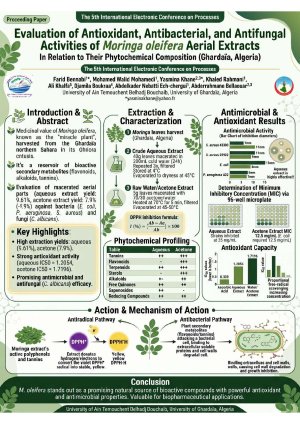
Moringa oleifera, a drought-tolerant medicinal plant native to subtropical regions, holds significant therapeutic promise due to its rich reservoir of bioactive compounds. This work provides a comprehensive assessment of M. oleifera leaves harvested from the arid Ghardaïa province in southern Algeria, focusing on their phytochemical profile and associated biological activities. The aerial parts were subjected to maceration using two solvents of varying polarity, yielding aqueous (9.61%) and acetone (7.9%) extracts, which allowed for the differential extraction of hydrophilic and lipophilic compounds. Qualitative phytochemical screening of both extracts confirmed the presence of several secondary metabolite classes, notably flavonoids, anthocyanins, alkaloids, and tannins—all of which are recognized for their redox and antimicrobial properties. The antioxidant potential was quantified via DPPH radical scavenging assays, with the aqueous and water/acetone extracts exhibiting IC50 values of 1.2054 and 1.7196 mg/mL, respectively, indicating potent free-radical-neutralizing activity that correlates strongly with their polyphenolic load. The antimicrobial efficacy was screened using the agar diffusion method against four pathogenic bacterial strains (Escherichia coli, Pseudomonas aeruginosa, Staphylococcus aureus, and methicillin-resistant S. aureus ATCC 43300) as well as the opportunistic fungus Candida albicans, revealing moderate but consistent inhibitory effects across all tested microorganisms. To corroborate these preliminary findings, the Minimum Inhibitory Concentrations (MICs) were precisely determined using the broth microdilution method in liquid medium, which confirmed the dose-dependent efficacy of both extracts and validated the zone-of-inhibition data obtained on solid media. Collectively, this investigation not only substantiates the ethnomedicinal use of M. oleifera in traditional Algerian pharmacopoeia but also highlights the significant influence of its secondary metabolite composition on its multifunctional antioxidant and antimicrobial properties, paving the way for potential pharmaceutical and nutraceutical applications.
Keywords
Moringa oleifera
phenolic compounds
ntioxidant activity
antimicrobial activity
MIC
Poster
poster proceeding italy farid 20264.pdf
Smart LPG Gas Leakage Detection Robot with Real-Time Alerts and Automatic Shut-Off
Comparative evaluation of near-infrared, Fourier transform infrared, and nuclear magnetic resonance spectroscopy for λ-cyhalothrin screening in virgin olive oil