Event submissions
Published
This submission belongs to the session S1. Environmental and Green Processes of the event The 5th International Electronic Conference on Processes
Published date
15 Oct, 2026
Academic Editor
'%3e%3cpath%20d='M12.6657%2010.9104C12.4185%2010.325%2012.0599%209.79327%2011.6097%209.34482C11.1609%208.89508%2010.6293%208.5365%2010.0442%208.28888C10.0389%208.28626%2010.0337%208.28495%2010.0285%208.28233C10.8446%207.69279%2011.3752%206.73249%2011.3752%205.64904C11.3752%203.8542%209.92103%202.39999%208.1262%202.39999C6.33136%202.39999%204.87715%203.8542%204.87715%205.64904C4.87715%206.73249%205.40774%207.69279%206.22393%208.28364C6.21869%208.28626%206.21345%208.28757%206.20821%208.29019C5.62129%208.5378%205.09463%208.89284%204.64265%209.34613C4.1929%209.79493%203.83432%2010.3266%203.58671%2010.9117C3.34345%2011.4845%203.21226%2012.0987%203.20023%2012.7209C3.19988%2012.7349%203.20233%2012.7488%203.20744%2012.7619C3.21255%2012.7749%203.22022%2012.7867%203.22998%2012.7968C3.23975%2012.8068%203.25142%2012.8147%203.26431%2012.8202C3.2772%2012.8256%203.29105%2012.8284%203.30504%2012.8284H4.09109C4.14874%2012.8284%204.19459%2012.7825%204.1959%2012.7262C4.2221%2011.7148%204.62823%2010.7676%205.34617%2010.0497C6.08899%209.30683%207.0755%208.89808%208.1262%208.89808C9.17689%208.89808%2010.1634%209.30683%2010.9062%2010.0497C11.6242%2010.7676%2012.0303%2011.7148%2012.0565%2012.7262C12.0578%2012.7838%2012.1037%2012.8284%2012.1613%2012.8284H12.9474C12.9613%2012.8284%2012.9752%2012.8256%2012.9881%2012.8202C13.001%2012.8147%2013.0126%2012.8068%2013.0224%2012.7968C13.0322%2012.7867%2013.0398%2012.7749%2013.0449%2012.7619C13.0501%2012.7488%2013.0525%2012.7349%2013.0522%2012.7209C13.0391%2012.0947%2012.9094%2011.4855%2012.6657%2010.9104ZM8.1262%207.9024C7.52486%207.9024%206.9589%207.6679%206.53312%207.24211C6.10733%206.81633%205.87283%206.25037%205.87283%205.64904C5.87283%205.0477%206.10733%204.48174%206.53312%204.05596C6.9589%203.63018%207.52486%203.39567%208.1262%203.39567C8.72753%203.39567%209.29349%203.63018%209.71927%204.05596C10.1451%204.48174%2010.3796%205.0477%2010.3796%205.64904C10.3796%206.25037%2010.1451%206.81633%209.71927%207.24211C9.29349%207.6679%208.72753%207.9024%208.1262%207.9024Z'%20fill='%235D1EE1'/%3e%3c/g%3e%3c/svg%3e) Juan Francisco García Martín
Juan Francisco García MartínCitation
Abhishek Singh, Intelligent Automation for Greener Processes: An AI Framework for Environmental Monitoring and Efficiency, in Proceedings of The 5th International Electronic Conference on Processes, 20 October–22 October 2026, MDPI: Basel, Switzerland
Share
Email
Facebook
Twitter
LinkedIn
Intelligent Automation for Greener Processes: An AI Framework for Environmental Monitoring and Efficiency
'%3e%3cpath%20d='M12.6647%2010.9104C12.4176%2010.325%2012.0589%209.7933%2011.6088%209.34485C11.16%208.89511%2010.6283%208.53653%2010.0432%208.28891C10.038%208.28629%2010.0327%208.28498%2010.0275%208.28236C10.8437%207.69282%2011.3743%206.73252%2011.3743%205.64907C11.3743%203.85423%209.92005%202.40002%208.12522%202.40002C6.33038%202.40002%204.87618%203.85423%204.87618%205.64907C4.87618%206.73252%205.40677%207.69282%206.22296%208.28367C6.21772%208.28629%206.21248%208.2876%206.20724%208.29022C5.62031%208.53783%205.09365%208.89287%204.64167%209.34616C4.19192%209.79496%203.83334%2010.3266%203.58573%2010.9117C3.34247%2011.4846%203.21128%2012.0987%203.19925%2012.721C3.1989%2012.735%203.20135%2012.7489%203.20646%2012.7619C3.21157%2012.7749%203.21924%2012.7868%203.22901%2012.7968C3.23877%2012.8068%203.25045%2012.8148%203.26334%2012.8202C3.27623%2012.8256%203.29007%2012.8284%203.30406%2012.8284H4.09012C4.14776%2012.8284%204.19362%2012.7825%204.19493%2012.7262C4.22113%2011.7148%204.62726%2010.7676%205.34519%2010.0497C6.08802%209.30686%207.07452%208.89811%208.12522%208.89811C9.17592%208.89811%2010.1624%209.30686%2010.9052%2010.0497C11.6232%2010.7676%2012.0293%2011.7148%2012.0555%2012.7262C12.0568%2012.7839%2012.1027%2012.8284%2012.1603%2012.8284H12.9464C12.9604%2012.8284%2012.9742%2012.8256%2012.9871%2012.8202C13%2012.8148%2013.0117%2012.8068%2013.0214%2012.7968C13.0312%2012.7868%2013.0389%2012.7749%2013.044%2012.7619C13.0491%2012.7489%2013.0515%2012.735%2013.0512%2012.721C13.0381%2012.0947%2012.9084%2011.4856%2012.6647%2010.9104ZM8.12522%207.90243C7.52388%207.90243%206.95792%207.66793%206.53214%207.24215C6.10636%206.81636%205.87185%206.2504%205.87185%205.64907C5.87185%205.04773%206.10636%204.48177%206.53214%204.05599C6.95792%203.63021%207.52388%203.3957%208.12522%203.3957C8.72655%203.3957%209.29252%203.63021%209.7183%204.05599C10.1441%204.48177%2010.3786%205.04773%2010.3786%205.64907C10.3786%206.2504%2010.1441%206.81636%209.7183%207.24215C9.29252%207.66793%208.72655%207.90243%208.12522%207.90243Z'%20fill='%235D1EE1'/%3e%3c/g%3e%3c/svg%3e)
Abhishek Singh 1
1. Technology Management (Computing), Asia Pacific University (affiliated with Staffordshire University, UK), Kuala Lumpur, 57000, Malaysia
Abstract
Abstract:
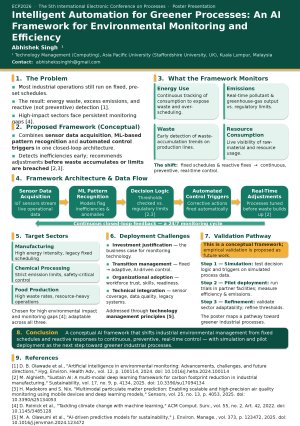
This paper presents a conceptual AI framework for real-time environmental monitoring and efficiency in industrial processes. Most industrial operations run on fixed schedules, leading to energy waste, excess emissions, and reactive rather than preventive problem detection [1]. We propose a framework combining sensor data acquisition, machine learning-based pattern recognition, and automated control triggers to continuously monitor energy use, emissions, waste, and resource consumption. The framework is designed to detect inefficiencies and recommend real-time adjustments before waste accumulates or regulatory limits are breached [2,3]. It targets adaptability across manufacturing, chemical processing, and food production — sectors with high environmental impact and persistent monitoring gaps [4]. As this is a conceptual framework, empirical validation is proposed as future work through simulation and pilot deployment in partner facilities. This paper details the framework's architecture, data flow, and decision logic, and discusses the technical and organizational challenges of deployment — including investment justification, transition management, and adoption — drawing on technology management principles [5]. This presentation introduces the framework and its intended validation pathway toward greener industrial processes.
References
[1] D. B. Olawade et al., "Artificial intelligence in environmental monitoring: Advancements, challenges, and future directions," Hyg. Environ. Health Adv., vol. 12, p. 100114, 2024. doi: 10.1016/j.heha.2024.100114
[2] M. Alghieth, "Sustain AI: A multi-modal deep learning framework for carbon footprint reduction in industrial manufacturing," Sustainability, vol. 17, no. 9, p. 4134, 2025. doi: 10.3390/su17094134
[3] H. Madokoro and S. Nix, "Multimodal particulate matter prediction: Enabling scalable and high-precision air quality monitoring using mobile devices and deep learning models," Sensors, vol. 25, no. 13, p. 4053, 2025. doi: 10.3390/s25134053
[4] D. Rolnick et al., "Tackling climate change with machine learning," ACM Comput. Surv., vol. 55, no. 2, Art. 42, 2022. doi: 10.1145/3485128
[5] M. A. Olawumi et al., "AI-driven predictive models for sustainability," J. Environ. Manage., vol. 373, p. 123472, 2025. doi: 10.1016/j.jenvman.2024.123472
Keywords
AI-driven environmental monitoring
machine learning for sustainability
industrial process automation
energy efficiency optimization
emissions monitoring
Poster
Pdf.pdf
Physics-Informed Machine Learning for Intelligent Fault Detection and Classification in Photovoltaic Energy Systems: A Comparative Study
Ergonomic Cartridge Transfer Car Design to Improve Lean Manufacturing and Operational Efficiency in Tire Production