Event submissions
Published
This submission belongs to the session S6. Mathematical Analysis and Statistics of the event The 1st International Online Conference on Symmetry
Published date
15 Oct, 2026
Academic Editor
'%3e%3cpath%20d='M12.6657%2010.9104C12.4185%2010.325%2012.0599%209.79327%2011.6097%209.34482C11.1609%208.89508%2010.6293%208.5365%2010.0442%208.28888C10.0389%208.28626%2010.0337%208.28495%2010.0285%208.28233C10.8446%207.69279%2011.3752%206.73249%2011.3752%205.64904C11.3752%203.8542%209.92103%202.39999%208.1262%202.39999C6.33136%202.39999%204.87715%203.8542%204.87715%205.64904C4.87715%206.73249%205.40774%207.69279%206.22393%208.28364C6.21869%208.28626%206.21345%208.28757%206.20821%208.29019C5.62129%208.5378%205.09463%208.89284%204.64265%209.34613C4.1929%209.79493%203.83432%2010.3266%203.58671%2010.9117C3.34345%2011.4845%203.21226%2012.0987%203.20023%2012.7209C3.19988%2012.7349%203.20233%2012.7488%203.20744%2012.7619C3.21255%2012.7749%203.22022%2012.7867%203.22998%2012.7968C3.23975%2012.8068%203.25142%2012.8147%203.26431%2012.8202C3.2772%2012.8256%203.29105%2012.8284%203.30504%2012.8284H4.09109C4.14874%2012.8284%204.19459%2012.7825%204.1959%2012.7262C4.2221%2011.7148%204.62823%2010.7676%205.34617%2010.0497C6.08899%209.30683%207.0755%208.89808%208.1262%208.89808C9.17689%208.89808%2010.1634%209.30683%2010.9062%2010.0497C11.6242%2010.7676%2012.0303%2011.7148%2012.0565%2012.7262C12.0578%2012.7838%2012.1037%2012.8284%2012.1613%2012.8284H12.9474C12.9613%2012.8284%2012.9752%2012.8256%2012.9881%2012.8202C13.001%2012.8147%2013.0126%2012.8068%2013.0224%2012.7968C13.0322%2012.7867%2013.0398%2012.7749%2013.0449%2012.7619C13.0501%2012.7488%2013.0525%2012.7349%2013.0522%2012.7209C13.0391%2012.0947%2012.9094%2011.4855%2012.6657%2010.9104ZM8.1262%207.9024C7.52486%207.9024%206.9589%207.6679%206.53312%207.24211C6.10733%206.81633%205.87283%206.25037%205.87283%205.64904C5.87283%205.0477%206.10733%204.48174%206.53312%204.05596C6.9589%203.63018%207.52486%203.39567%208.1262%203.39567C8.72753%203.39567%209.29349%203.63018%209.71927%204.05596C10.1451%204.48174%2010.3796%205.0477%2010.3796%205.64904C10.3796%206.25037%2010.1451%206.81633%209.71927%207.24211C9.29349%207.6679%208.72753%207.9024%208.1262%207.9024Z'%20fill='%235D1EE1'/%3e%3c/g%3e%3c/svg%3e) Calogero Vetro
Calogero VetroCitation
Istiak Ahmed, Abul Fatta Mohammad Tariqul Islam, Azizur Rahman, Functional Data Analysis of Sentinel-2 Derived Vegetative Phenology for Potato Yield Estimation Under Normal and Cyclone Conditions, in Proceedings of The 1st International Online Conference on Symmetry, 20 October–22 October 2026, MDPI: Basel, Switzerland
Share
Email
Facebook
Twitter
LinkedIn
Functional Data Analysis of Sentinel-2 Derived Vegetative Phenology for Potato Yield Estimation Under Normal and Cyclone Conditions
'%3e%3cpath%20d='M12.6647%2010.9104C12.4176%2010.325%2012.0589%209.7933%2011.6088%209.34485C11.16%208.89511%2010.6283%208.53653%2010.0432%208.28891C10.038%208.28629%2010.0327%208.28498%2010.0275%208.28236C10.8437%207.69282%2011.3743%206.73252%2011.3743%205.64907C11.3743%203.85423%209.92005%202.40002%208.12522%202.40002C6.33038%202.40002%204.87618%203.85423%204.87618%205.64907C4.87618%206.73252%205.40677%207.69282%206.22296%208.28367C6.21772%208.28629%206.21248%208.2876%206.20724%208.29022C5.62031%208.53783%205.09365%208.89287%204.64167%209.34616C4.19192%209.79496%203.83334%2010.3266%203.58573%2010.9117C3.34247%2011.4846%203.21128%2012.0987%203.19925%2012.721C3.1989%2012.735%203.20135%2012.7489%203.20646%2012.7619C3.21157%2012.7749%203.21924%2012.7868%203.22901%2012.7968C3.23877%2012.8068%203.25045%2012.8148%203.26334%2012.8202C3.27623%2012.8256%203.29007%2012.8284%203.30406%2012.8284H4.09012C4.14776%2012.8284%204.19362%2012.7825%204.19493%2012.7262C4.22113%2011.7148%204.62726%2010.7676%205.34519%2010.0497C6.08802%209.30686%207.07452%208.89811%208.12522%208.89811C9.17592%208.89811%2010.1624%209.30686%2010.9052%2010.0497C11.6232%2010.7676%2012.0293%2011.7148%2012.0555%2012.7262C12.0568%2012.7839%2012.1027%2012.8284%2012.1603%2012.8284H12.9464C12.9604%2012.8284%2012.9742%2012.8256%2012.9871%2012.8202C13%2012.8148%2013.0117%2012.8068%2013.0214%2012.7968C13.0312%2012.7868%2013.0389%2012.7749%2013.044%2012.7619C13.0491%2012.7489%2013.0515%2012.735%2013.0512%2012.721C13.0381%2012.0947%2012.9084%2011.4856%2012.6647%2010.9104ZM8.12522%207.90243C7.52388%207.90243%206.95792%207.66793%206.53214%207.24215C6.10636%206.81636%205.87185%206.2504%205.87185%205.64907C5.87185%205.04773%206.10636%204.48177%206.53214%204.05599C6.95792%203.63021%207.52388%203.3957%208.12522%203.3957C8.72655%203.3957%209.29252%203.63021%209.7183%204.05599C10.1441%204.48177%2010.3786%205.04773%2010.3786%205.64907C10.3786%206.2504%2010.1441%206.81636%209.7183%207.24215C9.29252%207.66793%208.72655%207.90243%208.12522%207.90243Z'%20fill='%235D1EE1'/%3e%3c/g%3e%3c/svg%3e)
Istiak Ahmed 1,2,3
Abul Fatta Mohammad Tariqul Islam 2,4
Azizur Rahman 3,5
1. Agricultural Statistics and ICT Division, Bangladesh Agricultural Research Institute, Gazipur-1701, Bangladesh
2. Agro-environmental Remote Sensing and Modeling (ARSAM) Laboratory, Bangladesh Agricultural Research Institute, Gazipur-1701, Bangladesh
3. Theoretical and Applied Statistical Innovation Laboratory (TASiLab), Winnipeg, R3E 0T4, Canada
4. Agricultural Engineering Unit, Bangladesh Agricultural Research Council, Dhaka-1215, Bangladesh
5. Department of Community Health Sciences, University of Manitoba, Winnipeg, R3E 0T4, Canada
Abstract
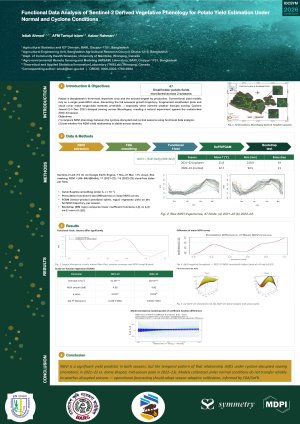
Sentinel-2 derived vegetative phenology indicators, such as the Normalized Difference Vegetation Index (NDVI), have been effective at predicting potato yields, but earlier approaches relied on a single approach, ignoring the whole seasonal pattern. In this study, we used functional data analysis (FDA) on NDVI time series from 47 smallholder fields across two seasons: one affected by a cyclone in 2021–22 and the other a normal season in 2022–23. Cyclone Jawad brought 137 mm of rain in early December 2021, more than twice the usual rainfall, causing delays in sowing. The NDVI data were collected across both seasons and then smoothed separately using penalized cubic B-splines. A permutation-based functional t-test showed that NDVI patterns differed significantly between the two seasons, especially early in the season, suggesting that crop establishment was delayed in 2021–22. The scalar-on-function regression (SoFR) models for each season, using a functional generalized additive model (FGAM), were applied to assess whether the two patterns had significant effects on yield. Adjusted R2=0.238 with p=0.016 for the 2021–22 season and adjusted R2=0.283 with p=0.013 for the 2022-23 season revealed that the full NDVI pattern was a significant predictor of yield. In 2021–22, yield increased steadily with NDVI, whereas in 2022–23, yield peaked during mid-season canopy closure. A bootstrap test confirmed that these differences in the relationship between NDVI and yield were significant, suggesting that models trained in normal years may not work well in years with extreme weather. The FDA provides a way to detect and measure these changes, which can help improve remote-sensing yield forecasts in regions affected by climate change.
Keywords
Remote Sensing
NDVI time series
Cyclone Jawad
B-Spline
Functional t-test
Scalar-on-function regression
Bootstrap test
Poster
Ahmed_FDA_Potato_Yield_Poster.pdf
A Jacobian-Based Generalization of Volume of a Solid of Revolution Along an Oblique Axis
An Experimental and Statistical Approach to Optimize Filtration Rate in a Chemical Process