Event submissions
Published
This submission belongs to the session S4. Process Control, Monitoring and Machine Learning of the event The 5th International Electronic Conference on Processes
Published date
15 Oct, 2026
Academic Editor
'%3e%3cpath%20d='M12.6657%2010.9104C12.4185%2010.325%2012.0599%209.79327%2011.6097%209.34482C11.1609%208.89508%2010.6293%208.5365%2010.0442%208.28888C10.0389%208.28626%2010.0337%208.28495%2010.0285%208.28233C10.8446%207.69279%2011.3752%206.73249%2011.3752%205.64904C11.3752%203.8542%209.92103%202.39999%208.1262%202.39999C6.33136%202.39999%204.87715%203.8542%204.87715%205.64904C4.87715%206.73249%205.40774%207.69279%206.22393%208.28364C6.21869%208.28626%206.21345%208.28757%206.20821%208.29019C5.62129%208.5378%205.09463%208.89284%204.64265%209.34613C4.1929%209.79493%203.83432%2010.3266%203.58671%2010.9117C3.34345%2011.4845%203.21226%2012.0987%203.20023%2012.7209C3.19988%2012.7349%203.20233%2012.7488%203.20744%2012.7619C3.21255%2012.7749%203.22022%2012.7867%203.22998%2012.7968C3.23975%2012.8068%203.25142%2012.8147%203.26431%2012.8202C3.2772%2012.8256%203.29105%2012.8284%203.30504%2012.8284H4.09109C4.14874%2012.8284%204.19459%2012.7825%204.1959%2012.7262C4.2221%2011.7148%204.62823%2010.7676%205.34617%2010.0497C6.08899%209.30683%207.0755%208.89808%208.1262%208.89808C9.17689%208.89808%2010.1634%209.30683%2010.9062%2010.0497C11.6242%2010.7676%2012.0303%2011.7148%2012.0565%2012.7262C12.0578%2012.7838%2012.1037%2012.8284%2012.1613%2012.8284H12.9474C12.9613%2012.8284%2012.9752%2012.8256%2012.9881%2012.8202C13.001%2012.8147%2013.0126%2012.8068%2013.0224%2012.7968C13.0322%2012.7867%2013.0398%2012.7749%2013.0449%2012.7619C13.0501%2012.7488%2013.0525%2012.7349%2013.0522%2012.7209C13.0391%2012.0947%2012.9094%2011.4855%2012.6657%2010.9104ZM8.1262%207.9024C7.52486%207.9024%206.9589%207.6679%206.53312%207.24211C6.10733%206.81633%205.87283%206.25037%205.87283%205.64904C5.87283%205.0477%206.10733%204.48174%206.53312%204.05596C6.9589%203.63018%207.52486%203.39567%208.1262%203.39567C8.72753%203.39567%209.29349%203.63018%209.71927%204.05596C10.1451%204.48174%2010.3796%205.0477%2010.3796%205.64904C10.3796%206.25037%2010.1451%206.81633%209.71927%207.24211C9.29349%207.6679%208.72753%207.9024%208.1262%207.9024Z'%20fill='%235D1EE1'/%3e%3c/g%3e%3c/svg%3e) Ravendra Singh
Ravendra SinghContribution&Funding
Conceptualization,
[ALPER YILDIRIM] ; [Mustafa Caner Akuner]
Methodology,
[ALPER YILDIRIM] ; [Mustafa Caner Akuner]
Software,
[ALPER YILDIRIM]
Validation,
[ALPER YILDIRIM]
Formal analysis,
[ALPER YILDIRIM]
Investigation,
[ALPER YILDIRIM] ; [Mustafa Caner Akuner]
Resources,
[ALPER YILDIRIM]
Writing - original draft,
[ALPER YILDIRIM]
Writing - review,
[editing] ; [Mustafa Caner Akuner]
Supervision,
[Mustafa Caner Akuner]
Project administration,
[Mustafa Caner Akuner]
Funding acquisition,
[Mustafa Caner Akuner]
Funding: --
Citation
ALPER YILDIRIM, Mustafa Caner Akuner, Gazi Akgun, Learning Robust Quadrupedal Locomotion via Asymmetric Adversarial Sabotage, in Proceedings of The 5th International Electronic Conference on Processes, 20 October–22 October 2026, MDPI: Basel, Switzerland
Share
Email
Facebook
Twitter
LinkedIn
Learning Robust Quadrupedal Locomotion via Asymmetric Adversarial Sabotage
'%3e%3cpath%20d='M12.6647%2010.9104C12.4176%2010.325%2012.0589%209.7933%2011.6088%209.34485C11.16%208.89511%2010.6283%208.53653%2010.0432%208.28891C10.038%208.28629%2010.0327%208.28498%2010.0275%208.28236C10.8437%207.69282%2011.3743%206.73252%2011.3743%205.64907C11.3743%203.85423%209.92005%202.40002%208.12522%202.40002C6.33038%202.40002%204.87618%203.85423%204.87618%205.64907C4.87618%206.73252%205.40677%207.69282%206.22296%208.28367C6.21772%208.28629%206.21248%208.2876%206.20724%208.29022C5.62031%208.53783%205.09365%208.89287%204.64167%209.34616C4.19192%209.79496%203.83334%2010.3266%203.58573%2010.9117C3.34247%2011.4846%203.21128%2012.0987%203.19925%2012.721C3.1989%2012.735%203.20135%2012.7489%203.20646%2012.7619C3.21157%2012.7749%203.21924%2012.7868%203.22901%2012.7968C3.23877%2012.8068%203.25045%2012.8148%203.26334%2012.8202C3.27623%2012.8256%203.29007%2012.8284%203.30406%2012.8284H4.09012C4.14776%2012.8284%204.19362%2012.7825%204.19493%2012.7262C4.22113%2011.7148%204.62726%2010.7676%205.34519%2010.0497C6.08802%209.30686%207.07452%208.89811%208.12522%208.89811C9.17592%208.89811%2010.1624%209.30686%2010.9052%2010.0497C11.6232%2010.7676%2012.0293%2011.7148%2012.0555%2012.7262C12.0568%2012.7839%2012.1027%2012.8284%2012.1603%2012.8284H12.9464C12.9604%2012.8284%2012.9742%2012.8256%2012.9871%2012.8202C13%2012.8148%2013.0117%2012.8068%2013.0214%2012.7968C13.0312%2012.7868%2013.0389%2012.7749%2013.044%2012.7619C13.0491%2012.7489%2013.0515%2012.735%2013.0512%2012.721C13.0381%2012.0947%2012.9084%2011.4856%2012.6647%2010.9104ZM8.12522%207.90243C7.52388%207.90243%206.95792%207.66793%206.53214%207.24215C6.10636%206.81636%205.87185%206.2504%205.87185%205.64907C5.87185%205.04773%206.10636%204.48177%206.53214%204.05599C6.95792%203.63021%207.52388%203.3957%208.12522%203.3957C8.72655%203.3957%209.29252%203.63021%209.7183%204.05599C10.1441%204.48177%2010.3786%205.04773%2010.3786%205.64907C10.3786%206.2504%2010.1441%206.81636%209.7183%207.24215C9.29252%207.66793%208.72655%207.90243%208.12522%207.90243Z'%20fill='%235D1EE1'/%3e%3c/g%3e%3c/svg%3e)
ALPER YILDIRIM 1

Mustafa Caner Akuner 1

Gazi Akgun 2
1. Department of Mechatronics Engineering , Marmara University , Istanbul, 34854, Turkey (Türkiye)
2. Mechatronics, The University of Tennessee at Chattanooga, Chattanooga, TN 37403, USA
Abstract
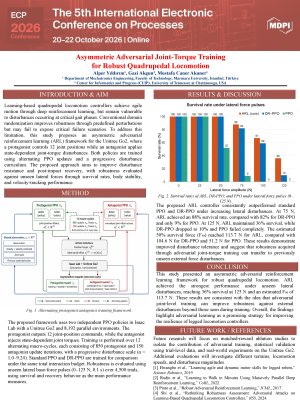
The operational capability of legged robots in dynamic and unpredictable real-world environments depends heavily on their resilience and capacity to withstand severe external perturbations. To elevate the disturbance rejection and physical robustness of the Unitree Go2 quadruped robot to extreme levels, this study proposes an innovative asymmetric Adversarial Reinforcement Learning (ARL) framework founded upon the core principle of "learning through sabotage." Unlike conventional adversarial training paradigms that often rely on decoupled or overly complex network topologies, this framework uniquely features protagonist (controller) and antagonist (saboteur) agents that share a single, unified neural network architecture. This tightly integrated asymmetric structure enables the saboteur to rapidly discover and exploit the controller's latent vulnerabilities through direct parameter sharing, allowing it to apply precise, strategic perturbing forces precisely at the most critical junctures of the gait cycle. The overall training process is systematically executed via a meticulously designed three-stage pipeline: a warm-up phase dedicated to foundational locomotion acquisition, a development phase aimed at building baseline controller resilience, and a competitive zero-sum game phase where the intelligent saboteur relentlessly focuses on destabilizing the robot. Deliberately unconstrained by conventional trade-offs such as energy efficiency or mechanical power optimization, the optimization objective focuses exclusively on high-fidelity command tracking and dynamic stability under duress. Comprehensive stress tests conducted within the high-fidelity Isaac Sim environment demonstrate that the proposed asymmetric ARL method significantly increases the robot's physical tipping threshold by 50% compared to standard domain randomization techniques, while successfully preserving robust trajectory tracking and balance under extreme, unforeseen perturbations.
Keywords
Quadrupedal Locomotion
Adversarial Reinforcement Learning (ARL)
Robustness
Perturbation Resistance
Sim-to-Real
Unitree Go2.
Poster
ARL_poster_ECP2026.pdf
Development of a VBA-Based Automation Tool for Performance Analysis and Diagnostic Monitoring of Automotive HVAC Systems
Machine Learning-Based Process Monitoring for Automated Crop Health Diagnosis in Precision Agriculture.