Event submissions
Published
This submission belongs to the session S4. Process Control, Monitoring and Machine Learning of the event The 5th International Electronic Conference on Processes
Published date
15 Oct, 2026
Academic Editor
'%3e%3cpath%20d='M12.6657%2010.9104C12.4185%2010.325%2012.0599%209.79327%2011.6097%209.34482C11.1609%208.89508%2010.6293%208.5365%2010.0442%208.28888C10.0389%208.28626%2010.0337%208.28495%2010.0285%208.28233C10.8446%207.69279%2011.3752%206.73249%2011.3752%205.64904C11.3752%203.8542%209.92103%202.39999%208.1262%202.39999C6.33136%202.39999%204.87715%203.8542%204.87715%205.64904C4.87715%206.73249%205.40774%207.69279%206.22393%208.28364C6.21869%208.28626%206.21345%208.28757%206.20821%208.29019C5.62129%208.5378%205.09463%208.89284%204.64265%209.34613C4.1929%209.79493%203.83432%2010.3266%203.58671%2010.9117C3.34345%2011.4845%203.21226%2012.0987%203.20023%2012.7209C3.19988%2012.7349%203.20233%2012.7488%203.20744%2012.7619C3.21255%2012.7749%203.22022%2012.7867%203.22998%2012.7968C3.23975%2012.8068%203.25142%2012.8147%203.26431%2012.8202C3.2772%2012.8256%203.29105%2012.8284%203.30504%2012.8284H4.09109C4.14874%2012.8284%204.19459%2012.7825%204.1959%2012.7262C4.2221%2011.7148%204.62823%2010.7676%205.34617%2010.0497C6.08899%209.30683%207.0755%208.89808%208.1262%208.89808C9.17689%208.89808%2010.1634%209.30683%2010.9062%2010.0497C11.6242%2010.7676%2012.0303%2011.7148%2012.0565%2012.7262C12.0578%2012.7838%2012.1037%2012.8284%2012.1613%2012.8284H12.9474C12.9613%2012.8284%2012.9752%2012.8256%2012.9881%2012.8202C13.001%2012.8147%2013.0126%2012.8068%2013.0224%2012.7968C13.0322%2012.7867%2013.0398%2012.7749%2013.0449%2012.7619C13.0501%2012.7488%2013.0525%2012.7349%2013.0522%2012.7209C13.0391%2012.0947%2012.9094%2011.4855%2012.6657%2010.9104ZM8.1262%207.9024C7.52486%207.9024%206.9589%207.6679%206.53312%207.24211C6.10733%206.81633%205.87283%206.25037%205.87283%205.64904C5.87283%205.0477%206.10733%204.48174%206.53312%204.05596C6.9589%203.63018%207.52486%203.39567%208.1262%203.39567C8.72753%203.39567%209.29349%203.63018%209.71927%204.05596C10.1451%204.48174%2010.3796%205.0477%2010.3796%205.64904C10.3796%206.25037%2010.1451%206.81633%209.71927%207.24211C9.29349%207.6679%208.72753%207.9024%208.1262%207.9024Z'%20fill='%235D1EE1'/%3e%3c/g%3e%3c/svg%3e) Ravendra Singh
Ravendra SinghCitation
Yechuri Sivaramakrishna, Pravallika Yechuri, Ganesh Miriyala, Machine Learning-Based Process Monitoring for Automated Crop Health Diagnosis in Precision Agriculture., in Proceedings of The 5th International Electronic Conference on Processes, 20 October–22 October 2026, MDPI: Basel, Switzerland
Share
Email
Facebook
Twitter
LinkedIn
Machine Learning-Based Process Monitoring for Automated Crop Health Diagnosis in Precision Agriculture.
'%3e%3cpath%20d='M12.6647%2010.9104C12.4176%2010.325%2012.0589%209.7933%2011.6088%209.34485C11.16%208.89511%2010.6283%208.53653%2010.0432%208.28891C10.038%208.28629%2010.0327%208.28498%2010.0275%208.28236C10.8437%207.69282%2011.3743%206.73252%2011.3743%205.64907C11.3743%203.85423%209.92005%202.40002%208.12522%202.40002C6.33038%202.40002%204.87618%203.85423%204.87618%205.64907C4.87618%206.73252%205.40677%207.69282%206.22296%208.28367C6.21772%208.28629%206.21248%208.2876%206.20724%208.29022C5.62031%208.53783%205.09365%208.89287%204.64167%209.34616C4.19192%209.79496%203.83334%2010.3266%203.58573%2010.9117C3.34247%2011.4846%203.21128%2012.0987%203.19925%2012.721C3.1989%2012.735%203.20135%2012.7489%203.20646%2012.7619C3.21157%2012.7749%203.21924%2012.7868%203.22901%2012.7968C3.23877%2012.8068%203.25045%2012.8148%203.26334%2012.8202C3.27623%2012.8256%203.29007%2012.8284%203.30406%2012.8284H4.09012C4.14776%2012.8284%204.19362%2012.7825%204.19493%2012.7262C4.22113%2011.7148%204.62726%2010.7676%205.34519%2010.0497C6.08802%209.30686%207.07452%208.89811%208.12522%208.89811C9.17592%208.89811%2010.1624%209.30686%2010.9052%2010.0497C11.6232%2010.7676%2012.0293%2011.7148%2012.0555%2012.7262C12.0568%2012.7839%2012.1027%2012.8284%2012.1603%2012.8284H12.9464C12.9604%2012.8284%2012.9742%2012.8256%2012.9871%2012.8202C13%2012.8148%2013.0117%2012.8068%2013.0214%2012.7968C13.0312%2012.7868%2013.0389%2012.7749%2013.044%2012.7619C13.0491%2012.7489%2013.0515%2012.735%2013.0512%2012.721C13.0381%2012.0947%2012.9084%2011.4856%2012.6647%2010.9104ZM8.12522%207.90243C7.52388%207.90243%206.95792%207.66793%206.53214%207.24215C6.10636%206.81636%205.87185%206.2504%205.87185%205.64907C5.87185%205.04773%206.10636%204.48177%206.53214%204.05599C6.95792%203.63021%207.52388%203.3957%208.12522%203.3957C8.72655%203.3957%209.29252%203.63021%209.7183%204.05599C10.1441%204.48177%2010.3786%205.04773%2010.3786%205.64907C10.3786%206.2504%2010.1441%206.81636%209.7183%207.24215C9.29252%207.66793%208.72655%207.90243%208.12522%207.90243Z'%20fill='%235D1EE1'/%3e%3c/g%3e%3c/svg%3e)
Yechuri Sivaramakrishna 1
Pravallika Yechuri 2
Ganesh Miriyala 1
1. Department of Electronics and Communication Engineering, MLR Institute of Technology (MLRIT), Hyderabad – 500 043, Telangana, India
2. Department of Computer Science and Engineering (CSE), MLR Institute of Technology (MLRIT), Hyderabad – 500 043, Telangana, India
Abstract
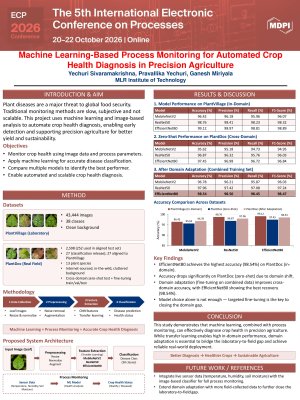
Continuous monitoring of crop health is essential for early disease detection, timely intervention, and efficient resource management in precision agriculture. Conventional manual inspection methods are labor-intensive, subjective, and difficult to scale across large agricultural environments, creating a need for automated and intelligent crop health monitoring systems. This paper proposes a Machine Learning-Based Process Monitoring Framework for automated crop disease diagnosis using transfer learning and deep convolutional neural networks. The proposed framework integrates image preprocessing, data augmentation, feature extraction, transfer learning, and disease classification into a unified image-based crop monitoring pipeline. Three pretrained convolutional neural network architectures, namely MobileNetV2, ResNet50, and EfficientNetB0, are comparatively evaluated to identify an effective balance between classification performance and computational efficiency. The PlantVillage dataset is divided into 80% training and 20% validation, while the PlantDoc dataset is reserved exclusively as an independent test set to evaluate model generalization. Since both datasets primarily provide static leaf images, they are used to validate the core disease-classification component rather than directly measure temporal crop monitoring. Continuous monitoring is operationalized at the framework level through repeated acquisition and classification of leaf images, where each observation is processed to determine crop health status and support timely agricultural decisions. Experimental results demonstrate that EfficientNetB0 achieves the highest classification accuracy of 98.54%, with an approximate precision of 98.50%, recall of 98.45%, and F1-score of 98.47% on the independent PlantDoc test dataset. The selected model contains approximately 5.3 million parameters, requires approximately 21 MB of storage, and achieves an average inference latency of approximately 25 ms per image, indicating a favorable balance between classification performance and computational requirements. The results demonstrate that transfer learning provides highly accurate crop disease recognition while reducing the computational requirements associated with training deep learning models from scratch. The proposed framework therefore provides a practical foundation for image-based crop health monitoring, with potential applications in edge-assisted agricultural systems, mobile applications, and intelligent precision farming platforms.
Keywords
Process Monitoring
Machine Learning Precision Agriculture
Crop Health Diagnosis
Transfer Learning
Deep Learning
Smart Farming
Decision Support.
Poster
Precision_Agriculture_ML_Poster_ECP2026.pdf
Learning Robust Quadrupedal Locomotion via Asymmetric Adversarial Sabotage
Adaptive Local SNR-Guided Signal–Noise Boundary Detection for Intelligent Signal Monitoring and Robust Hybrid Denoising