Event submissions
Published
This submission belongs to the session S6. Mathematical Analysis and Statistics of the event The 1st International Online Conference on Symmetry
Published date
15 Oct, 2026
Academic Editor
'%3e%3cpath%20d='M12.6657%2010.9104C12.4185%2010.325%2012.0599%209.79327%2011.6097%209.34482C11.1609%208.89508%2010.6293%208.5365%2010.0442%208.28888C10.0389%208.28626%2010.0337%208.28495%2010.0285%208.28233C10.8446%207.69279%2011.3752%206.73249%2011.3752%205.64904C11.3752%203.8542%209.92103%202.39999%208.1262%202.39999C6.33136%202.39999%204.87715%203.8542%204.87715%205.64904C4.87715%206.73249%205.40774%207.69279%206.22393%208.28364C6.21869%208.28626%206.21345%208.28757%206.20821%208.29019C5.62129%208.5378%205.09463%208.89284%204.64265%209.34613C4.1929%209.79493%203.83432%2010.3266%203.58671%2010.9117C3.34345%2011.4845%203.21226%2012.0987%203.20023%2012.7209C3.19988%2012.7349%203.20233%2012.7488%203.20744%2012.7619C3.21255%2012.7749%203.22022%2012.7867%203.22998%2012.7968C3.23975%2012.8068%203.25142%2012.8147%203.26431%2012.8202C3.2772%2012.8256%203.29105%2012.8284%203.30504%2012.8284H4.09109C4.14874%2012.8284%204.19459%2012.7825%204.1959%2012.7262C4.2221%2011.7148%204.62823%2010.7676%205.34617%2010.0497C6.08899%209.30683%207.0755%208.89808%208.1262%208.89808C9.17689%208.89808%2010.1634%209.30683%2010.9062%2010.0497C11.6242%2010.7676%2012.0303%2011.7148%2012.0565%2012.7262C12.0578%2012.7838%2012.1037%2012.8284%2012.1613%2012.8284H12.9474C12.9613%2012.8284%2012.9752%2012.8256%2012.9881%2012.8202C13.001%2012.8147%2013.0126%2012.8068%2013.0224%2012.7968C13.0322%2012.7867%2013.0398%2012.7749%2013.0449%2012.7619C13.0501%2012.7488%2013.0525%2012.7349%2013.0522%2012.7209C13.0391%2012.0947%2012.9094%2011.4855%2012.6657%2010.9104ZM8.1262%207.9024C7.52486%207.9024%206.9589%207.6679%206.53312%207.24211C6.10733%206.81633%205.87283%206.25037%205.87283%205.64904C5.87283%205.0477%206.10733%204.48174%206.53312%204.05596C6.9589%203.63018%207.52486%203.39567%208.1262%203.39567C8.72753%203.39567%209.29349%203.63018%209.71927%204.05596C10.1451%204.48174%2010.3796%205.0477%2010.3796%205.64904C10.3796%206.25037%2010.1451%206.81633%209.71927%207.24211C9.29349%207.6679%208.72753%207.9024%208.1262%207.9024Z'%20fill='%235D1EE1'/%3e%3c/g%3e%3c/svg%3e) Calogero Vetro
Calogero VetroCitation
Abdul Al Shorif, Azizur Rahman, Rumana Rois, Grouped Robust Functional Time Series Forecasting Model of Mortality Rates: A case study of Matlab Health and Demographic Surveillance System, Bangladesh, in Proceedings of The 1st International Online Conference on Symmetry, 20 October–22 October 2026, MDPI: Basel, Switzerland
Share
Email
Facebook
Twitter
LinkedIn
Grouped Robust Functional Time Series Forecasting Model of Mortality Rates: A case study of Matlab Health and Demographic Surveillance System, Bangladesh
'%3e%3cpath%20d='M12.6647%2010.9104C12.4176%2010.325%2012.0589%209.7933%2011.6088%209.34485C11.16%208.89511%2010.6283%208.53653%2010.0432%208.28891C10.038%208.28629%2010.0327%208.28498%2010.0275%208.28236C10.8437%207.69282%2011.3743%206.73252%2011.3743%205.64907C11.3743%203.85423%209.92005%202.40002%208.12522%202.40002C6.33038%202.40002%204.87618%203.85423%204.87618%205.64907C4.87618%206.73252%205.40677%207.69282%206.22296%208.28367C6.21772%208.28629%206.21248%208.2876%206.20724%208.29022C5.62031%208.53783%205.09365%208.89287%204.64167%209.34616C4.19192%209.79496%203.83334%2010.3266%203.58573%2010.9117C3.34247%2011.4846%203.21128%2012.0987%203.19925%2012.721C3.1989%2012.735%203.20135%2012.7489%203.20646%2012.7619C3.21157%2012.7749%203.21924%2012.7868%203.22901%2012.7968C3.23877%2012.8068%203.25045%2012.8148%203.26334%2012.8202C3.27623%2012.8256%203.29007%2012.8284%203.30406%2012.8284H4.09012C4.14776%2012.8284%204.19362%2012.7825%204.19493%2012.7262C4.22113%2011.7148%204.62726%2010.7676%205.34519%2010.0497C6.08802%209.30686%207.07452%208.89811%208.12522%208.89811C9.17592%208.89811%2010.1624%209.30686%2010.9052%2010.0497C11.6232%2010.7676%2012.0293%2011.7148%2012.0555%2012.7262C12.0568%2012.7839%2012.1027%2012.8284%2012.1603%2012.8284H12.9464C12.9604%2012.8284%2012.9742%2012.8256%2012.9871%2012.8202C13%2012.8148%2013.0117%2012.8068%2013.0214%2012.7968C13.0312%2012.7868%2013.0389%2012.7749%2013.044%2012.7619C13.0491%2012.7489%2013.0515%2012.735%2013.0512%2012.721C13.0381%2012.0947%2012.9084%2011.4856%2012.6647%2010.9104ZM8.12522%207.90243C7.52388%207.90243%206.95792%207.66793%206.53214%207.24215C6.10636%206.81636%205.87185%206.2504%205.87185%205.64907C5.87185%205.04773%206.10636%204.48177%206.53214%204.05599C6.95792%203.63021%207.52388%203.3957%208.12522%203.3957C8.72655%203.3957%209.29252%203.63021%209.7183%204.05599C10.1441%204.48177%2010.3786%205.04773%2010.3786%205.64907C10.3786%206.2504%2010.1441%206.81636%209.7183%207.24215C9.29252%207.66793%208.72655%207.90243%208.12522%207.90243Z'%20fill='%235D1EE1'/%3e%3c/g%3e%3c/svg%3e)
Abdul Al Shorif 1
Azizur Rahman 2
Rumana Rois 1
1. Department of Statistics and Data Science, Jahangirnagar University, Dhaka-1342, Bangladesh
2. Social Innovation Office, Government of Manitoba, Manitoba, Canada
Abstract
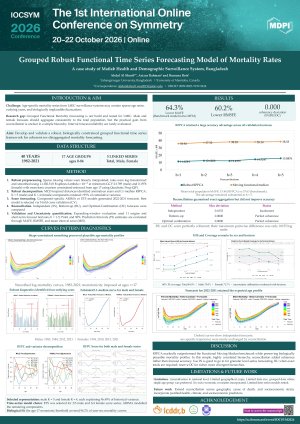
Age-specific mortality rates in low- and middle-income countries (LMICs) are often disaggregated by sex, requiring forecasts that maintain hierarchical coherency while respecting biological constraints. We applied robust grouped functional time series forecasting methods to 40 years’ (1982-2021) worth of mortality data from the Matlab HDSS in Bangladesh, extending the Shang and Hyndman (2017) framework with robust statistical techniques suited to demographic surveillance data. Our approach combines: (1) empirically determined monotonicity constraints ensuring biologically plausible age-mortality profiles, (2) robust functional principal component analysis (RFPCA) with L1-median centering and MCD -nspired outlier detection, and (3) hierarchical forecast reconciliation via bottom-up and optimal combination methods ensuring male and female forecasts aggregate to total population projections. A total of eight B-spline basis functions with an monotonic mortality threshold of 17 years is empirically determined and applied. MCD procedures identified 10% of years as anomalous and selected K=5 for male and K=4 for female PC, explaining >95% of historical variance. Exponential smoothing models dominated univariate forecasts of component scores. All reconciliation methods produced almost identical results due to naturally coherent sex-specific forecasts in this simple hierarchical structure. The bootstrap 80% PI produced an overall (average of 10 horizons) mean interval width of 0.4674 and 0.5943 for males and females, respectively, at the log scale. The point forecast accuracy yielded mean (average of 5 horizons) MAFEs of 13.44, 16.06, and 19.35 units for the total, male, and female populations, respectively, which produced a 64.3% error reduction compared to the naïve moving median method. We found monotonic deterioration with forecast horizon across all three series. Total population MIS rises 41%, from 59.13 at h = 1 to 83.36 at h = 5. MIS rises by 38% for males and 31% for females. Empirical coverage assessment yielded 84.9%, 75.0%, and 71.7% coverage for the total, male, and female populations (target: 80%). COVID-19 pandemic impact analysis revealed mortality declines of 16.4%, 13.8%, and 19.3% for the total, male, and female populations during 2020-2021. The permutation tests found no significant functional differences (p=0.094-0.181) across only 2 post-pandemic years. This approach demonstrates that grouped functional time series forecasting enhanced with robust techniques provides a coherent framework for demographic projections in surveillance settings, with implications for the INDEPTH network's more than 50 HDSS sites globally.
Keywords
Functional time series
hierarchical forecasting
mortality forecasting
robust statistics
Bangladesh
health and demographic surveillance
COVID-19 impact
Poster
IOCSYM2026_Mortality_Forecasting_Poster_Abdul_Al_Shorif.pdf
Optimization of Laser Cutting Parameters Considering Quality and Sustainability
Establishment of Fixed-Point Results via a Triplet of Auxiliary Functions in Relational Partial Metric Spaces