Event submissions
Published
This submission belongs to the session S1. Environmental and Green Processes of the event The 5th International Electronic Conference on Processes
Published date
15 Oct, 2026
Academic Editor
'%3e%3cpath%20d='M12.6657%2010.9104C12.4185%2010.325%2012.0599%209.79327%2011.6097%209.34482C11.1609%208.89508%2010.6293%208.5365%2010.0442%208.28888C10.0389%208.28626%2010.0337%208.28495%2010.0285%208.28233C10.8446%207.69279%2011.3752%206.73249%2011.3752%205.64904C11.3752%203.8542%209.92103%202.39999%208.1262%202.39999C6.33136%202.39999%204.87715%203.8542%204.87715%205.64904C4.87715%206.73249%205.40774%207.69279%206.22393%208.28364C6.21869%208.28626%206.21345%208.28757%206.20821%208.29019C5.62129%208.5378%205.09463%208.89284%204.64265%209.34613C4.1929%209.79493%203.83432%2010.3266%203.58671%2010.9117C3.34345%2011.4845%203.21226%2012.0987%203.20023%2012.7209C3.19988%2012.7349%203.20233%2012.7488%203.20744%2012.7619C3.21255%2012.7749%203.22022%2012.7867%203.22998%2012.7968C3.23975%2012.8068%203.25142%2012.8147%203.26431%2012.8202C3.2772%2012.8256%203.29105%2012.8284%203.30504%2012.8284H4.09109C4.14874%2012.8284%204.19459%2012.7825%204.1959%2012.7262C4.2221%2011.7148%204.62823%2010.7676%205.34617%2010.0497C6.08899%209.30683%207.0755%208.89808%208.1262%208.89808C9.17689%208.89808%2010.1634%209.30683%2010.9062%2010.0497C11.6242%2010.7676%2012.0303%2011.7148%2012.0565%2012.7262C12.0578%2012.7838%2012.1037%2012.8284%2012.1613%2012.8284H12.9474C12.9613%2012.8284%2012.9752%2012.8256%2012.9881%2012.8202C13.001%2012.8147%2013.0126%2012.8068%2013.0224%2012.7968C13.0322%2012.7867%2013.0398%2012.7749%2013.0449%2012.7619C13.0501%2012.7488%2013.0525%2012.7349%2013.0522%2012.7209C13.0391%2012.0947%2012.9094%2011.4855%2012.6657%2010.9104ZM8.1262%207.9024C7.52486%207.9024%206.9589%207.6679%206.53312%207.24211C6.10733%206.81633%205.87283%206.25037%205.87283%205.64904C5.87283%205.0477%206.10733%204.48174%206.53312%204.05596C6.9589%203.63018%207.52486%203.39567%208.1262%203.39567C8.72753%203.39567%209.29349%203.63018%209.71927%204.05596C10.1451%204.48174%2010.3796%205.0477%2010.3796%205.64904C10.3796%206.25037%2010.1451%206.81633%209.71927%207.24211C9.29349%207.6679%208.72753%207.9024%208.1262%207.9024Z'%20fill='%235D1EE1'/%3e%3c/g%3e%3c/svg%3e) Juan Francisco García Martín
Juan Francisco García MartínCitation
Jelena Milinković Budinčić, Lidija Petrović, Željana Radonić, Jadranka Fraj, Sandra Bučko, Ljiljana Spasojević, Jelena Ostojić, Mina Bosnić, Jaroslav Katona, Development and rheological evaluation of chitosan/hyaluronic acid polyelectrolyte complex hydrogels, in Proceedings of The 5th International Electronic Conference on Processes, 20 October–22 October 2026, MDPI: Basel, Switzerland
Share
Email
Facebook
Twitter
LinkedIn
Development and rheological evaluation of chitosan/hyaluronic acid polyelectrolyte complex hydrogels
'%3e%3cpath%20d='M12.6647%2010.9104C12.4176%2010.325%2012.0589%209.7933%2011.6088%209.34485C11.16%208.89511%2010.6283%208.53653%2010.0432%208.28891C10.038%208.28629%2010.0327%208.28498%2010.0275%208.28236C10.8437%207.69282%2011.3743%206.73252%2011.3743%205.64907C11.3743%203.85423%209.92005%202.40002%208.12522%202.40002C6.33038%202.40002%204.87618%203.85423%204.87618%205.64907C4.87618%206.73252%205.40677%207.69282%206.22296%208.28367C6.21772%208.28629%206.21248%208.2876%206.20724%208.29022C5.62031%208.53783%205.09365%208.89287%204.64167%209.34616C4.19192%209.79496%203.83334%2010.3266%203.58573%2010.9117C3.34247%2011.4846%203.21128%2012.0987%203.19925%2012.721C3.1989%2012.735%203.20135%2012.7489%203.20646%2012.7619C3.21157%2012.7749%203.21924%2012.7868%203.22901%2012.7968C3.23877%2012.8068%203.25045%2012.8148%203.26334%2012.8202C3.27623%2012.8256%203.29007%2012.8284%203.30406%2012.8284H4.09012C4.14776%2012.8284%204.19362%2012.7825%204.19493%2012.7262C4.22113%2011.7148%204.62726%2010.7676%205.34519%2010.0497C6.08802%209.30686%207.07452%208.89811%208.12522%208.89811C9.17592%208.89811%2010.1624%209.30686%2010.9052%2010.0497C11.6232%2010.7676%2012.0293%2011.7148%2012.0555%2012.7262C12.0568%2012.7839%2012.1027%2012.8284%2012.1603%2012.8284H12.9464C12.9604%2012.8284%2012.9742%2012.8256%2012.9871%2012.8202C13%2012.8148%2013.0117%2012.8068%2013.0214%2012.7968C13.0312%2012.7868%2013.0389%2012.7749%2013.044%2012.7619C13.0491%2012.7489%2013.0515%2012.735%2013.0512%2012.721C13.0381%2012.0947%2012.9084%2011.4856%2012.6647%2010.9104ZM8.12522%207.90243C7.52388%207.90243%206.95792%207.66793%206.53214%207.24215C6.10636%206.81636%205.87185%206.2504%205.87185%205.64907C5.87185%205.04773%206.10636%204.48177%206.53214%204.05599C6.95792%203.63021%207.52388%203.3957%208.12522%203.3957C8.72655%203.3957%209.29252%203.63021%209.7183%204.05599C10.1441%204.48177%2010.3786%205.04773%2010.3786%205.64907C10.3786%206.2504%2010.1441%206.81636%209.7183%207.24215C9.29252%207.66793%208.72655%207.90243%208.12522%207.90243Z'%20fill='%235D1EE1'/%3e%3c/g%3e%3c/svg%3e)
Jelena Milinković Budinčić 1
Lidija Petrović 1
Željana Radonić 1
Jadranka Fraj 1
Sandra Bučko 2
Ljiljana Spasojević 2
Jelena Ostojić 2
Mina Bosnić 1

Jaroslav Katona 2
1. Department of Pharmaceutical Engineering, Faculty of Technology Novi Sad, University of Novi Sad, 21102 Novi Sad, Serbia
2. Department of Applied and Engineering Chemistry, Faculty of Technology Novi Sad, University of Novi Sad, 21101 Novi Sad, Serbia
Abstract
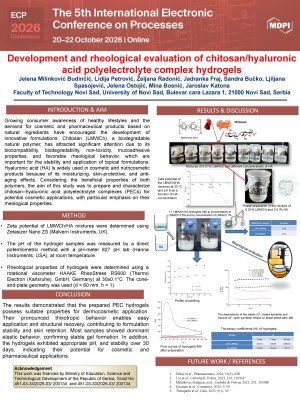
Growing consumer demand for sustainable cosmetic and pharmaceutical products has driven the development of environmentally friendly formulations based on biodegradable and bio-based materials. Among natural polymers, chitosan has attracted considerable attention due to its biocompatibility, biodegradability, non-toxicity, high charge density, and mucoadhesive properties, while hyaluronic acid is widely used for its moisturizing, skin-protective, and anti-aging effects. Combining the beneficial properties of both biopolymers, this study focused on the preparation and characterization of chitosan–hyaluronic acid polyelectrolyte complexes (PECs) as promising green materials for sustainable cosmetic applications.
The zeta potential of low molecular weight chitosan (LMWCh) and hyaluronic acid (HA) mixtures was initially determined to identify the optimal ratio for PEC formation. Based on these results and the negative charge of the stratum corneum surface, a 1:1 (LMWCh:HA) ratio was selected for hydrogel preparation. The resulting PEC hydrogels were then characterized by organoleptic evaluation, rheological analysis, pH measurement, swelling and stability testing.
The results showed that the investigated hydrogels were stable and exhibited favorable sensory properties. They had a homogeneous structure, formed a thin film on the skin, and provided a pleasant feel. The pH values of the hydrogels containing 0.5% and 1% LMWCh were 5.98 and 6.02, respectively, and were therefore considered suitable for skin application without risk of irritation. Rheological studies confirmed thixotropic behavior, with thixotropy coefficients of 442 and 247 for the hydrogels containing 0.5% and 1% LMWCh, respectively, which is favorable for skin application. Swelling tests showed higher water absorption in the sample containing 0.5% LMWCh. After 30 days, the PEC hydrogels remained thixotropic but became firmer, most likely due to water loss over time.
The obtained results demonstrated that the prepared PEC hydrogels possess favorable physicochemical and functional properties, indicating their potential for application in the pharmaceutical and cosmetic industries.
Keywords
chitosan
hyaluronic acid
hydrogels
rheology
Poster
Development and rheological evaluation of chitosan hyaluronic acid polyelectrolyte complex hydrogels.pdf
Research on the Mechanism and Process Optimization for Efficient Recovery of Rare Earth Elements from Waste Light-Emitting Diodes
Environmental Performance of Electricity Generation Systems in OECD Countries: A DEA-Based Assessment