Event submissions
Published
This submission belongs to the session S1. Environmental and Green Processes of the event The 5th International Electronic Conference on Processes
Published date
15 Oct, 2026
Academic Editor
'%3e%3cpath%20d='M12.6657%2010.9104C12.4185%2010.325%2012.0599%209.79327%2011.6097%209.34482C11.1609%208.89508%2010.6293%208.5365%2010.0442%208.28888C10.0389%208.28626%2010.0337%208.28495%2010.0285%208.28233C10.8446%207.69279%2011.3752%206.73249%2011.3752%205.64904C11.3752%203.8542%209.92103%202.39999%208.1262%202.39999C6.33136%202.39999%204.87715%203.8542%204.87715%205.64904C4.87715%206.73249%205.40774%207.69279%206.22393%208.28364C6.21869%208.28626%206.21345%208.28757%206.20821%208.29019C5.62129%208.5378%205.09463%208.89284%204.64265%209.34613C4.1929%209.79493%203.83432%2010.3266%203.58671%2010.9117C3.34345%2011.4845%203.21226%2012.0987%203.20023%2012.7209C3.19988%2012.7349%203.20233%2012.7488%203.20744%2012.7619C3.21255%2012.7749%203.22022%2012.7867%203.22998%2012.7968C3.23975%2012.8068%203.25142%2012.8147%203.26431%2012.8202C3.2772%2012.8256%203.29105%2012.8284%203.30504%2012.8284H4.09109C4.14874%2012.8284%204.19459%2012.7825%204.1959%2012.7262C4.2221%2011.7148%204.62823%2010.7676%205.34617%2010.0497C6.08899%209.30683%207.0755%208.89808%208.1262%208.89808C9.17689%208.89808%2010.1634%209.30683%2010.9062%2010.0497C11.6242%2010.7676%2012.0303%2011.7148%2012.0565%2012.7262C12.0578%2012.7838%2012.1037%2012.8284%2012.1613%2012.8284H12.9474C12.9613%2012.8284%2012.9752%2012.8256%2012.9881%2012.8202C13.001%2012.8147%2013.0126%2012.8068%2013.0224%2012.7968C13.0322%2012.7867%2013.0398%2012.7749%2013.0449%2012.7619C13.0501%2012.7488%2013.0525%2012.7349%2013.0522%2012.7209C13.0391%2012.0947%2012.9094%2011.4855%2012.6657%2010.9104ZM8.1262%207.9024C7.52486%207.9024%206.9589%207.6679%206.53312%207.24211C6.10733%206.81633%205.87283%206.25037%205.87283%205.64904C5.87283%205.0477%206.10733%204.48174%206.53312%204.05596C6.9589%203.63018%207.52486%203.39567%208.1262%203.39567C8.72753%203.39567%209.29349%203.63018%209.71927%204.05596C10.1451%204.48174%2010.3796%205.0477%2010.3796%205.64904C10.3796%206.25037%2010.1451%206.81633%209.71927%207.24211C9.29349%207.6679%208.72753%207.9024%208.1262%207.9024Z'%20fill='%235D1EE1'/%3e%3c/g%3e%3c/svg%3e) Juan Francisco García Martín
Juan Francisco García MartínCitation
Dušica Jovanović, Daniela Šojić Merkulov, Vesna Despotović, Sabolč Bognar, Nina Finčur, When Light Meets Pharmaceuticals: Comparative Study of Photolysis and Photocatalysis, in Proceedings of The 5th International Electronic Conference on Processes, 20 October–22 October 2026, MDPI: Basel, Switzerland
Share
Email
Facebook
Twitter
LinkedIn
When Light Meets Pharmaceuticals: Comparative Study of Photolysis and Photocatalysis
'%3e%3cpath%20d='M12.6647%2010.9104C12.4176%2010.325%2012.0589%209.7933%2011.6088%209.34485C11.16%208.89511%2010.6283%208.53653%2010.0432%208.28891C10.038%208.28629%2010.0327%208.28498%2010.0275%208.28236C10.8437%207.69282%2011.3743%206.73252%2011.3743%205.64907C11.3743%203.85423%209.92005%202.40002%208.12522%202.40002C6.33038%202.40002%204.87618%203.85423%204.87618%205.64907C4.87618%206.73252%205.40677%207.69282%206.22296%208.28367C6.21772%208.28629%206.21248%208.2876%206.20724%208.29022C5.62031%208.53783%205.09365%208.89287%204.64167%209.34616C4.19192%209.79496%203.83334%2010.3266%203.58573%2010.9117C3.34247%2011.4846%203.21128%2012.0987%203.19925%2012.721C3.1989%2012.735%203.20135%2012.7489%203.20646%2012.7619C3.21157%2012.7749%203.21924%2012.7868%203.22901%2012.7968C3.23877%2012.8068%203.25045%2012.8148%203.26334%2012.8202C3.27623%2012.8256%203.29007%2012.8284%203.30406%2012.8284H4.09012C4.14776%2012.8284%204.19362%2012.7825%204.19493%2012.7262C4.22113%2011.7148%204.62726%2010.7676%205.34519%2010.0497C6.08802%209.30686%207.07452%208.89811%208.12522%208.89811C9.17592%208.89811%2010.1624%209.30686%2010.9052%2010.0497C11.6232%2010.7676%2012.0293%2011.7148%2012.0555%2012.7262C12.0568%2012.7839%2012.1027%2012.8284%2012.1603%2012.8284H12.9464C12.9604%2012.8284%2012.9742%2012.8256%2012.9871%2012.8202C13%2012.8148%2013.0117%2012.8068%2013.0214%2012.7968C13.0312%2012.7868%2013.0389%2012.7749%2013.044%2012.7619C13.0491%2012.7489%2013.0515%2012.735%2013.0512%2012.721C13.0381%2012.0947%2012.9084%2011.4856%2012.6647%2010.9104ZM8.12522%207.90243C7.52388%207.90243%206.95792%207.66793%206.53214%207.24215C6.10636%206.81636%205.87185%206.2504%205.87185%205.64907C5.87185%205.04773%206.10636%204.48177%206.53214%204.05599C6.95792%203.63021%207.52388%203.3957%208.12522%203.3957C8.72655%203.3957%209.29252%203.63021%209.7183%204.05599C10.1441%204.48177%2010.3786%205.04773%2010.3786%205.64907C10.3786%206.2504%2010.1441%206.81636%209.7183%207.24215C9.29252%207.66793%208.72655%207.90243%208.12522%207.90243Z'%20fill='%235D1EE1'/%3e%3c/g%3e%3c/svg%3e)
Dušica Jovanović 1

Daniela Šojić Merkulov 2
Vesna Despotović 2
Sabolč Bognar 2

Nina Finčur 2
1. Faculty of Sciences, University of Novi Sad, Novi Sad 21000, Serbia
2. Department of Chemistry, Biochemistry and Environmental Protection, University of Novi Sad Faculty of Sciences, Trg D. Obradovića 3, 21000 Novi Sad, Serbia
Abstract
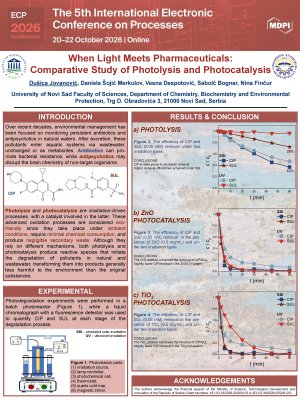
Over recent decades, environmental management has been focused on monitoring persistent antibiotics and antipsychotics in natural waters. After excretion, these pollutants enter aquatic systems via wastewater, unchanged or as metabolites. Antibiotics can promote bacterial resistance, while antipsychotics may disrupt the brain chemistry of non-target organisms.
Photolysis and photocatalysis are irradiation-driven processes, with a catalyst involved in the latter. These advanced oxidation processes are considered eco-friendly since they take place under ambient conditions, require minimal chemical consumption, and produce negligible secondary waste. Although they rely on different mechanisms, both photolysis and photocatalysis produce reactive species that initiate the degradation of pollutants in natural and wastewater, transforming them into products generally less harmful to the environment than the original substances.
Therefore, one fluoroquinolone antibiotic (ciprofloxacin, CIP) and one benzamide class antipsychotic (sulpiride, SUL) were pharmaceuticals selected for this study. Direct photolysis, ZnO and TiO2 heterogeneous photocatalysis, as three green processes, were utilized to evaluate pharmaceuticals removal under ultraviolet (UV) and simulated solar irradiation (SSI).
Photolytic experiments demonstrated that CIP is significantly more prone to photolytic removal under both irradiation types. Moreover, higher removal efficiencies of CIP and SUL were achieved under SSI (63 and 28%, respectively). Next, the results of heterogeneous photocatalysis revealed that the addition of ZnO/TiO2 enhanced the removal of CIP/SUL. Namely, ~100% of both pharmaceuticals was removed after 60 min of irradiation. The only exception were the CIP/ZnO/UV and CIP/TiO2/UV systems, which amounted to somewhat diminished, but still high CIP removal efficiencies (93 and 92%).
Acknowledgements
The authors acknowledge the financial support of the Ministry of Science, Technological Development and Innovation of the Republic of Serbia (Grant Numbers: 451-03-33/2026-03/200125 & 451-03-34/2026-03/200125).
Keywords
Antibiotic
Antipsychotic
Ciprofloxacin
Sulpiride
Photolysis
Photocatalysis
ZnO
TiO2
Poster
ECP2026_Dušica Jovanović_Poster PDF.pdf
Removal of copper (Cu), and cadmium (Cd) from binary system using eco-friendly cellulose nanocrystals gels derived from orange peels
Electrocatalytic Nitrate Reduction to Ammonia Over Pt-Fe3O4 Supported on Ni Foam Nanocomposite