Event submissions
Published
This submission belongs to the session S6. Energy Systems of the event The 5th International Electronic Conference on Processes
Published date
15 Oct, 2026
Academic Editor
'%3e%3cpath%20d='M12.6657%2010.9104C12.4185%2010.325%2012.0599%209.79327%2011.6097%209.34482C11.1609%208.89508%2010.6293%208.5365%2010.0442%208.28888C10.0389%208.28626%2010.0337%208.28495%2010.0285%208.28233C10.8446%207.69279%2011.3752%206.73249%2011.3752%205.64904C11.3752%203.8542%209.92103%202.39999%208.1262%202.39999C6.33136%202.39999%204.87715%203.8542%204.87715%205.64904C4.87715%206.73249%205.40774%207.69279%206.22393%208.28364C6.21869%208.28626%206.21345%208.28757%206.20821%208.29019C5.62129%208.5378%205.09463%208.89284%204.64265%209.34613C4.1929%209.79493%203.83432%2010.3266%203.58671%2010.9117C3.34345%2011.4845%203.21226%2012.0987%203.20023%2012.7209C3.19988%2012.7349%203.20233%2012.7488%203.20744%2012.7619C3.21255%2012.7749%203.22022%2012.7867%203.22998%2012.7968C3.23975%2012.8068%203.25142%2012.8147%203.26431%2012.8202C3.2772%2012.8256%203.29105%2012.8284%203.30504%2012.8284H4.09109C4.14874%2012.8284%204.19459%2012.7825%204.1959%2012.7262C4.2221%2011.7148%204.62823%2010.7676%205.34617%2010.0497C6.08899%209.30683%207.0755%208.89808%208.1262%208.89808C9.17689%208.89808%2010.1634%209.30683%2010.9062%2010.0497C11.6242%2010.7676%2012.0303%2011.7148%2012.0565%2012.7262C12.0578%2012.7838%2012.1037%2012.8284%2012.1613%2012.8284H12.9474C12.9613%2012.8284%2012.9752%2012.8256%2012.9881%2012.8202C13.001%2012.8147%2013.0126%2012.8068%2013.0224%2012.7968C13.0322%2012.7867%2013.0398%2012.7749%2013.0449%2012.7619C13.0501%2012.7488%2013.0525%2012.7349%2013.0522%2012.7209C13.0391%2012.0947%2012.9094%2011.4855%2012.6657%2010.9104ZM8.1262%207.9024C7.52486%207.9024%206.9589%207.6679%206.53312%207.24211C6.10733%206.81633%205.87283%206.25037%205.87283%205.64904C5.87283%205.0477%206.10733%204.48174%206.53312%204.05596C6.9589%203.63018%207.52486%203.39567%208.1262%203.39567C8.72753%203.39567%209.29349%203.63018%209.71927%204.05596C10.1451%204.48174%2010.3796%205.0477%2010.3796%205.64904C10.3796%206.25037%2010.1451%206.81633%209.71927%207.24211C9.29349%207.6679%208.72753%207.9024%208.1262%207.9024Z'%20fill='%235D1EE1'/%3e%3c/g%3e%3c/svg%3e) Michael C. Georgiadis
Michael C. GeorgiadisCitation
Joanna Kazimierowicz, Marcin Dębowski, Sequential Conversion of Tetraselmis subcordiformis Biomass into Hydrogen, Methane, and Bio-Oil for Renewable Energy Systems, in Proceedings of The 5th International Electronic Conference on Processes, 20 October–22 October 2026, MDPI: Basel, Switzerland
Share
Email
Facebook
Twitter
LinkedIn
Sequential Conversion of Tetraselmis subcordiformis Biomass into Hydrogen, Methane, and Bio-Oil for Renewable Energy Systems

Joanna Kazimierowicz 1

Marcin Dębowski 2
1. Department of Water Supply and Sewage Systems, Faculty of Civil Engineering and Environmental Sciences, Bialystok University of Technology, 15-351 Bialystok, Poland
2. Department of Environment Engineering, Faculty of Geoengineering, University of Warmia and Mazury in Olsztyn, Str. Oczapowskiego 5, 10-719 Olsztyn, Poland
Abstract
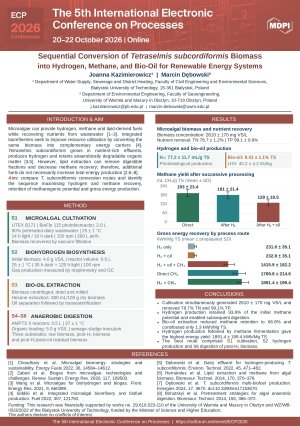
The development of renewable energy systems requires integrated processes that enable efficient conversion of biological resources into multiple energy carriers. Microalgae are promising bioenergy feedstocks due to their rapid growth, biochemical versatility, and potential for sequential conversion into different renewable fuels. However, most studies have focused on individual biofuel pathways rather than on maximizing energy recovery from the same biomass through integrated processing. This study evaluated alternative technological routes for converting Tetraselmis subcordiformis biomass into hydrogen, methane, and bio-oil, with emphasis on biomass utilization and gross energy recovery. Microalgae were cultivated in a photobioreactor, subjected to hydrogen biosynthesis, bio-oil extraction, and/or anaerobic digestion in different process sequences, and the energy outputs of the resulting carriers were compared. The final biomass concentration reached 2610 ± 170 mgVS/L. Hydrogen production was 77.2 ± 11.7 mL H2/gTS. Direct anaerobic digestion yielded 193 ± 23.4 mL CH₄/gTS, while biomass remaining after hydrogen production yielded 181 ± 21.4 mL CH4/gTS, retaining 93.8% of the methane-production potential of untreated biomass. After bio-oil extraction, methane yield decreased to 129 ± 19.5 mL CH₄/gTS, corresponding to 66.8% of the direct-digestion value. Bio-oil content was 8.41 ± 1.1%TS, with a calorific value of 40.2 ± 4.2 MJ/kg, but contributed only 1.3 kWh/MgTS to the gross energy output. The highest gross energy recovery was obtained for biomass production followed by hydrogen biosynthesis and anaerobic digestion, reaching 1891.4 ± 199.4 kWh/MgTS, compared with 1769.8 ± 214.6 kWh/MgTS for direct methane fermentation and 1415.9 kWh/MgTS for the hydrogen–bio-oil–methane sequence. The results show that process optimization should focus primarily on the selection and order of unit operations. Omitting the low-yield bio-oil extraction step and directing hydrogen-depleted biomass to anaerobic digestion maximized gross energy recovery while limiting losses in methanogenic potential.
Keywords
Tetraselmis subcordiformis
microalgal biomass
multi-biofuel production
sequential conversion
hydrogen production
methane fermentation
bio-oil
renewable energy systems
bioenergy recovery
process integration
Poster
ECP2026 Kazimierowicz, Debowski.pdf
Physics-Informed AI Framework for Waste Heat Recovery and Thermal Energy Optimization in Sustainable Laser Additive Manufacturing of Aerospace Components
M2PC for Quasi-Z-Source Inverter Fed by PV/ Battery Storage System-based Flying Squirrel Search Optimization (FSSO)