Event submissions
Published
This submission belongs to the session S6. Energy Systems of the event The 5th International Electronic Conference on Processes
Published date
15 Oct, 2026
Academic Editor
'%3e%3cpath%20d='M12.6657%2010.9104C12.4185%2010.325%2012.0599%209.79327%2011.6097%209.34482C11.1609%208.89508%2010.6293%208.5365%2010.0442%208.28888C10.0389%208.28626%2010.0337%208.28495%2010.0285%208.28233C10.8446%207.69279%2011.3752%206.73249%2011.3752%205.64904C11.3752%203.8542%209.92103%202.39999%208.1262%202.39999C6.33136%202.39999%204.87715%203.8542%204.87715%205.64904C4.87715%206.73249%205.40774%207.69279%206.22393%208.28364C6.21869%208.28626%206.21345%208.28757%206.20821%208.29019C5.62129%208.5378%205.09463%208.89284%204.64265%209.34613C4.1929%209.79493%203.83432%2010.3266%203.58671%2010.9117C3.34345%2011.4845%203.21226%2012.0987%203.20023%2012.7209C3.19988%2012.7349%203.20233%2012.7488%203.20744%2012.7619C3.21255%2012.7749%203.22022%2012.7867%203.22998%2012.7968C3.23975%2012.8068%203.25142%2012.8147%203.26431%2012.8202C3.2772%2012.8256%203.29105%2012.8284%203.30504%2012.8284H4.09109C4.14874%2012.8284%204.19459%2012.7825%204.1959%2012.7262C4.2221%2011.7148%204.62823%2010.7676%205.34617%2010.0497C6.08899%209.30683%207.0755%208.89808%208.1262%208.89808C9.17689%208.89808%2010.1634%209.30683%2010.9062%2010.0497C11.6242%2010.7676%2012.0303%2011.7148%2012.0565%2012.7262C12.0578%2012.7838%2012.1037%2012.8284%2012.1613%2012.8284H12.9474C12.9613%2012.8284%2012.9752%2012.8256%2012.9881%2012.8202C13.001%2012.8147%2013.0126%2012.8068%2013.0224%2012.7968C13.0322%2012.7867%2013.0398%2012.7749%2013.0449%2012.7619C13.0501%2012.7488%2013.0525%2012.7349%2013.0522%2012.7209C13.0391%2012.0947%2012.9094%2011.4855%2012.6657%2010.9104ZM8.1262%207.9024C7.52486%207.9024%206.9589%207.6679%206.53312%207.24211C6.10733%206.81633%205.87283%206.25037%205.87283%205.64904C5.87283%205.0477%206.10733%204.48174%206.53312%204.05596C6.9589%203.63018%207.52486%203.39567%208.1262%203.39567C8.72753%203.39567%209.29349%203.63018%209.71927%204.05596C10.1451%204.48174%2010.3796%205.0477%2010.3796%205.64904C10.3796%206.25037%2010.1451%206.81633%209.71927%207.24211C9.29349%207.6679%208.72753%207.9024%208.1262%207.9024Z'%20fill='%235D1EE1'/%3e%3c/g%3e%3c/svg%3e) Michael C. Georgiadis
Michael C. GeorgiadisCitation
VICTOR OMOEFE ADOGBEJI, Peter O Akindele, Olamide. Salami, Adekeye M Solomon, Shade O. Ademokoya, Mohsen Sharifpur, AI-Based Modeling and Predictive Analysis for Ternary Hybrid Nanofluids (THNFs) for Advanced Thermal Applications, in Proceedings of The 5th International Electronic Conference on Processes, 20 October–22 October 2026, MDPI: Basel, Switzerland
Share
Email
Facebook
Twitter
LinkedIn
AI-Based Modeling and Predictive Analysis for Ternary Hybrid Nanofluids (THNFs) for Advanced Thermal Applications
'%3e%3cpath%20d='M12.6647%2010.9104C12.4176%2010.325%2012.0589%209.7933%2011.6088%209.34485C11.16%208.89511%2010.6283%208.53653%2010.0432%208.28891C10.038%208.28629%2010.0327%208.28498%2010.0275%208.28236C10.8437%207.69282%2011.3743%206.73252%2011.3743%205.64907C11.3743%203.85423%209.92005%202.40002%208.12522%202.40002C6.33038%202.40002%204.87618%203.85423%204.87618%205.64907C4.87618%206.73252%205.40677%207.69282%206.22296%208.28367C6.21772%208.28629%206.21248%208.2876%206.20724%208.29022C5.62031%208.53783%205.09365%208.89287%204.64167%209.34616C4.19192%209.79496%203.83334%2010.3266%203.58573%2010.9117C3.34247%2011.4846%203.21128%2012.0987%203.19925%2012.721C3.1989%2012.735%203.20135%2012.7489%203.20646%2012.7619C3.21157%2012.7749%203.21924%2012.7868%203.22901%2012.7968C3.23877%2012.8068%203.25045%2012.8148%203.26334%2012.8202C3.27623%2012.8256%203.29007%2012.8284%203.30406%2012.8284H4.09012C4.14776%2012.8284%204.19362%2012.7825%204.19493%2012.7262C4.22113%2011.7148%204.62726%2010.7676%205.34519%2010.0497C6.08802%209.30686%207.07452%208.89811%208.12522%208.89811C9.17592%208.89811%2010.1624%209.30686%2010.9052%2010.0497C11.6232%2010.7676%2012.0293%2011.7148%2012.0555%2012.7262C12.0568%2012.7839%2012.1027%2012.8284%2012.1603%2012.8284H12.9464C12.9604%2012.8284%2012.9742%2012.8256%2012.9871%2012.8202C13%2012.8148%2013.0117%2012.8068%2013.0214%2012.7968C13.0312%2012.7868%2013.0389%2012.7749%2013.044%2012.7619C13.0491%2012.7489%2013.0515%2012.735%2013.0512%2012.721C13.0381%2012.0947%2012.9084%2011.4856%2012.6647%2010.9104ZM8.12522%207.90243C7.52388%207.90243%206.95792%207.66793%206.53214%207.24215C6.10636%206.81636%205.87185%206.2504%205.87185%205.64907C5.87185%205.04773%206.10636%204.48177%206.53214%204.05599C6.95792%203.63021%207.52388%203.3957%208.12522%203.3957C8.72655%203.3957%209.29252%203.63021%209.7183%204.05599C10.1441%204.48177%2010.3786%205.04773%2010.3786%205.64907C10.3786%206.2504%2010.1441%206.81636%209.7183%207.24215C9.29252%207.66793%208.72655%207.90243%208.12522%207.90243Z'%20fill='%235D1EE1'/%3e%3c/g%3e%3c/svg%3e)
VICTOR OMOEFE ADOGBEJI 1
Peter O Akindele 1
Olamide. Salami 1
Adekeye M Solomon 1
Shade O. Ademokoya 1
Mohsen Sharifpur 2,3,4,5
1. Department of Mechanical Engineering, Babcock University, Ilishan Remo, Nigeria
2. School of Mechanical, Industrial and Aeronautical Engineering, University of the Witwatersrand, Private Bag 3, Wits 2050, South Africa,
3. Department of Mechanical and Aeronautical Engineering, University of Pretoria, Pretoria, Private Bag X20, Hatfield, 0028, South Africa
4. Department of Medical Research, China Medical University, China Medical University Hospital, Taichung, Taiwan,
5. Artificial Intelligence Research Center Asia University, Taichung City, 41354, Taiwan
Abstract
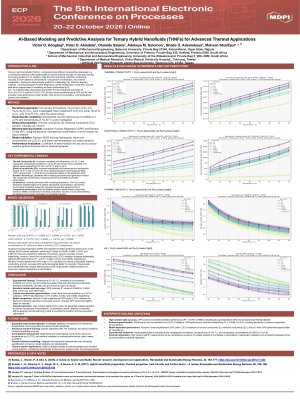
This study presents a comparative machine learning framework for predicting the thermal conductivity (k), electrical conductivity (EC), viscosity (μ), and pH of magnetic (Fe3O4/Al2O3/TiO2) and non-magnetic (Fe2O3/Al2O3/TiO2) ternary hybrid nanofluids as a function of temperature and nanoparticle concentration. Two regression algorithms were trained and evaluated on the same feature set: Gaussian Process Regression (GPR), a non-parametric Bayesian approach that models the underlying function as a distribution over possible fits, and Random Forest (RF) regression, an ensemble tree-based baseline. Model performance was assessed using the coefficient of determination (R²), root mean squared error (RMSE), and mean absolute error (MAE) for each of the four target properties. Gaussian Process Regression achieved higher R² and lower error than Random Forest for three of the four properties — thermal conductivity (R² = 0.797 vs. 0.770), viscosity (R² = 0.949 vs. 0.803), and pH (R² = 0.945 vs. 0.821) — while Random Forest achieved a marginally higher R² for electrical conductivity (0.803 vs. 0.787). These results indicate that Gaussian Process Regression is generally the stronger predictive model for this dataset, particularly for viscosity and pH, where it reduced RMSE by roughly half relative to Random Forest, while the two algorithms are effectively comparable for electrical conductivity. The findings support the use of Gaussian Process Regression as the primary surrogate model for thermophysical property prediction in ternary hybrid nanofluids, with Random Forest retained as a useful, more interpretable baseline for comparison.
Keywords
Keywords: Artificial Intelligence
Machine Learning
Predictive Modeling
Ternary Hybrid Nanofluids
Thermal Conductivity
Heat Transfer Enhancement
Thermophysical Properties
Advanced Thermal Applications.
Poster
ECP2026_THNF_Completed_Poster.pdf
Experiments and Numerical Analysis of Rollover Phenomena in LNG Storage Tanks for Rocket Launch Sites
Event-Aware Graph Neural Networks for Real-Time Optimal Power Dispatch in Distribution Microgrid