Event submissions
Published
This submission belongs to the session S3. Food Process Engineering of the event The 5th International Electronic Conference on Processes
Published date
15 Oct, 2026
Academic Editor
'%3e%3cpath%20d='M12.6657%2010.9104C12.4185%2010.325%2012.0599%209.79327%2011.6097%209.34482C11.1609%208.89508%2010.6293%208.5365%2010.0442%208.28888C10.0389%208.28626%2010.0337%208.28495%2010.0285%208.28233C10.8446%207.69279%2011.3752%206.73249%2011.3752%205.64904C11.3752%203.8542%209.92103%202.39999%208.1262%202.39999C6.33136%202.39999%204.87715%203.8542%204.87715%205.64904C4.87715%206.73249%205.40774%207.69279%206.22393%208.28364C6.21869%208.28626%206.21345%208.28757%206.20821%208.29019C5.62129%208.5378%205.09463%208.89284%204.64265%209.34613C4.1929%209.79493%203.83432%2010.3266%203.58671%2010.9117C3.34345%2011.4845%203.21226%2012.0987%203.20023%2012.7209C3.19988%2012.7349%203.20233%2012.7488%203.20744%2012.7619C3.21255%2012.7749%203.22022%2012.7867%203.22998%2012.7968C3.23975%2012.8068%203.25142%2012.8147%203.26431%2012.8202C3.2772%2012.8256%203.29105%2012.8284%203.30504%2012.8284H4.09109C4.14874%2012.8284%204.19459%2012.7825%204.1959%2012.7262C4.2221%2011.7148%204.62823%2010.7676%205.34617%2010.0497C6.08899%209.30683%207.0755%208.89808%208.1262%208.89808C9.17689%208.89808%2010.1634%209.30683%2010.9062%2010.0497C11.6242%2010.7676%2012.0303%2011.7148%2012.0565%2012.7262C12.0578%2012.7838%2012.1037%2012.8284%2012.1613%2012.8284H12.9474C12.9613%2012.8284%2012.9752%2012.8256%2012.9881%2012.8202C13.001%2012.8147%2013.0126%2012.8068%2013.0224%2012.7968C13.0322%2012.7867%2013.0398%2012.7749%2013.0449%2012.7619C13.0501%2012.7488%2013.0525%2012.7349%2013.0522%2012.7209C13.0391%2012.0947%2012.9094%2011.4855%2012.6657%2010.9104ZM8.1262%207.9024C7.52486%207.9024%206.9589%207.6679%206.53312%207.24211C6.10733%206.81633%205.87283%206.25037%205.87283%205.64904C5.87283%205.0477%206.10733%204.48174%206.53312%204.05596C6.9589%203.63018%207.52486%203.39567%208.1262%203.39567C8.72753%203.39567%209.29349%203.63018%209.71927%204.05596C10.1451%204.48174%2010.3796%205.0477%2010.3796%205.64904C10.3796%206.25037%2010.1451%206.81633%209.71927%207.24211C9.29349%207.6679%208.72753%207.9024%208.1262%207.9024Z'%20fill='%235D1EE1'/%3e%3c/g%3e%3c/svg%3e) Dariusz Dziki
Dariusz DzikiContribution&Funding
Conceptualization,
[Camilaa Aparecida Lessa Soares] ; [Luana Haeberlin] ; [Wellerson de Oliveira Alves da Silva]
Methodology,
[Camilaa Aparecida Lessa Soares]
Writing - review,
[editing] ; [Renata Cássia Campos] ; [Nathan Mickael de Bessa Cunha] ; [Lucas Gonzaga Fagundes] ; [Ítalo Esteves Lopes] ; [Thalya Aleixo Avelar] ; [Beatriz Costa Carvalho] ; [Lara Rabello Nunes]
Funding: The authors would like to thank CAPES (Coordination for the Improvement of Higher Education Personnel – Funding Code 001) and CNPq (National Council for Scientific and Technological Development).
Citation
Camilaa Aparecida Lessa Soares, Luana Haeberlin, Renata Cássia Campos, Wellerson de Oliveira Alves da Silva, Nathan Mickael de Bessa Cunha, Lucas Gonzaga Fagundes, Ítalo Esteves Lopes, Thalya Aleixo Avelar, Beatriz Costa Carvalho, Lara Rabello Nunes, Application of Computer Vision and Digital Feature Extraction in the Identification of Post-Harvest Deterioration in Pitaya (Hylocereus undatus), in Proceedings of The 5th International Electronic Conference on Processes, 20 October–22 October 2026, MDPI: Basel, Switzerland
Share
Email
Facebook
Twitter
LinkedIn
Application of Computer Vision and Digital Feature Extraction in the Identification of Post-Harvest Deterioration in Pitaya (Hylocereus undatus)
'%3e%3cpath%20d='M12.6647%2010.9104C12.4176%2010.325%2012.0589%209.7933%2011.6088%209.34485C11.16%208.89511%2010.6283%208.53653%2010.0432%208.28891C10.038%208.28629%2010.0327%208.28498%2010.0275%208.28236C10.8437%207.69282%2011.3743%206.73252%2011.3743%205.64907C11.3743%203.85423%209.92005%202.40002%208.12522%202.40002C6.33038%202.40002%204.87618%203.85423%204.87618%205.64907C4.87618%206.73252%205.40677%207.69282%206.22296%208.28367C6.21772%208.28629%206.21248%208.2876%206.20724%208.29022C5.62031%208.53783%205.09365%208.89287%204.64167%209.34616C4.19192%209.79496%203.83334%2010.3266%203.58573%2010.9117C3.34247%2011.4846%203.21128%2012.0987%203.19925%2012.721C3.1989%2012.735%203.20135%2012.7489%203.20646%2012.7619C3.21157%2012.7749%203.21924%2012.7868%203.22901%2012.7968C3.23877%2012.8068%203.25045%2012.8148%203.26334%2012.8202C3.27623%2012.8256%203.29007%2012.8284%203.30406%2012.8284H4.09012C4.14776%2012.8284%204.19362%2012.7825%204.19493%2012.7262C4.22113%2011.7148%204.62726%2010.7676%205.34519%2010.0497C6.08802%209.30686%207.07452%208.89811%208.12522%208.89811C9.17592%208.89811%2010.1624%209.30686%2010.9052%2010.0497C11.6232%2010.7676%2012.0293%2011.7148%2012.0555%2012.7262C12.0568%2012.7839%2012.1027%2012.8284%2012.1603%2012.8284H12.9464C12.9604%2012.8284%2012.9742%2012.8256%2012.9871%2012.8202C13%2012.8148%2013.0117%2012.8068%2013.0214%2012.7968C13.0312%2012.7868%2013.0389%2012.7749%2013.044%2012.7619C13.0491%2012.7489%2013.0515%2012.735%2013.0512%2012.721C13.0381%2012.0947%2012.9084%2011.4856%2012.6647%2010.9104ZM8.12522%207.90243C7.52388%207.90243%206.95792%207.66793%206.53214%207.24215C6.10636%206.81636%205.87185%206.2504%205.87185%205.64907C5.87185%205.04773%206.10636%204.48177%206.53214%204.05599C6.95792%203.63021%207.52388%203.3957%208.12522%203.3957C8.72655%203.3957%209.29252%203.63021%209.7183%204.05599C10.1441%204.48177%2010.3786%205.04773%2010.3786%205.64907C10.3786%206.2504%2010.1441%206.81636%209.7183%207.24215C9.29252%207.66793%208.72655%207.90243%208.12522%207.90243Z'%20fill='%235D1EE1'/%3e%3c/g%3e%3c/svg%3e)
Camilaa Aparecida Lessa Soares 1
Luana Haeberlin 2
Renata Cássia Campos 1
Wellerson de Oliveira Alves da Silva 1
Nathan Mickael de Bessa Cunha 1
Lucas Gonzaga Fagundes 1
Ítalo Esteves Lopes 1
Thalya Aleixo Avelar 1
Beatriz Costa Carvalho 1
Lara Rabello Nunes 1
1. Engenharia Agrícola, Universidade Federal de Viçosa, Viçosa, 36570-000, Brazil
2. Departamento Engenharia Agrícola, Universidade Federal de Viçosa, Viçosa, 36570-000, Brazil
Abstract
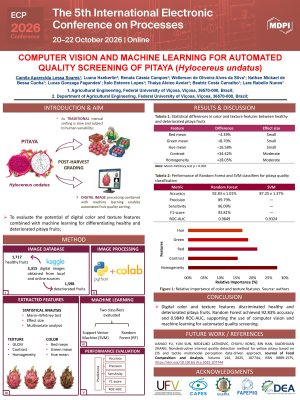
The pitaya (Hylocereus undatus) has high perishability and susceptibility to post-harvest pathogenic deterioration, resulting in economic losses during storage. As traditional manual sorting is slow and subject to human variability, this study evaluated the potential of digital color and texture features to differentiate healthy and deteriorated fruits. A database composed of 3,315 digital images was used, with 1,717 of healthy fruits and 1,598 of deteriorated fruits, obtained from local and internet sources available on the Kaggle platform. The images were processed in Python, in the Google Colab environment, to extract color features in RGB and HSV spaces and texture using the Gray Level Co-occurrence Matrix (GLCM). The averages of the red, green and hue channels were evaluated, in addition to the contrast and homogeneity descriptors. The five characteristics showed differences between classes according to the Mann-Whitney test (p < 0.001). Among the texture descriptors, contrast was 34.42% higher in deteriorated fruits, while homogeneity showed an increase of 28.05%, both with moderate effect sizes. Color characteristics showed smaller differences, with variations of -4.39%, +8.70%, and -16.58% for the means of red, green, and hue, respectively, and small effect sizes. Multivariate analysis indicated considerable overlap between classes. In the cross-validation classification, Random Forest outperformed SVM, with an accuracy of 92.83 ± 1.01%, precision of 89.79%, sensitivity of 96.09%, F1-score of 92.81%, and ROC-AUC of 0.9849, while SVM showed an accuracy of 87.25 ± 1.37% and an ROC-AUC of 0.9324. In Random Forest, homogeneity showed the highest relative importance for classification (27.65%), followed by the averages of red (21.47%) and green (18.63%), hue (16.85%), and texture contrast (15.40%). The results demonstrate that digital color and texture characteristics have discriminative capacity between healthy and deteriorated fruits, highlighting the potential of computer vision associated with machine learning for the automated quality screening of pitayas.
Keywords
Digital image processing Tropical fruit growing Color and texture descriptors
Poster
Banner_pitaya.pdf
Extension of a QuEChERS–UHPLC–QTOF-MS/MS Method for Tropane Alkaloid Determination in Maize Flour
Decoction-Based Extraction Conditions Governing Phenolic Recovery and Antioxidant Potential of Opuntia ficus indica