Event submissions
Published
This submission belongs to the session S3. Food Process Engineering of the event The 5th International Electronic Conference on Processes
Published date
15 Oct, 2026
Academic Editor
'%3e%3cpath%20d='M12.6657%2010.9104C12.4185%2010.325%2012.0599%209.79327%2011.6097%209.34482C11.1609%208.89508%2010.6293%208.5365%2010.0442%208.28888C10.0389%208.28626%2010.0337%208.28495%2010.0285%208.28233C10.8446%207.69279%2011.3752%206.73249%2011.3752%205.64904C11.3752%203.8542%209.92103%202.39999%208.1262%202.39999C6.33136%202.39999%204.87715%203.8542%204.87715%205.64904C4.87715%206.73249%205.40774%207.69279%206.22393%208.28364C6.21869%208.28626%206.21345%208.28757%206.20821%208.29019C5.62129%208.5378%205.09463%208.89284%204.64265%209.34613C4.1929%209.79493%203.83432%2010.3266%203.58671%2010.9117C3.34345%2011.4845%203.21226%2012.0987%203.20023%2012.7209C3.19988%2012.7349%203.20233%2012.7488%203.20744%2012.7619C3.21255%2012.7749%203.22022%2012.7867%203.22998%2012.7968C3.23975%2012.8068%203.25142%2012.8147%203.26431%2012.8202C3.2772%2012.8256%203.29105%2012.8284%203.30504%2012.8284H4.09109C4.14874%2012.8284%204.19459%2012.7825%204.1959%2012.7262C4.2221%2011.7148%204.62823%2010.7676%205.34617%2010.0497C6.08899%209.30683%207.0755%208.89808%208.1262%208.89808C9.17689%208.89808%2010.1634%209.30683%2010.9062%2010.0497C11.6242%2010.7676%2012.0303%2011.7148%2012.0565%2012.7262C12.0578%2012.7838%2012.1037%2012.8284%2012.1613%2012.8284H12.9474C12.9613%2012.8284%2012.9752%2012.8256%2012.9881%2012.8202C13.001%2012.8147%2013.0126%2012.8068%2013.0224%2012.7968C13.0322%2012.7867%2013.0398%2012.7749%2013.0449%2012.7619C13.0501%2012.7488%2013.0525%2012.7349%2013.0522%2012.7209C13.0391%2012.0947%2012.9094%2011.4855%2012.6657%2010.9104ZM8.1262%207.9024C7.52486%207.9024%206.9589%207.6679%206.53312%207.24211C6.10733%206.81633%205.87283%206.25037%205.87283%205.64904C5.87283%205.0477%206.10733%204.48174%206.53312%204.05596C6.9589%203.63018%207.52486%203.39567%208.1262%203.39567C8.72753%203.39567%209.29349%203.63018%209.71927%204.05596C10.1451%204.48174%2010.3796%205.0477%2010.3796%205.64904C10.3796%206.25037%2010.1451%206.81633%209.71927%207.24211C9.29349%207.6679%208.72753%207.9024%208.1262%207.9024Z'%20fill='%235D1EE1'/%3e%3c/g%3e%3c/svg%3e) Dariusz Dziki
Dariusz DzikiCitation
Walid Zeghbib, Fares BOUDJOUAN, asma ourabah, Decoction-Based Extraction Conditions Governing Phenolic Recovery and Antioxidant Potential of Opuntia ficus indica, in Proceedings of The 5th International Electronic Conference on Processes, 20 October–22 October 2026, MDPI: Basel, Switzerland
Share
Email
Facebook
Twitter
LinkedIn
Decoction-Based Extraction Conditions Governing Phenolic Recovery and Antioxidant Potential of Opuntia ficus indica
'%3e%3cpath%20d='M12.6647%2010.9104C12.4176%2010.325%2012.0589%209.7933%2011.6088%209.34485C11.16%208.89511%2010.6283%208.53653%2010.0432%208.28891C10.038%208.28629%2010.0327%208.28498%2010.0275%208.28236C10.8437%207.69282%2011.3743%206.73252%2011.3743%205.64907C11.3743%203.85423%209.92005%202.40002%208.12522%202.40002C6.33038%202.40002%204.87618%203.85423%204.87618%205.64907C4.87618%206.73252%205.40677%207.69282%206.22296%208.28367C6.21772%208.28629%206.21248%208.2876%206.20724%208.29022C5.62031%208.53783%205.09365%208.89287%204.64167%209.34616C4.19192%209.79496%203.83334%2010.3266%203.58573%2010.9117C3.34247%2011.4846%203.21128%2012.0987%203.19925%2012.721C3.1989%2012.735%203.20135%2012.7489%203.20646%2012.7619C3.21157%2012.7749%203.21924%2012.7868%203.22901%2012.7968C3.23877%2012.8068%203.25045%2012.8148%203.26334%2012.8202C3.27623%2012.8256%203.29007%2012.8284%203.30406%2012.8284H4.09012C4.14776%2012.8284%204.19362%2012.7825%204.19493%2012.7262C4.22113%2011.7148%204.62726%2010.7676%205.34519%2010.0497C6.08802%209.30686%207.07452%208.89811%208.12522%208.89811C9.17592%208.89811%2010.1624%209.30686%2010.9052%2010.0497C11.6232%2010.7676%2012.0293%2011.7148%2012.0555%2012.7262C12.0568%2012.7839%2012.1027%2012.8284%2012.1603%2012.8284H12.9464C12.9604%2012.8284%2012.9742%2012.8256%2012.9871%2012.8202C13%2012.8148%2013.0117%2012.8068%2013.0214%2012.7968C13.0312%2012.7868%2013.0389%2012.7749%2013.044%2012.7619C13.0491%2012.7489%2013.0515%2012.735%2013.0512%2012.721C13.0381%2012.0947%2012.9084%2011.4856%2012.6647%2010.9104ZM8.12522%207.90243C7.52388%207.90243%206.95792%207.66793%206.53214%207.24215C6.10636%206.81636%205.87185%206.2504%205.87185%205.64907C5.87185%205.04773%206.10636%204.48177%206.53214%204.05599C6.95792%203.63021%207.52388%203.3957%208.12522%203.3957C8.72655%203.3957%209.29252%203.63021%209.7183%204.05599C10.1441%204.48177%2010.3786%205.04773%2010.3786%205.64907C10.3786%206.2504%2010.1441%206.81636%209.7183%207.24215C9.29252%207.66793%208.72655%207.90243%208.12522%207.90243Z'%20fill='%235D1EE1'/%3e%3c/g%3e%3c/svg%3e)
Walid Zeghbib 1

Fares BOUDJOUAN 2
asma ourabah 1
1. Faculté des Sciences de la Nature et de la Vie, Laboratoire de Biochimie Appliquée, Université de Bejaia, Bejaia, 06000, Algeria
2. Faculté de Technologie, Laboratoire de Génie dd l’Environnement, Université de Béjaia, Bejaia, 06000, Algeria
Abstract
Introduction and Aim
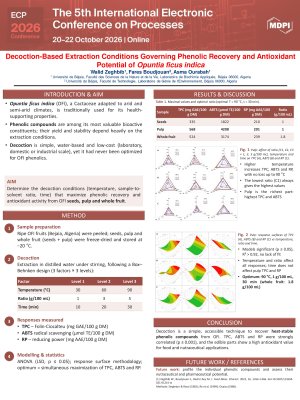
Phenolic compounds are important bioactive constituents from Opuntia ficus indica (OFI). Since the yield and stability of these compounds depend heavily on the extraction conditions applied, identifying a simple and cost-effective method to maximize their recovery is essential for the valorization of this plant. This work aimed to determine the decoction conditions temperature, sample-to-solvent ratio, and extraction time that maximize phenolic recovery and antioxidant activity from different parts of OFI.
Methodology
Seeds, pulp, and whole fruit of OFI were subjected to decoction extraction under varying temperature, sample-to-solvent ratio, and time conditions. Total phenolic content (TPC) was quantified, and antioxidant activity was assessed via ABTS radical scavenging and reducing power (RP) assays. The influence of each extraction parameter was statistically evaluated, and the extraction conditions were optimized using response surface methodology (RSM), with the optimization criterion defined as the simultaneous maximization of TPC, ABTS radical-scavenging activity, and RP.
Results
Maximal TPC values of 335, 568, and 524 mg GAE/100g DM were obtained for seeds, pulp, and whole fruit, respectively. Corresponding ABTS activities reached 1822, 4208, and 3174 µmol TE/100g DM, while RP values were 210, 201, and 239 mg AAE/100g DM. At a significance level of p < 0.05, all extraction parameters significantly influenced phenolic recovery and antioxidant activity, except for time, which had no significant effect on TPC and RP in the pulp. The optimal decoction conditions were established at 90 °C, a 1 g/100 mL sample-to-solvent ratio, and 30 min, with the whole fruit requiring a higher ratio of 1.8 g/100 mL.
Conclusion
These findings establish decoction as a suitable and accessible extraction technique for recovering heat-stable phenolic compounds from OFI, offering a practical route for enhancing the antioxidant value of this plant's edible parts for food and nutraceutical applications.
Keywords
Opuntia ficus indica; Decoction; Extraction conditions; Phenolic compounds; Antioxidant activity
Poster
poster ZEGHBIB et al_ECP2026.pdf
Application of Computer Vision and Digital Feature Extraction in the Identification of Post-Harvest Deterioration in Pitaya (Hylocereus undatus)
Structure–Function Characterization of Terminalia catappa (TC) Seed Lectin by Chemical and Spectroscopic Approaches