Event submissions
Published
This submission belongs to the session S3. Food Process Engineering of the event The 5th International Electronic Conference on Processes
Published date
15 Oct, 2026
Academic Editor
'%3e%3cpath%20d='M12.6657%2010.9104C12.4185%2010.325%2012.0599%209.79327%2011.6097%209.34482C11.1609%208.89508%2010.6293%208.5365%2010.0442%208.28888C10.0389%208.28626%2010.0337%208.28495%2010.0285%208.28233C10.8446%207.69279%2011.3752%206.73249%2011.3752%205.64904C11.3752%203.8542%209.92103%202.39999%208.1262%202.39999C6.33136%202.39999%204.87715%203.8542%204.87715%205.64904C4.87715%206.73249%205.40774%207.69279%206.22393%208.28364C6.21869%208.28626%206.21345%208.28757%206.20821%208.29019C5.62129%208.5378%205.09463%208.89284%204.64265%209.34613C4.1929%209.79493%203.83432%2010.3266%203.58671%2010.9117C3.34345%2011.4845%203.21226%2012.0987%203.20023%2012.7209C3.19988%2012.7349%203.20233%2012.7488%203.20744%2012.7619C3.21255%2012.7749%203.22022%2012.7867%203.22998%2012.7968C3.23975%2012.8068%203.25142%2012.8147%203.26431%2012.8202C3.2772%2012.8256%203.29105%2012.8284%203.30504%2012.8284H4.09109C4.14874%2012.8284%204.19459%2012.7825%204.1959%2012.7262C4.2221%2011.7148%204.62823%2010.7676%205.34617%2010.0497C6.08899%209.30683%207.0755%208.89808%208.1262%208.89808C9.17689%208.89808%2010.1634%209.30683%2010.9062%2010.0497C11.6242%2010.7676%2012.0303%2011.7148%2012.0565%2012.7262C12.0578%2012.7838%2012.1037%2012.8284%2012.1613%2012.8284H12.9474C12.9613%2012.8284%2012.9752%2012.8256%2012.9881%2012.8202C13.001%2012.8147%2013.0126%2012.8068%2013.0224%2012.7968C13.0322%2012.7867%2013.0398%2012.7749%2013.0449%2012.7619C13.0501%2012.7488%2013.0525%2012.7349%2013.0522%2012.7209C13.0391%2012.0947%2012.9094%2011.4855%2012.6657%2010.9104ZM8.1262%207.9024C7.52486%207.9024%206.9589%207.6679%206.53312%207.24211C6.10733%206.81633%205.87283%206.25037%205.87283%205.64904C5.87283%205.0477%206.10733%204.48174%206.53312%204.05596C6.9589%203.63018%207.52486%203.39567%208.1262%203.39567C8.72753%203.39567%209.29349%203.63018%209.71927%204.05596C10.1451%204.48174%2010.3796%205.0477%2010.3796%205.64904C10.3796%206.25037%2010.1451%206.81633%209.71927%207.24211C9.29349%207.6679%208.72753%207.9024%208.1262%207.9024Z'%20fill='%235D1EE1'/%3e%3c/g%3e%3c/svg%3e) Dariusz Dziki
Dariusz DzikiCitation
Linda Oluchi Akajiaku, Euphresia Nkiru Odimegwu, Chukwuma Munachiso Umelo, Anthonia E Uzoukwu, Godswill Kelechi Elemuo, Esther Ogheneofego Oviomo, Functional Properties of Cassava Starch–Mesquite Seed Flour Composite Blends for Prawn Cracker Production, in Proceedings of The 5th International Electronic Conference on Processes, 20 October–22 October 2026, MDPI: Basel, Switzerland
Share
Email
Facebook
Twitter
LinkedIn
Functional Properties of Cassava Starch–Mesquite Seed Flour Composite Blends for Prawn Cracker Production
'%3e%3cpath%20d='M12.6647%2010.9104C12.4176%2010.325%2012.0589%209.7933%2011.6088%209.34485C11.16%208.89511%2010.6283%208.53653%2010.0432%208.28891C10.038%208.28629%2010.0327%208.28498%2010.0275%208.28236C10.8437%207.69282%2011.3743%206.73252%2011.3743%205.64907C11.3743%203.85423%209.92005%202.40002%208.12522%202.40002C6.33038%202.40002%204.87618%203.85423%204.87618%205.64907C4.87618%206.73252%205.40677%207.69282%206.22296%208.28367C6.21772%208.28629%206.21248%208.2876%206.20724%208.29022C5.62031%208.53783%205.09365%208.89287%204.64167%209.34616C4.19192%209.79496%203.83334%2010.3266%203.58573%2010.9117C3.34247%2011.4846%203.21128%2012.0987%203.19925%2012.721C3.1989%2012.735%203.20135%2012.7489%203.20646%2012.7619C3.21157%2012.7749%203.21924%2012.7868%203.22901%2012.7968C3.23877%2012.8068%203.25045%2012.8148%203.26334%2012.8202C3.27623%2012.8256%203.29007%2012.8284%203.30406%2012.8284H4.09012C4.14776%2012.8284%204.19362%2012.7825%204.19493%2012.7262C4.22113%2011.7148%204.62726%2010.7676%205.34519%2010.0497C6.08802%209.30686%207.07452%208.89811%208.12522%208.89811C9.17592%208.89811%2010.1624%209.30686%2010.9052%2010.0497C11.6232%2010.7676%2012.0293%2011.7148%2012.0555%2012.7262C12.0568%2012.7839%2012.1027%2012.8284%2012.1603%2012.8284H12.9464C12.9604%2012.8284%2012.9742%2012.8256%2012.9871%2012.8202C13%2012.8148%2013.0117%2012.8068%2013.0214%2012.7968C13.0312%2012.7868%2013.0389%2012.7749%2013.044%2012.7619C13.0491%2012.7489%2013.0515%2012.735%2013.0512%2012.721C13.0381%2012.0947%2012.9084%2011.4856%2012.6647%2010.9104ZM8.12522%207.90243C7.52388%207.90243%206.95792%207.66793%206.53214%207.24215C6.10636%206.81636%205.87185%206.2504%205.87185%205.64907C5.87185%205.04773%206.10636%204.48177%206.53214%204.05599C6.95792%203.63021%207.52388%203.3957%208.12522%203.3957C8.72655%203.3957%209.29252%203.63021%209.7183%204.05599C10.1441%204.48177%2010.3786%205.04773%2010.3786%205.64907C10.3786%206.2504%2010.1441%206.81636%209.7183%207.24215C9.29252%207.66793%208.72655%207.90243%208.12522%207.90243Z'%20fill='%235D1EE1'/%3e%3c/g%3e%3c/svg%3e)
Linda Oluchi Akajiaku 1
Euphresia Nkiru Odimegwu 1
Chukwuma Munachiso Umelo 1
Anthonia E Uzoukwu 1
Godswill Kelechi Elemuo 1
Esther Ogheneofego Oviomo 1
1. Food Science and Technology, Federal University of Technology, P.M.B 1526, Owerri, Imo State, Nigeria, Owerri, Nigeria
Abstract
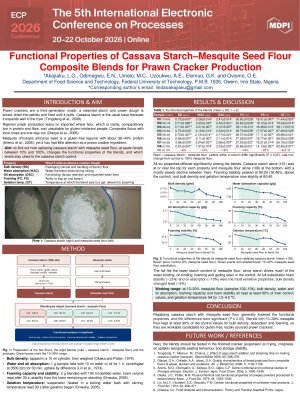
Wheat flour dependence in Nigeria's food industry is a major constraint on snack production, driven by high importation costs, its comparatively low protein and dietary fibre content, and gluten intolerance concerns associated with its use. This study evaluated the functional properties of composite blends of cassava starch and mesquite (Prosopis africana) seed flour formulated for prawn cracker production, with a view to identifying gluten-free, locally sourced alternatives to wheat-based snacks. Eight blends were prepared at cassava starch-to-mesquite flour ratios of 100:0 (control, Sample 101), 90:10, 80:20, 70:30, 60:40, 50:50, 40:60 and 0:100 (Sample 108), and analyzed in duplicate for bulk density, water absorption capacity, oil absorption capacity, foaming capacity, foaming stability and gelation capacity using standard methods. All functional properties declined progressively and significantly (P≤0.05) with increasing mesquite substitution. Sample 101 recorded the highest values across all parameters (bulk density 0.73 g/ml, water absorption 2.28 g/g, oil absorption 2.47 g/g, foaming capacity 29.83%, foaming stability 18.31%, gelation capacity 71.44°C), while Sample 108 recorded the lowest (0.67 g/ml, 1.97 g/g, 2.03 g/g, 25.66%, 14.13%, 63.45°C, respectively). The consistent decline suggests that mesquite seed flour's lower starch content reduces the water- and oil-binding, foaming, and gelling behaviour typically driven by cassava starch. These results indicate that moderate cassava-to-mesquite substitution levels (e.g., 90:10 to 70:30) can preserve functional adequacy for prawn cracker production, supporting mesquite seed flour's potential as a partial, gluten-free substitute in composite-flour snack formulations.
Keywords
Cassava starch; Composite blends; Functional properties; Gluten-free snacks; Mesquite seed flour; Prawn crackers
Poster
ECP 2026 Poster on Functional Properties of Cassava Starch–Mesquite Seed Flour Composite Blends for Prawn Cracker.pdf
HACCP System Applied to the Control of Water Activity and the Hysteresis Phenomenon inSalted Fish During Storage
Optimization of Bioactive Compound Extraction from Pineapple By-Products Using Ultrasonic-Assisted Techniques