Event submissions
Published
This submission belongs to the session S3. Food Process Engineering of the event The 5th International Electronic Conference on Processes
Published date
15 Oct, 2026
Academic Editor
'%3e%3cpath%20d='M12.6657%2010.9104C12.4185%2010.325%2012.0599%209.79327%2011.6097%209.34482C11.1609%208.89508%2010.6293%208.5365%2010.0442%208.28888C10.0389%208.28626%2010.0337%208.28495%2010.0285%208.28233C10.8446%207.69279%2011.3752%206.73249%2011.3752%205.64904C11.3752%203.8542%209.92103%202.39999%208.1262%202.39999C6.33136%202.39999%204.87715%203.8542%204.87715%205.64904C4.87715%206.73249%205.40774%207.69279%206.22393%208.28364C6.21869%208.28626%206.21345%208.28757%206.20821%208.29019C5.62129%208.5378%205.09463%208.89284%204.64265%209.34613C4.1929%209.79493%203.83432%2010.3266%203.58671%2010.9117C3.34345%2011.4845%203.21226%2012.0987%203.20023%2012.7209C3.19988%2012.7349%203.20233%2012.7488%203.20744%2012.7619C3.21255%2012.7749%203.22022%2012.7867%203.22998%2012.7968C3.23975%2012.8068%203.25142%2012.8147%203.26431%2012.8202C3.2772%2012.8256%203.29105%2012.8284%203.30504%2012.8284H4.09109C4.14874%2012.8284%204.19459%2012.7825%204.1959%2012.7262C4.2221%2011.7148%204.62823%2010.7676%205.34617%2010.0497C6.08899%209.30683%207.0755%208.89808%208.1262%208.89808C9.17689%208.89808%2010.1634%209.30683%2010.9062%2010.0497C11.6242%2010.7676%2012.0303%2011.7148%2012.0565%2012.7262C12.0578%2012.7838%2012.1037%2012.8284%2012.1613%2012.8284H12.9474C12.9613%2012.8284%2012.9752%2012.8256%2012.9881%2012.8202C13.001%2012.8147%2013.0126%2012.8068%2013.0224%2012.7968C13.0322%2012.7867%2013.0398%2012.7749%2013.0449%2012.7619C13.0501%2012.7488%2013.0525%2012.7349%2013.0522%2012.7209C13.0391%2012.0947%2012.9094%2011.4855%2012.6657%2010.9104ZM8.1262%207.9024C7.52486%207.9024%206.9589%207.6679%206.53312%207.24211C6.10733%206.81633%205.87283%206.25037%205.87283%205.64904C5.87283%205.0477%206.10733%204.48174%206.53312%204.05596C6.9589%203.63018%207.52486%203.39567%208.1262%203.39567C8.72753%203.39567%209.29349%203.63018%209.71927%204.05596C10.1451%204.48174%2010.3796%205.0477%2010.3796%205.64904C10.3796%206.25037%2010.1451%206.81633%209.71927%207.24211C9.29349%207.6679%208.72753%207.9024%208.1262%207.9024Z'%20fill='%235D1EE1'/%3e%3c/g%3e%3c/svg%3e) Dariusz Dziki
Dariusz DzikiCitation
Ruzimurod Jurayev, Oxidative Stability and Antioxidant Activity of Vegetable Oils from Uzbekistan, in Proceedings of The 5th International Electronic Conference on Processes, 20 October–22 October 2026, MDPI: Basel, Switzerland
Share
Email
Facebook
Twitter
LinkedIn
Oxidative Stability and Antioxidant Activity of Vegetable Oils from Uzbekistan
'%3e%3cpath%20d='M12.6647%2010.9104C12.4176%2010.325%2012.0589%209.7933%2011.6088%209.34485C11.16%208.89511%2010.6283%208.53653%2010.0432%208.28891C10.038%208.28629%2010.0327%208.28498%2010.0275%208.28236C10.8437%207.69282%2011.3743%206.73252%2011.3743%205.64907C11.3743%203.85423%209.92005%202.40002%208.12522%202.40002C6.33038%202.40002%204.87618%203.85423%204.87618%205.64907C4.87618%206.73252%205.40677%207.69282%206.22296%208.28367C6.21772%208.28629%206.21248%208.2876%206.20724%208.29022C5.62031%208.53783%205.09365%208.89287%204.64167%209.34616C4.19192%209.79496%203.83334%2010.3266%203.58573%2010.9117C3.34247%2011.4846%203.21128%2012.0987%203.19925%2012.721C3.1989%2012.735%203.20135%2012.7489%203.20646%2012.7619C3.21157%2012.7749%203.21924%2012.7868%203.22901%2012.7968C3.23877%2012.8068%203.25045%2012.8148%203.26334%2012.8202C3.27623%2012.8256%203.29007%2012.8284%203.30406%2012.8284H4.09012C4.14776%2012.8284%204.19362%2012.7825%204.19493%2012.7262C4.22113%2011.7148%204.62726%2010.7676%205.34519%2010.0497C6.08802%209.30686%207.07452%208.89811%208.12522%208.89811C9.17592%208.89811%2010.1624%209.30686%2010.9052%2010.0497C11.6232%2010.7676%2012.0293%2011.7148%2012.0555%2012.7262C12.0568%2012.7839%2012.1027%2012.8284%2012.1603%2012.8284H12.9464C12.9604%2012.8284%2012.9742%2012.8256%2012.9871%2012.8202C13%2012.8148%2013.0117%2012.8068%2013.0214%2012.7968C13.0312%2012.7868%2013.0389%2012.7749%2013.044%2012.7619C13.0491%2012.7489%2013.0515%2012.735%2013.0512%2012.721C13.0381%2012.0947%2012.9084%2011.4856%2012.6647%2010.9104ZM8.12522%207.90243C7.52388%207.90243%206.95792%207.66793%206.53214%207.24215C6.10636%206.81636%205.87185%206.2504%205.87185%205.64907C5.87185%205.04773%206.10636%204.48177%206.53214%204.05599C6.95792%203.63021%207.52388%203.3957%208.12522%203.3957C8.72655%203.3957%209.29252%203.63021%209.7183%204.05599C10.1441%204.48177%2010.3786%205.04773%2010.3786%205.64907C10.3786%206.2504%2010.1441%206.81636%209.7183%207.24215C9.29252%207.66793%208.72655%207.90243%208.12522%207.90243Z'%20fill='%235D1EE1'/%3e%3c/g%3e%3c/svg%3e)
Ruzimurod Jurayev 1
1. Department of Industrial Engineering and Management, Karshi state technical university, Mustakillik avenue, 225,
Karshi, Uzbekistan
Abstract
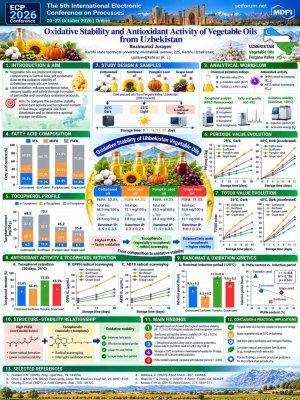
Vegetable oils represent a critical dietary component in Central Asia, yet systematic characterization of oxidative stability for Uzbekistan-origin oils remains limited. This study evaluated the oxidative stability and antioxidant activity of four major cold-pressed vegetable oils (cottonseed, sunflower, pumpkin seed, and grape seed) from the Fergana Valley, Uzbekistan. Peroxide value (PV), p-anisidine value (AnV), and TOTOX were monitored during 30-day storage at 25°C (light/dark) and 60°C (accelerated oxidation, dark). Antioxidant capacity was quantified via DPPH and ABTS radical scavenging assays (IC₅₀). Rancimat induction periods at 120°C and HPLC-fluorescence tocopherol analysis were employed to correlate endogenous antioxidant content with oxidative resistance. Fatty acid profiling revealed grape seed oil as the most polyunsaturated (71.2% linoleic acid), followed by sunflower (64.2%), cottonseed (52.8%), and pumpkin seed (43.8%). Initial total tocopherol content ranged from 35.8 mg/100 g (grape seed) to 72.1 mg/100 g (sunflower). Rancimat analysis demonstrated pumpkin seed oil as the most stable (induction period: 11.3 ± 0.4 h), whereas sunflower oil exhibited the lowest oxidative stability (4.2 ± 0.2 h). A strong negative correlation was observed between PUFA content and induction period (r = −0.434), though this relationship was modulated by tocopherol homologue distribution. Accelerated storage at 60°C caused rapid deterioration: sunflower oil reached PV 62.3 meq O₂/kg after 12 days, while pumpkin seed oil remained below 40 meq O₂/kg. Tocopherol retention after 30 days at 25°C dark ranged from 53.4% (sunflower) to 72.5% (pumpkin seed). Pumpkin seed oil demonstrated superior oxidative stability attributable to its balanced fatty acid profile and effective γ-tocopherol-mediated antioxidant protection. Storage at 25°C in darkness maintained oil quality for 30 days, whereas 60°C accelerated oxidation consistent with Arrhenius behavior (Eₐ: 78.5–92.8 kJ/mol). These findings provide practical guidance for the Uzbekistan oil industry regarding storage optimization and antioxidant fortification strategies.
Keywords
vegetable oils
lipid oxidation
antioxidant activity
tocopherol
Rancimat
Uzbekistan
fatty acid composition
accelerated storage
Poster
018cc02e665aecad4dc6fa98ccccfef8.pdf
Matrix-Dependent Effects of Convective Drying on Bioactive Compounds and Pigment Stability in Rose Hip and Blackcurrant
Chitosan–carnauba wax composite edible coatings for shelf-life extension and quality preservation of guava (Psidium guajava L.) during cold storage