Event submissions
Published
This submission belongs to the session S3. Food Process Engineering of the event The 5th International Electronic Conference on Processes
Published date
15 Oct, 2026
Academic Editor
'%3e%3cpath%20d='M12.6657%2010.9104C12.4185%2010.325%2012.0599%209.79327%2011.6097%209.34482C11.1609%208.89508%2010.6293%208.5365%2010.0442%208.28888C10.0389%208.28626%2010.0337%208.28495%2010.0285%208.28233C10.8446%207.69279%2011.3752%206.73249%2011.3752%205.64904C11.3752%203.8542%209.92103%202.39999%208.1262%202.39999C6.33136%202.39999%204.87715%203.8542%204.87715%205.64904C4.87715%206.73249%205.40774%207.69279%206.22393%208.28364C6.21869%208.28626%206.21345%208.28757%206.20821%208.29019C5.62129%208.5378%205.09463%208.89284%204.64265%209.34613C4.1929%209.79493%203.83432%2010.3266%203.58671%2010.9117C3.34345%2011.4845%203.21226%2012.0987%203.20023%2012.7209C3.19988%2012.7349%203.20233%2012.7488%203.20744%2012.7619C3.21255%2012.7749%203.22022%2012.7867%203.22998%2012.7968C3.23975%2012.8068%203.25142%2012.8147%203.26431%2012.8202C3.2772%2012.8256%203.29105%2012.8284%203.30504%2012.8284H4.09109C4.14874%2012.8284%204.19459%2012.7825%204.1959%2012.7262C4.2221%2011.7148%204.62823%2010.7676%205.34617%2010.0497C6.08899%209.30683%207.0755%208.89808%208.1262%208.89808C9.17689%208.89808%2010.1634%209.30683%2010.9062%2010.0497C11.6242%2010.7676%2012.0303%2011.7148%2012.0565%2012.7262C12.0578%2012.7838%2012.1037%2012.8284%2012.1613%2012.8284H12.9474C12.9613%2012.8284%2012.9752%2012.8256%2012.9881%2012.8202C13.001%2012.8147%2013.0126%2012.8068%2013.0224%2012.7968C13.0322%2012.7867%2013.0398%2012.7749%2013.0449%2012.7619C13.0501%2012.7488%2013.0525%2012.7349%2013.0522%2012.7209C13.0391%2012.0947%2012.9094%2011.4855%2012.6657%2010.9104ZM8.1262%207.9024C7.52486%207.9024%206.9589%207.6679%206.53312%207.24211C6.10733%206.81633%205.87283%206.25037%205.87283%205.64904C5.87283%205.0477%206.10733%204.48174%206.53312%204.05596C6.9589%203.63018%207.52486%203.39567%208.1262%203.39567C8.72753%203.39567%209.29349%203.63018%209.71927%204.05596C10.1451%204.48174%2010.3796%205.0477%2010.3796%205.64904C10.3796%206.25037%2010.1451%206.81633%209.71927%207.24211C9.29349%207.6679%208.72753%207.9024%208.1262%207.9024Z'%20fill='%235D1EE1'/%3e%3c/g%3e%3c/svg%3e) Dariusz Dziki
Dariusz DzikiCitation
Esther Omobola Areo, Exploring the nutritional improvement and bacteriocidal activity of Lactobacillus acidophilus, Streptococcus salivarious subsp. thermophilus and Lactobacillus delbrueckii subsp. bulgaricus: Insight into time-monitoring bioprocessed coconut fruit extract, in Proceedings of The 5th International Electronic Conference on Processes, 20 October–22 October 2026, MDPI: Basel, Switzerland
Share
Email
Facebook
Twitter
LinkedIn
Exploring the nutritional improvement and bacteriocidal activity of Lactobacillus acidophilus, Streptococcus salivarious subsp. thermophilus and Lactobacillus delbrueckii subsp. bulgaricus: Insight into time-monitoring bioprocessed coconut fruit extract

Esther Omobola Areo 1
1. Microbiology Department, Hallmark University, Ijebu-Itele, Ogun State, Nigeria
Abstract
Introduction: Coconut fruits are popularly consumed in Nigeria for medical benefit; however, bio-processing could enhance their nutritional and biochemical quality.
Aim and Objectives: This study examined the effects of bioprocessing (fermentation) on coconut fruits extract in Nigeria. The study assessed the effect of fermentation time on the nutritional and physicochemical properties of the food.
Methods: Seven samples were drawn from 13 production units of fermented coconut extract by Lactobacillus acidophilus, Streptococcus salivarious subsp. thermophilus and Lactobacillus delbrueckii subsp. Bulgaricus, at 0, 12, 36, 48, 60, and 72h. These were analysed for physicochemical, phytochemical, fatty-acid, fat rancidity, mineral, vitamins, amino acids, and microbial susceptibility during the process.
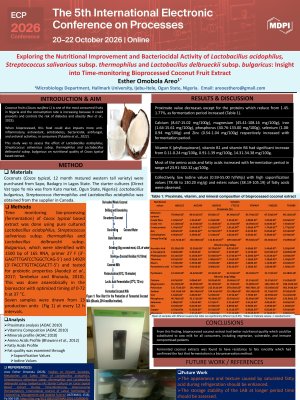
Results: Proximate value decreases except for the proteins which reduce from 1.45-1.77%, as fermentation period increased. Calcium (8.67-15.02 mg/100g), magnesium (45.41-108.16 mg/100g), iron (1.64-15.61 mg/100g), phosphorus (40.76-133.00 mg/100g), selenium (1.08-0.94 mg/100g) and Zinc (0.54-1.04 mg/100g) respectively increased with fermentation period. Vitamin K (phylloquinone), vitamin B1 and vitamin B6 had significant increase from 0.11-0.24 mg/100g, 0.91-1.39 mg/100g, 14.31-34.38 mg/100g. Most of the amino acids and fatty acids increased with fermentation period in range of 23.91-502.32 μg/100g. Collectively, low Iodine (0.59-55.00 IV/Wijs) with high saponification (78.46 to 130.20 mg/g) and esters values (38.19-105.19) of fatty acids were observed.
Conclusions: From this finding, bioprocessed coconut extract had better nutritional and functional quality which could be substituted to cow milk for all consumers, including vegetarian, vulnerable, and immune compromised patients.
Keywords
Coconut fruits extract
Fermentation
Lactic Acid Bacteria
Nutritional value
Poster
Poster.ECP2026.Areo.pdf
Performance Improvement of Photovoltaic MPPT Using a Hybrid Strategy
Active and Reactive Power control of DFIG for WECS System: PI and Anti-Windup PI Approaches