Event submissions
Published
This submission belongs to the session S3. Food Process Engineering of the event The 5th International Electronic Conference on Processes
Published date
15 Oct, 2026
Academic Editor
'%3e%3cpath%20d='M12.6657%2010.9104C12.4185%2010.325%2012.0599%209.79327%2011.6097%209.34482C11.1609%208.89508%2010.6293%208.5365%2010.0442%208.28888C10.0389%208.28626%2010.0337%208.28495%2010.0285%208.28233C10.8446%207.69279%2011.3752%206.73249%2011.3752%205.64904C11.3752%203.8542%209.92103%202.39999%208.1262%202.39999C6.33136%202.39999%204.87715%203.8542%204.87715%205.64904C4.87715%206.73249%205.40774%207.69279%206.22393%208.28364C6.21869%208.28626%206.21345%208.28757%206.20821%208.29019C5.62129%208.5378%205.09463%208.89284%204.64265%209.34613C4.1929%209.79493%203.83432%2010.3266%203.58671%2010.9117C3.34345%2011.4845%203.21226%2012.0987%203.20023%2012.7209C3.19988%2012.7349%203.20233%2012.7488%203.20744%2012.7619C3.21255%2012.7749%203.22022%2012.7867%203.22998%2012.7968C3.23975%2012.8068%203.25142%2012.8147%203.26431%2012.8202C3.2772%2012.8256%203.29105%2012.8284%203.30504%2012.8284H4.09109C4.14874%2012.8284%204.19459%2012.7825%204.1959%2012.7262C4.2221%2011.7148%204.62823%2010.7676%205.34617%2010.0497C6.08899%209.30683%207.0755%208.89808%208.1262%208.89808C9.17689%208.89808%2010.1634%209.30683%2010.9062%2010.0497C11.6242%2010.7676%2012.0303%2011.7148%2012.0565%2012.7262C12.0578%2012.7838%2012.1037%2012.8284%2012.1613%2012.8284H12.9474C12.9613%2012.8284%2012.9752%2012.8256%2012.9881%2012.8202C13.001%2012.8147%2013.0126%2012.8068%2013.0224%2012.7968C13.0322%2012.7867%2013.0398%2012.7749%2013.0449%2012.7619C13.0501%2012.7488%2013.0525%2012.7349%2013.0522%2012.7209C13.0391%2012.0947%2012.9094%2011.4855%2012.6657%2010.9104ZM8.1262%207.9024C7.52486%207.9024%206.9589%207.6679%206.53312%207.24211C6.10733%206.81633%205.87283%206.25037%205.87283%205.64904C5.87283%205.0477%206.10733%204.48174%206.53312%204.05596C6.9589%203.63018%207.52486%203.39567%208.1262%203.39567C8.72753%203.39567%209.29349%203.63018%209.71927%204.05596C10.1451%204.48174%2010.3796%205.0477%2010.3796%205.64904C10.3796%206.25037%2010.1451%206.81633%209.71927%207.24211C9.29349%207.6679%208.72753%207.9024%208.1262%207.9024Z'%20fill='%235D1EE1'/%3e%3c/g%3e%3c/svg%3e) Dariusz Dziki
Dariusz DzikiCitation
Adriana Rodrigues Machado, Liliana Araujo, Ana C. Cassoni, Gonçalo Sá, João Nunes, Manuela Pintado, Upcycling of brewers’ spent grain flour: physicochemical characterization and potential applications, in Proceedings of The 5th International Electronic Conference on Processes, 20 October–22 October 2026, MDPI: Basel, Switzerland
Share
Email
Facebook
Twitter
LinkedIn
Upcycling of brewers’ spent grain flour: physicochemical characterization and potential applications
'%3e%3cpath%20d='M12.6647%2010.9104C12.4176%2010.325%2012.0589%209.7933%2011.6088%209.34485C11.16%208.89511%2010.6283%208.53653%2010.0432%208.28891C10.038%208.28629%2010.0327%208.28498%2010.0275%208.28236C10.8437%207.69282%2011.3743%206.73252%2011.3743%205.64907C11.3743%203.85423%209.92005%202.40002%208.12522%202.40002C6.33038%202.40002%204.87618%203.85423%204.87618%205.64907C4.87618%206.73252%205.40677%207.69282%206.22296%208.28367C6.21772%208.28629%206.21248%208.2876%206.20724%208.29022C5.62031%208.53783%205.09365%208.89287%204.64167%209.34616C4.19192%209.79496%203.83334%2010.3266%203.58573%2010.9117C3.34247%2011.4846%203.21128%2012.0987%203.19925%2012.721C3.1989%2012.735%203.20135%2012.7489%203.20646%2012.7619C3.21157%2012.7749%203.21924%2012.7868%203.22901%2012.7968C3.23877%2012.8068%203.25045%2012.8148%203.26334%2012.8202C3.27623%2012.8256%203.29007%2012.8284%203.30406%2012.8284H4.09012C4.14776%2012.8284%204.19362%2012.7825%204.19493%2012.7262C4.22113%2011.7148%204.62726%2010.7676%205.34519%2010.0497C6.08802%209.30686%207.07452%208.89811%208.12522%208.89811C9.17592%208.89811%2010.1624%209.30686%2010.9052%2010.0497C11.6232%2010.7676%2012.0293%2011.7148%2012.0555%2012.7262C12.0568%2012.7839%2012.1027%2012.8284%2012.1603%2012.8284H12.9464C12.9604%2012.8284%2012.9742%2012.8256%2012.9871%2012.8202C13%2012.8148%2013.0117%2012.8068%2013.0214%2012.7968C13.0312%2012.7868%2013.0389%2012.7749%2013.044%2012.7619C13.0491%2012.7489%2013.0515%2012.735%2013.0512%2012.721C13.0381%2012.0947%2012.9084%2011.4856%2012.6647%2010.9104ZM8.12522%207.90243C7.52388%207.90243%206.95792%207.66793%206.53214%207.24215C6.10636%206.81636%205.87185%206.2504%205.87185%205.64907C5.87185%205.04773%206.10636%204.48177%206.53214%204.05599C6.95792%203.63021%207.52388%203.3957%208.12522%203.3957C8.72655%203.3957%209.29252%203.63021%209.7183%204.05599C10.1441%204.48177%2010.3786%205.04773%2010.3786%205.64907C10.3786%206.2504%2010.1441%206.81636%209.7183%207.24215C9.29252%207.66793%208.72655%207.90243%208.12522%207.90243Z'%20fill='%235D1EE1'/%3e%3c/g%3e%3c/svg%3e)
Adriana Rodrigues Machado 1,2
Liliana Araujo 2
Ana C. Cassoni 2
Gonçalo Sá 1
João Nunes 1
Manuela Pintado 2
1. Associação CECOLAB, Collaborative Laboratory Towards Circular Economy, Business Centre, Rua Nossa Senhora da Conceição, 2, Oliveira do Hospital, 3405-155 Coimbra, Portugal
2. Centro de Biotecnologia e Química Fina (CBQF), Universidade Católica Portuguesa, 4169-005 Porto, Portugal
Abstract
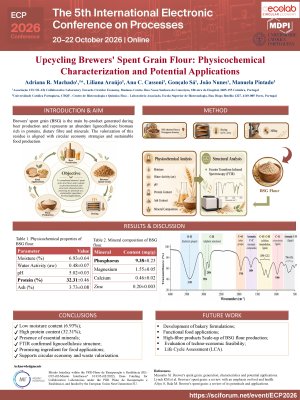
The study considers the reuse of brewing industry residue, known as brewers’ spent grain (BSG), by transforming it into flour and analyzing its physicochemical properties and possible applications. The raw material was provided by a Portuguese brewery and dried at 40 °C for 24 hours, followed by milling. Subsequently, the flour was analysed for physicochemical parameters, and characterization was performed using Fourier transform infrared spectroscopy (FTIR). The physicochemical results showed that the brewers’ spent grain flour has a low moisture content (6.93%), a relatively moderate water activity (0.48), and a slightly acidic pH (5.02). It also showed a high protein content (32.31%) and a considerable ash content (3.73%), indicating the presence of minerals. Despite the low moisture content, the higher water activity suggests greater availability of free water, which may promote chemical reactions or microbial growth if storage conditions are not properly controlled. This behavior is explained by its composition, rich in proteins and insoluble fibers, which retain less total water but make part of it more available. Mineral analysis showed that the brewery residue mainly contains phosphorus (9.38 mg/g), magnesium (1.55 mg/g), calcium (0.46 mg/g), and zinc (0.20 mg/g). However, overall, it has a lower mineral content than other agro-industrial residues, such as those derived from viticulture. FTIR analysis confirmed the presence of various organic compounds, including hydroxyl groups, aliphatic chains, esters and aromatic structures. Components typical of plant biomass, such as cellulose, hemicellulose, and lignin, were also identified, as evidenced by characteristic bands in the spectrum. Taken together, the results show that brewers’ grains have high nutritional value and functional potential and can be used as a sustainable ingredient in the food industry, helping to valorise agro-industrial by-products and cutting waste.
Keywords
Biomass
Organic compounds
waste.
Poster
ecp 2026-Dresch_CC_AM.pdf
Investigation and Quality Improvement of Chickpea Flour-Based Spreadable Cheese Analogue Through Roasting and Rice Flour Incorporation
Simultaneous Treatment of River Water and Electricity Generation Using Constructed Wetland-Microbial Fuel Cell with Megathyrsus maximus