Event submissions
Published
This submission belongs to the session S3. Food Process Engineering of the event The 5th International Electronic Conference on Processes
Published date
15 Oct, 2026
Academic Editor
'%3e%3cpath%20d='M12.6657%2010.9104C12.4185%2010.325%2012.0599%209.79327%2011.6097%209.34482C11.1609%208.89508%2010.6293%208.5365%2010.0442%208.28888C10.0389%208.28626%2010.0337%208.28495%2010.0285%208.28233C10.8446%207.69279%2011.3752%206.73249%2011.3752%205.64904C11.3752%203.8542%209.92103%202.39999%208.1262%202.39999C6.33136%202.39999%204.87715%203.8542%204.87715%205.64904C4.87715%206.73249%205.40774%207.69279%206.22393%208.28364C6.21869%208.28626%206.21345%208.28757%206.20821%208.29019C5.62129%208.5378%205.09463%208.89284%204.64265%209.34613C4.1929%209.79493%203.83432%2010.3266%203.58671%2010.9117C3.34345%2011.4845%203.21226%2012.0987%203.20023%2012.7209C3.19988%2012.7349%203.20233%2012.7488%203.20744%2012.7619C3.21255%2012.7749%203.22022%2012.7867%203.22998%2012.7968C3.23975%2012.8068%203.25142%2012.8147%203.26431%2012.8202C3.2772%2012.8256%203.29105%2012.8284%203.30504%2012.8284H4.09109C4.14874%2012.8284%204.19459%2012.7825%204.1959%2012.7262C4.2221%2011.7148%204.62823%2010.7676%205.34617%2010.0497C6.08899%209.30683%207.0755%208.89808%208.1262%208.89808C9.17689%208.89808%2010.1634%209.30683%2010.9062%2010.0497C11.6242%2010.7676%2012.0303%2011.7148%2012.0565%2012.7262C12.0578%2012.7838%2012.1037%2012.8284%2012.1613%2012.8284H12.9474C12.9613%2012.8284%2012.9752%2012.8256%2012.9881%2012.8202C13.001%2012.8147%2013.0126%2012.8068%2013.0224%2012.7968C13.0322%2012.7867%2013.0398%2012.7749%2013.0449%2012.7619C13.0501%2012.7488%2013.0525%2012.7349%2013.0522%2012.7209C13.0391%2012.0947%2012.9094%2011.4855%2012.6657%2010.9104ZM8.1262%207.9024C7.52486%207.9024%206.9589%207.6679%206.53312%207.24211C6.10733%206.81633%205.87283%206.25037%205.87283%205.64904C5.87283%205.0477%206.10733%204.48174%206.53312%204.05596C6.9589%203.63018%207.52486%203.39567%208.1262%203.39567C8.72753%203.39567%209.29349%203.63018%209.71927%204.05596C10.1451%204.48174%2010.3796%205.0477%2010.3796%205.64904C10.3796%206.25037%2010.1451%206.81633%209.71927%207.24211C9.29349%207.6679%208.72753%207.9024%208.1262%207.9024Z'%20fill='%235D1EE1'/%3e%3c/g%3e%3c/svg%3e) Dariusz Dziki
Dariusz DzikiCitation
Natalia Georgi Stoyanova, Vasili M. Travkin, Inna P. Solyanikova, The Influence of Sporogenic Yeasts of the Family Saccharomycetaceae (Hanseniaspora uvarum and Saccharomyces cerevisiae) Isolated from the Spontaneous Microflora of Grapes in the Central Chernozem Region on the Qualitative Composition of Red Wine Material, in Proceedings of The 5th International Electronic Conference on Processes, 20 October–22 October 2026, MDPI: Basel, Switzerland
Share
Email
Facebook
Twitter
LinkedIn
The Influence of Sporogenic Yeasts of the Family Saccharomycetaceae (Hanseniaspora uvarum and Saccharomyces cerevisiae) Isolated from the Spontaneous Microflora of Grapes in the Central Chernozem Region on the Qualitative Composition of Red Wine Material
'%3e%3cpath%20d='M12.6647%2010.9104C12.4176%2010.325%2012.0589%209.7933%2011.6088%209.34485C11.16%208.89511%2010.6283%208.53653%2010.0432%208.28891C10.038%208.28629%2010.0327%208.28498%2010.0275%208.28236C10.8437%207.69282%2011.3743%206.73252%2011.3743%205.64907C11.3743%203.85423%209.92005%202.40002%208.12522%202.40002C6.33038%202.40002%204.87618%203.85423%204.87618%205.64907C4.87618%206.73252%205.40677%207.69282%206.22296%208.28367C6.21772%208.28629%206.21248%208.2876%206.20724%208.29022C5.62031%208.53783%205.09365%208.89287%204.64167%209.34616C4.19192%209.79496%203.83334%2010.3266%203.58573%2010.9117C3.34247%2011.4846%203.21128%2012.0987%203.19925%2012.721C3.1989%2012.735%203.20135%2012.7489%203.20646%2012.7619C3.21157%2012.7749%203.21924%2012.7868%203.22901%2012.7968C3.23877%2012.8068%203.25045%2012.8148%203.26334%2012.8202C3.27623%2012.8256%203.29007%2012.8284%203.30406%2012.8284H4.09012C4.14776%2012.8284%204.19362%2012.7825%204.19493%2012.7262C4.22113%2011.7148%204.62726%2010.7676%205.34519%2010.0497C6.08802%209.30686%207.07452%208.89811%208.12522%208.89811C9.17592%208.89811%2010.1624%209.30686%2010.9052%2010.0497C11.6232%2010.7676%2012.0293%2011.7148%2012.0555%2012.7262C12.0568%2012.7839%2012.1027%2012.8284%2012.1603%2012.8284H12.9464C12.9604%2012.8284%2012.9742%2012.8256%2012.9871%2012.8202C13%2012.8148%2013.0117%2012.8068%2013.0214%2012.7968C13.0312%2012.7868%2013.0389%2012.7749%2013.044%2012.7619C13.0491%2012.7489%2013.0515%2012.735%2013.0512%2012.721C13.0381%2012.0947%2012.9084%2011.4856%2012.6647%2010.9104ZM8.12522%207.90243C7.52388%207.90243%206.95792%207.66793%206.53214%207.24215C6.10636%206.81636%205.87185%206.2504%205.87185%205.64907C5.87185%205.04773%206.10636%204.48177%206.53214%204.05599C6.95792%203.63021%207.52388%203.3957%208.12522%203.3957C8.72655%203.3957%209.29252%203.63021%209.7183%204.05599C10.1441%204.48177%2010.3786%205.04773%2010.3786%205.64907C10.3786%206.2504%2010.1441%206.81636%209.7183%207.24215C9.29252%207.66793%208.72655%207.90243%208.12522%207.90243Z'%20fill='%235D1EE1'/%3e%3c/g%3e%3c/svg%3e)
Natalia Georgi Stoyanova 1
Vasili M. Travkin 2
Inna P. Solyanikova 2
1. Department of Biochemistry, Scientific Research Institute ‘Pharmacology of Living Systems’, Belgorod State National Research University,
Belgorod, Russia 308015
2. Regional Microbiological Center, Belgorod State National Research University, Belgorod, Russia 308015
Abstract
According to the OIV 2025 review, the global wine industry is responding to changes in trade policy and consumption patterns, as well as climate change. In 2025, wine production reached 227 million hectolitres, an increase of 0.6% compared to 2024. Climate change leads to a deficiency of organic acids in grapes from southern regions, resulting in low-acid wines, which poses a problem. In this context, wines from hybrid, open-vineyard grape varieties grown in northern regions are of interest.
Studying the yeasts of the natural microflora during grape crushing and pressing is crucial. Yeast plays a key role in wine fermentation and maturation. The aim of the study was to isolate wild type yeasts for grape processing from the natural microflora of Marquette grapes from the Belgorod region and study their impact on wine quality.
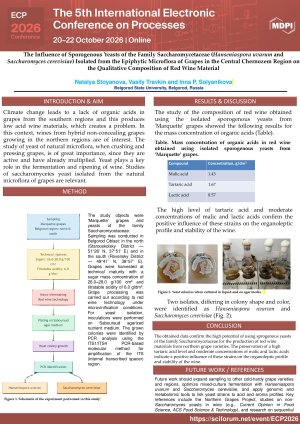
The study subjects were Marquette grapes and yeasts of the Saccharomycetaceae family. The region's coordinates for grape cultivation were 51°26′ N 37°51′ E and 49°41′ N 38°57′ E. Grapes were harvested at technical maturity, with a sugar mass concentration of 26.0-28.0 g/100 cm³ and a titratable acidity of 6.0 g/dm³. microwinemaking conditions was used for grapeprocessing. Yeast was isolated on Sabouraud medium. The colonies grown were identified using PCR. The species has been identofied as Hanseniaspora uvarum and Saccharomyces cerevisiae.
The results of the study of the composition of red wine obtained using H. uvarum and S. cerevisiae from Marquette grapes - the mass concentration of malic acid is 1.43 g / dm3, the mass concentration of tartaric acid is 1.67 g / dm3, the mass concentration of lactic acid is 0.57 g / dm3.The obtained results indicate the potential of using wild yeast in winemaking to produce high-quality wine material.
Keywords
Hanseniaspora uvarum
Saccharomyces cerevisiae
grape variety
interspecific hybrids
malolactic fermentation
winemaking conditions
Poster
Stoyanova _2026_final.pdf
Comparative Evaluation of Advanced FACTS Technologies for Improving and Damping Power Oscillation in Electric Power Systems Integrating Wind Energy
Performance Evaluation of a PI-Based PMSM Electric Vehicle Drive Under Dynamic Passenger Loading and Road Grade Variations