Event submissions
Published
This submission belongs to the session S3. Food Process Engineering of the event The 5th International Electronic Conference on Processes
Published date
15 Oct, 2026
Academic Editor
'%3e%3cpath%20d='M12.6657%2010.9104C12.4185%2010.325%2012.0599%209.79327%2011.6097%209.34482C11.1609%208.89508%2010.6293%208.5365%2010.0442%208.28888C10.0389%208.28626%2010.0337%208.28495%2010.0285%208.28233C10.8446%207.69279%2011.3752%206.73249%2011.3752%205.64904C11.3752%203.8542%209.92103%202.39999%208.1262%202.39999C6.33136%202.39999%204.87715%203.8542%204.87715%205.64904C4.87715%206.73249%205.40774%207.69279%206.22393%208.28364C6.21869%208.28626%206.21345%208.28757%206.20821%208.29019C5.62129%208.5378%205.09463%208.89284%204.64265%209.34613C4.1929%209.79493%203.83432%2010.3266%203.58671%2010.9117C3.34345%2011.4845%203.21226%2012.0987%203.20023%2012.7209C3.19988%2012.7349%203.20233%2012.7488%203.20744%2012.7619C3.21255%2012.7749%203.22022%2012.7867%203.22998%2012.7968C3.23975%2012.8068%203.25142%2012.8147%203.26431%2012.8202C3.2772%2012.8256%203.29105%2012.8284%203.30504%2012.8284H4.09109C4.14874%2012.8284%204.19459%2012.7825%204.1959%2012.7262C4.2221%2011.7148%204.62823%2010.7676%205.34617%2010.0497C6.08899%209.30683%207.0755%208.89808%208.1262%208.89808C9.17689%208.89808%2010.1634%209.30683%2010.9062%2010.0497C11.6242%2010.7676%2012.0303%2011.7148%2012.0565%2012.7262C12.0578%2012.7838%2012.1037%2012.8284%2012.1613%2012.8284H12.9474C12.9613%2012.8284%2012.9752%2012.8256%2012.9881%2012.8202C13.001%2012.8147%2013.0126%2012.8068%2013.0224%2012.7968C13.0322%2012.7867%2013.0398%2012.7749%2013.0449%2012.7619C13.0501%2012.7488%2013.0525%2012.7349%2013.0522%2012.7209C13.0391%2012.0947%2012.9094%2011.4855%2012.6657%2010.9104ZM8.1262%207.9024C7.52486%207.9024%206.9589%207.6679%206.53312%207.24211C6.10733%206.81633%205.87283%206.25037%205.87283%205.64904C5.87283%205.0477%206.10733%204.48174%206.53312%204.05596C6.9589%203.63018%207.52486%203.39567%208.1262%203.39567C8.72753%203.39567%209.29349%203.63018%209.71927%204.05596C10.1451%204.48174%2010.3796%205.0477%2010.3796%205.64904C10.3796%206.25037%2010.1451%206.81633%209.71927%207.24211C9.29349%207.6679%208.72753%207.9024%208.1262%207.9024Z'%20fill='%235D1EE1'/%3e%3c/g%3e%3c/svg%3e) Dariusz Dziki
Dariusz DzikiCitation
Branislava Teofilović, Snežena Papović, Nevena Grujić-Letić, Emilia Gligorić, Milan Vraneš, Phenolic Compound Profiling of Lavender (Lavandula angustifolia Mill.) Extracts Obtained with NADES and Ethanol Using HPLC-DAD, in Proceedings of The 5th International Electronic Conference on Processes, 20 October–22 October 2026, MDPI: Basel, Switzerland
Share
Email
Facebook
Twitter
LinkedIn
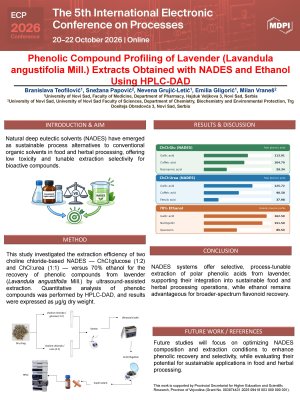
Phenolic Compound Profiling of Lavender (Lavandula angustifolia Mill.) Extracts Obtained with NADES and Ethanol Using HPLC-DAD
'%3e%3cpath%20d='M12.6647%2010.9104C12.4176%2010.325%2012.0589%209.7933%2011.6088%209.34485C11.16%208.89511%2010.6283%208.53653%2010.0432%208.28891C10.038%208.28629%2010.0327%208.28498%2010.0275%208.28236C10.8437%207.69282%2011.3743%206.73252%2011.3743%205.64907C11.3743%203.85423%209.92005%202.40002%208.12522%202.40002C6.33038%202.40002%204.87618%203.85423%204.87618%205.64907C4.87618%206.73252%205.40677%207.69282%206.22296%208.28367C6.21772%208.28629%206.21248%208.2876%206.20724%208.29022C5.62031%208.53783%205.09365%208.89287%204.64167%209.34616C4.19192%209.79496%203.83334%2010.3266%203.58573%2010.9117C3.34247%2011.4846%203.21128%2012.0987%203.19925%2012.721C3.1989%2012.735%203.20135%2012.7489%203.20646%2012.7619C3.21157%2012.7749%203.21924%2012.7868%203.22901%2012.7968C3.23877%2012.8068%203.25045%2012.8148%203.26334%2012.8202C3.27623%2012.8256%203.29007%2012.8284%203.30406%2012.8284H4.09012C4.14776%2012.8284%204.19362%2012.7825%204.19493%2012.7262C4.22113%2011.7148%204.62726%2010.7676%205.34519%2010.0497C6.08802%209.30686%207.07452%208.89811%208.12522%208.89811C9.17592%208.89811%2010.1624%209.30686%2010.9052%2010.0497C11.6232%2010.7676%2012.0293%2011.7148%2012.0555%2012.7262C12.0568%2012.7839%2012.1027%2012.8284%2012.1603%2012.8284H12.9464C12.9604%2012.8284%2012.9742%2012.8256%2012.9871%2012.8202C13%2012.8148%2013.0117%2012.8068%2013.0214%2012.7968C13.0312%2012.7868%2013.0389%2012.7749%2013.044%2012.7619C13.0491%2012.7489%2013.0515%2012.735%2013.0512%2012.721C13.0381%2012.0947%2012.9084%2011.4856%2012.6647%2010.9104ZM8.12522%207.90243C7.52388%207.90243%206.95792%207.66793%206.53214%207.24215C6.10636%206.81636%205.87185%206.2504%205.87185%205.64907C5.87185%205.04773%206.10636%204.48177%206.53214%204.05599C6.95792%203.63021%207.52388%203.3957%208.12522%203.3957C8.72655%203.3957%209.29252%203.63021%209.7183%204.05599C10.1441%204.48177%2010.3786%205.04773%2010.3786%205.64907C10.3786%206.2504%2010.1441%206.81636%209.7183%207.24215C9.29252%207.66793%208.72655%207.90243%208.12522%207.90243Z'%20fill='%235D1EE1'/%3e%3c/g%3e%3c/svg%3e)
Branislava Teofilović 1
Snežena Papović 2
Nevena Grujić-Letić 1
Emilia Gligorić 1
Milan Vraneš 2
1. Department of Pharmacy, Faculty of Medicine, University of Novi Sad, Hajduk Veljkova 3, 21000 Novi Sad, Serbia
2. Faculty of Science, University of Novi Sad, Trg Dositeja Obradovica 3, 21000 Novi Sad, Serbia
Abstract
Introduction: Deep eutectic solvents (DES) and natural deep eutectic solvents (NADES) have emerged as sustainable alternatives to conventional organic solvents for the extraction of phenolic compounds from aromatic plants. Multivariate chemometric tools provide a powerful means of evaluating complex extraction datasets and identifying the factors governing phenolic selectivity across different solvent systems.
Methods: Multivariate chemometric analysis was applied to evaluate the relationships among phenolic compound profiles of ten Lamiaceae species extracted with five solvent systems — two hydrophobic DES, two NADES, and 70% ethanol — yielding a dataset of 50 samples and 12 quantified phenolic compounds. Prior to analysis, data were standardized by z-score normalization. Principal Component Analysis (PCA), Hierarchical Cluster Analysis (HCA), and heatmap visualization were performed to assess sample grouping and identify key discriminating variables.
Results and Discussion: PCA revealed that the first two principal components accounted for 41.8% and 23.7% of total variance, respectively, with a cumulative explained variance of 65.5%. The score plot demonstrated a clear separation of samples primarily according to solvent polarity rather than botanical origin, indicating that extraction solvent is the dominant factor governing phenolic profiles in Lamiaceae species. The menthol/methyl salicylate DES formed a well-separated cluster driven by high rosmarinic acid, chlorogenic acid, and quercetin loadings, while NADES and ethanol extracts showed partial overlap, reflecting comparable polarity ranges. HCA confirmed two primary clusters corresponding to lipophilic DES and hydrophilic extraction systems. Loadings analysis identified rosmarinic acid, chlorogenic acid, and quercetin as principal discriminating variables.
Conclusions: These results demonstrate the utility of chemometric tools in characterizing solvent-dependent phenolic fingerprints and support rational solvent selection for targeted extraction from complex plant matrices.
Acknowledgments: This work is supported by Provincial Secretariat for Higher Education and Scientific Research, Province of Vojvodina (Grant No. 003874431 2025 09418 003 000 000 001).
Keywords
lavender
NADES
sustainable food processing
phenolic profile
HPLC-DAD
ultrasound-assisted extraction.
Poster
Poster_lavander_ECP2026.pdf
Phytochemical Profile and Bioactivity of Blueberry Pomace and Leaves
Valorization of Food Industry By-products from Citrus sinensis: Extraction, Encapsulation Stabilization, and Biological Evaluation of Orange Peel Essential Oils