Event submissions
Published
This submission belongs to the session S3. Food Process Engineering of the event The 5th International Electronic Conference on Processes
Published date
15 Oct, 2026
Academic Editor
'%3e%3cpath%20d='M12.6657%2010.9104C12.4185%2010.325%2012.0599%209.79327%2011.6097%209.34482C11.1609%208.89508%2010.6293%208.5365%2010.0442%208.28888C10.0389%208.28626%2010.0337%208.28495%2010.0285%208.28233C10.8446%207.69279%2011.3752%206.73249%2011.3752%205.64904C11.3752%203.8542%209.92103%202.39999%208.1262%202.39999C6.33136%202.39999%204.87715%203.8542%204.87715%205.64904C4.87715%206.73249%205.40774%207.69279%206.22393%208.28364C6.21869%208.28626%206.21345%208.28757%206.20821%208.29019C5.62129%208.5378%205.09463%208.89284%204.64265%209.34613C4.1929%209.79493%203.83432%2010.3266%203.58671%2010.9117C3.34345%2011.4845%203.21226%2012.0987%203.20023%2012.7209C3.19988%2012.7349%203.20233%2012.7488%203.20744%2012.7619C3.21255%2012.7749%203.22022%2012.7867%203.22998%2012.7968C3.23975%2012.8068%203.25142%2012.8147%203.26431%2012.8202C3.2772%2012.8256%203.29105%2012.8284%203.30504%2012.8284H4.09109C4.14874%2012.8284%204.19459%2012.7825%204.1959%2012.7262C4.2221%2011.7148%204.62823%2010.7676%205.34617%2010.0497C6.08899%209.30683%207.0755%208.89808%208.1262%208.89808C9.17689%208.89808%2010.1634%209.30683%2010.9062%2010.0497C11.6242%2010.7676%2012.0303%2011.7148%2012.0565%2012.7262C12.0578%2012.7838%2012.1037%2012.8284%2012.1613%2012.8284H12.9474C12.9613%2012.8284%2012.9752%2012.8256%2012.9881%2012.8202C13.001%2012.8147%2013.0126%2012.8068%2013.0224%2012.7968C13.0322%2012.7867%2013.0398%2012.7749%2013.0449%2012.7619C13.0501%2012.7488%2013.0525%2012.7349%2013.0522%2012.7209C13.0391%2012.0947%2012.9094%2011.4855%2012.6657%2010.9104ZM8.1262%207.9024C7.52486%207.9024%206.9589%207.6679%206.53312%207.24211C6.10733%206.81633%205.87283%206.25037%205.87283%205.64904C5.87283%205.0477%206.10733%204.48174%206.53312%204.05596C6.9589%203.63018%207.52486%203.39567%208.1262%203.39567C8.72753%203.39567%209.29349%203.63018%209.71927%204.05596C10.1451%204.48174%2010.3796%205.0477%2010.3796%205.64904C10.3796%206.25037%2010.1451%206.81633%209.71927%207.24211C9.29349%207.6679%208.72753%207.9024%208.1262%207.9024Z'%20fill='%235D1EE1'/%3e%3c/g%3e%3c/svg%3e) Dariusz Dziki
Dariusz DzikiCitation
Lamia TAOUZINET, Hind Houria BOUGHERRA, Salem KRIM, Sabiha BECHIR, Salima ADJIRI, Sofiane FATMI, Valorization of Food Industry By-products from Citrus sinensis: Extraction, Encapsulation Stabilization, and Biological Evaluation of Orange Peel Essential Oils, in Proceedings of The 5th International Electronic Conference on Processes, 20 October–22 October 2026, MDPI: Basel, Switzerland
Share
Email
Facebook
Twitter
LinkedIn
Valorization of Food Industry By-products from Citrus sinensis: Extraction, Encapsulation Stabilization, and Biological Evaluation of Orange Peel Essential Oils
'%3e%3cpath%20d='M12.6647%2010.9104C12.4176%2010.325%2012.0589%209.7933%2011.6088%209.34485C11.16%208.89511%2010.6283%208.53653%2010.0432%208.28891C10.038%208.28629%2010.0327%208.28498%2010.0275%208.28236C10.8437%207.69282%2011.3743%206.73252%2011.3743%205.64907C11.3743%203.85423%209.92005%202.40002%208.12522%202.40002C6.33038%202.40002%204.87618%203.85423%204.87618%205.64907C4.87618%206.73252%205.40677%207.69282%206.22296%208.28367C6.21772%208.28629%206.21248%208.2876%206.20724%208.29022C5.62031%208.53783%205.09365%208.89287%204.64167%209.34616C4.19192%209.79496%203.83334%2010.3266%203.58573%2010.9117C3.34247%2011.4846%203.21128%2012.0987%203.19925%2012.721C3.1989%2012.735%203.20135%2012.7489%203.20646%2012.7619C3.21157%2012.7749%203.21924%2012.7868%203.22901%2012.7968C3.23877%2012.8068%203.25045%2012.8148%203.26334%2012.8202C3.27623%2012.8256%203.29007%2012.8284%203.30406%2012.8284H4.09012C4.14776%2012.8284%204.19362%2012.7825%204.19493%2012.7262C4.22113%2011.7148%204.62726%2010.7676%205.34519%2010.0497C6.08802%209.30686%207.07452%208.89811%208.12522%208.89811C9.17592%208.89811%2010.1624%209.30686%2010.9052%2010.0497C11.6232%2010.7676%2012.0293%2011.7148%2012.0555%2012.7262C12.0568%2012.7839%2012.1027%2012.8284%2012.1603%2012.8284H12.9464C12.9604%2012.8284%2012.9742%2012.8256%2012.9871%2012.8202C13%2012.8148%2013.0117%2012.8068%2013.0214%2012.7968C13.0312%2012.7868%2013.0389%2012.7749%2013.044%2012.7619C13.0491%2012.7489%2013.0515%2012.735%2013.0512%2012.721C13.0381%2012.0947%2012.9084%2011.4856%2012.6647%2010.9104ZM8.12522%207.90243C7.52388%207.90243%206.95792%207.66793%206.53214%207.24215C6.10636%206.81636%205.87185%206.2504%205.87185%205.64907C5.87185%205.04773%206.10636%204.48177%206.53214%204.05599C6.95792%203.63021%207.52388%203.3957%208.12522%203.3957C8.72655%203.3957%209.29252%203.63021%209.7183%204.05599C10.1441%204.48177%2010.3786%205.04773%2010.3786%205.64907C10.3786%206.2504%2010.1441%206.81636%209.7183%207.24215C9.29252%207.66793%208.72655%207.90243%208.12522%207.90243Z'%20fill='%235D1EE1'/%3e%3c/g%3e%3c/svg%3e)
Lamia TAOUZINET 1
Hind Houria BOUGHERRA 1
Salem KRIM 1
Sabiha BECHIR 2
Salima ADJIRI 1
Sofiane FATMI 3,4
1. Centre de Recherche en Technologies Agro-Alimentaires, Route de Targa Ouzemmour, Campus Universitaire, Bejaia 06000, Algeria
2. Centre de Recherche en Technologies Agro-Alimentaires. Campus Universitaire Tergua Ouzemour. Bejaia. 06000. Algérie
3. Associated Laboratory in Marine Ecosystems and Aquaculture, Faculty of Nature and Life Sciences, Université de Bejaia, 06000 Bejaia, Algeria
4. Technology Pharmaceutical Laboratory, Faculty of Technology, Université de Bejaia, 06000 Bejaia, Algeria
Abstract
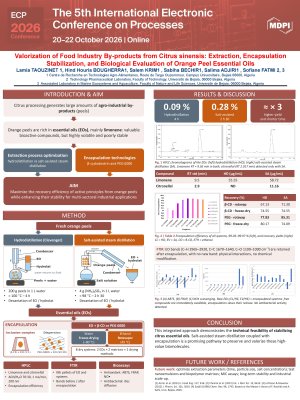
Introduction and Aim: In the context of agro-industrial by-product valorization, this study aims to develop and evaluate an integrated approach combining extraction process optimization and encapsulation technologies. The objective is to maximize the recovery efficiency of active principles from orange peels while enhancing their stability for multi-sectoral industrial applications.
Methodology: Two extraction methods were compared: hydrodistillation and salt-assisted steam distillation (salting-out effect). The resulting essential oils (EOs) were then encapsulated within two matrices (β-cyclodextrin and polyethylene glycol [PEG 6000]) using two drying methods: freeze-drying and rotary evaporation . The systems were characterized using HPLC chromatography and Fourier-transform infrared spectroscopy (FTIR). Finally, their antioxidant capacity was evaluated through complementary assays (FRAP, and NO•).
Results: Salt-assisted steam distillation proved to be more efficient than conventional hydrodistillation, reducing extraction time and favorably preserving the chemical profile. Notably, citronellal—which was absent during hydrodistillation—was successfully detected by HPLC alongside the major compound, limonene. Regarding formulation, exceptionally high encapsulation efficiencies (> 99%) were achieved across all studied systems. Recovery yields of the complexes ranged from 67.13% to 85.31%, with mass losses attributed to processing and drying stages (freeze-drying being optimal for the β-CD/EO system, while rotary evaporation performed better for PEG/EO). FTIR spectra confirmed the absence of major chemical modifications, validating the preservation of active compounds through purely physical interactions with the matrices. Biologically, raw EOs exhibited higher antioxidant activity compared to encapsulated systems due to the reduced immediate availability of the active compounds after formulation, although certain formulations retained a partial protective effect.
Conclusion: This integrated approach demonstrates the technical feasibility of stabilizing citrus essential oils. Salt-assisted steam distillation coupled with encapsulation represents a promising pathway to preserve and valorize these high-value biomolecules.
Keywords
Citrus sinensis
Essential oils
Salt-assisted extraction
Encapsulation
Antioxidant activity
Poster
Poster TAOUZINET et al ECP2026.pdf
Phenolic Compound Profiling of Lavender (Lavandula angustifolia Mill.) Extracts Obtained with NADES and Ethanol Using HPLC-DAD
Engineered eggplant drying with sustainable green pretreatments for enhanced characteristics and physicochemical properties