Event submissions
Published
This submission belongs to the session S3. Food Process Engineering of the event The 5th International Electronic Conference on Processes
Published date
15 Oct, 2026
Academic Editor
'%3e%3cpath%20d='M12.6657%2010.9104C12.4185%2010.325%2012.0599%209.79327%2011.6097%209.34482C11.1609%208.89508%2010.6293%208.5365%2010.0442%208.28888C10.0389%208.28626%2010.0337%208.28495%2010.0285%208.28233C10.8446%207.69279%2011.3752%206.73249%2011.3752%205.64904C11.3752%203.8542%209.92103%202.39999%208.1262%202.39999C6.33136%202.39999%204.87715%203.8542%204.87715%205.64904C4.87715%206.73249%205.40774%207.69279%206.22393%208.28364C6.21869%208.28626%206.21345%208.28757%206.20821%208.29019C5.62129%208.5378%205.09463%208.89284%204.64265%209.34613C4.1929%209.79493%203.83432%2010.3266%203.58671%2010.9117C3.34345%2011.4845%203.21226%2012.0987%203.20023%2012.7209C3.19988%2012.7349%203.20233%2012.7488%203.20744%2012.7619C3.21255%2012.7749%203.22022%2012.7867%203.22998%2012.7968C3.23975%2012.8068%203.25142%2012.8147%203.26431%2012.8202C3.2772%2012.8256%203.29105%2012.8284%203.30504%2012.8284H4.09109C4.14874%2012.8284%204.19459%2012.7825%204.1959%2012.7262C4.2221%2011.7148%204.62823%2010.7676%205.34617%2010.0497C6.08899%209.30683%207.0755%208.89808%208.1262%208.89808C9.17689%208.89808%2010.1634%209.30683%2010.9062%2010.0497C11.6242%2010.7676%2012.0303%2011.7148%2012.0565%2012.7262C12.0578%2012.7838%2012.1037%2012.8284%2012.1613%2012.8284H12.9474C12.9613%2012.8284%2012.9752%2012.8256%2012.9881%2012.8202C13.001%2012.8147%2013.0126%2012.8068%2013.0224%2012.7968C13.0322%2012.7867%2013.0398%2012.7749%2013.0449%2012.7619C13.0501%2012.7488%2013.0525%2012.7349%2013.0522%2012.7209C13.0391%2012.0947%2012.9094%2011.4855%2012.6657%2010.9104ZM8.1262%207.9024C7.52486%207.9024%206.9589%207.6679%206.53312%207.24211C6.10733%206.81633%205.87283%206.25037%205.87283%205.64904C5.87283%205.0477%206.10733%204.48174%206.53312%204.05596C6.9589%203.63018%207.52486%203.39567%208.1262%203.39567C8.72753%203.39567%209.29349%203.63018%209.71927%204.05596C10.1451%204.48174%2010.3796%205.0477%2010.3796%205.64904C10.3796%206.25037%2010.1451%206.81633%209.71927%207.24211C9.29349%207.6679%208.72753%207.9024%208.1262%207.9024Z'%20fill='%235D1EE1'/%3e%3c/g%3e%3c/svg%3e) Dariusz Dziki
Dariusz DzikiCitation
Tanja Brezo-Borjan, Jaroslava Švarc-Gajić, Extraction of aubergine peel by subcritical water: Chemical characterisation and bioactivity assays, in Proceedings of The 5th International Electronic Conference on Processes, 20 October–22 October 2026, MDPI: Basel, Switzerland
Share
Email
Facebook
Twitter
LinkedIn
Extraction of aubergine peel by subcritical water: Chemical characterisation and bioactivity assays

Tanja Brezo-Borjan 1

Jaroslava Švarc-Gajić 1
1. Faculty of Technology Novi Sad, University of Novi Sad, Bulevar cara Lazara 1, 21000 Novi Sad, Serbia
Abstract
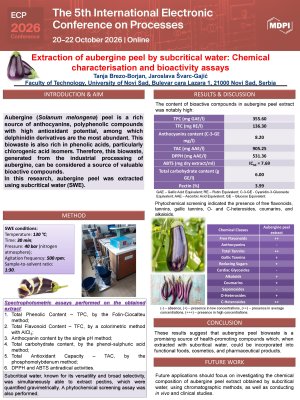
Aubergine (Solanum melongena) peel represents a rich source of anthocyanins, polyphenolic compounds with high antioxidant potential, among which delphinidin derivatives are most represented. This biowaste is also rich in phenolic acids, especially chlorogenic acid isomers. Therefore, this biowaste, generated from the industrial processing of aubergine, can be considered as a source of valuable bioactive compounds.
In this research, aubergine peel was extracted by subcritical water at 130 °C for 30 minutes in a nitrogen atmosphere at 40 bars under agitation (500 rpm). The sample-to-solvent ratio was 1:30. Spectrophotometric assays were performed to analyse total phenolic content (TPC) by Folin-Ciocalteu method, total flavonoid content (TFC) by a colorimetric method with AlCl3, and anthocyanins content by the single pH method. Total carbohydrate content, total antioxidant capacity (TAC), DPPH, and ABTS antiradical activities of the extract were also measured, along with phytochemical screening. Subcritical water, known for its versatility and broad selectivity, was able simultaneously to extract pectins, which were quantified gravimetrically.
The content of bioactive compounds in aubergine peel extract was notably high, with a TPC of 355.6 mg GAE/l, a TFC of 136.3 mg RE/l, and total anthocyanins of 8.2 mg C-3-C/l. The extract showed high antioxidant activity, with a TAC of 905.25 mg AAE/l and antiradical activity against DPPH radicals of 531.36 mg AAE/l. For ABTS radicals, the IC50 was 7.69 mg dry extract/ml. The extract contained a total carbohydrate content of 6 g/l, with pectin accounting for 3.99% of the extract. Phytochemical screening indicated the presence of free flavonoids, tannins, gallic tannins, O- and C-heterosides, coumarins, and alkaloids.
These results suggest that aubergine peel biowaste is a promising source of health-promoting compounds which, when extracted with subcritical water, could be incorporated into functional foods, cosmetics, and pharmaceutical products.
Keywords
aubergine peel
subcritical water extraction
bioactive compounds
polyphenolics
flavonoids
antioxidant activity
Poster
Sciforum-200757_Poster_Tanja Brezo-Borjan.pdf
Rapid Assessment of the K1 Freshness Index in Refrigerated Fish by Fast Protein and Metabolites Liquid Chromatography with an Automated Peak Deconvolution Algorithm
MATHEMATICAL MODELING OF THE DRYING KINETICS OF THE PHILIPPINE TARO (Colocasia esculuenta) WITH BLANCHING AS A PRETREATMENT