Event submissions
Published
This submission belongs to the session S3. Food Process Engineering of the event The 5th International Electronic Conference on Processes
Published date
15 Oct, 2026
Academic Editor
'%3e%3cpath%20d='M12.6657%2010.9104C12.4185%2010.325%2012.0599%209.79327%2011.6097%209.34482C11.1609%208.89508%2010.6293%208.5365%2010.0442%208.28888C10.0389%208.28626%2010.0337%208.28495%2010.0285%208.28233C10.8446%207.69279%2011.3752%206.73249%2011.3752%205.64904C11.3752%203.8542%209.92103%202.39999%208.1262%202.39999C6.33136%202.39999%204.87715%203.8542%204.87715%205.64904C4.87715%206.73249%205.40774%207.69279%206.22393%208.28364C6.21869%208.28626%206.21345%208.28757%206.20821%208.29019C5.62129%208.5378%205.09463%208.89284%204.64265%209.34613C4.1929%209.79493%203.83432%2010.3266%203.58671%2010.9117C3.34345%2011.4845%203.21226%2012.0987%203.20023%2012.7209C3.19988%2012.7349%203.20233%2012.7488%203.20744%2012.7619C3.21255%2012.7749%203.22022%2012.7867%203.22998%2012.7968C3.23975%2012.8068%203.25142%2012.8147%203.26431%2012.8202C3.2772%2012.8256%203.29105%2012.8284%203.30504%2012.8284H4.09109C4.14874%2012.8284%204.19459%2012.7825%204.1959%2012.7262C4.2221%2011.7148%204.62823%2010.7676%205.34617%2010.0497C6.08899%209.30683%207.0755%208.89808%208.1262%208.89808C9.17689%208.89808%2010.1634%209.30683%2010.9062%2010.0497C11.6242%2010.7676%2012.0303%2011.7148%2012.0565%2012.7262C12.0578%2012.7838%2012.1037%2012.8284%2012.1613%2012.8284H12.9474C12.9613%2012.8284%2012.9752%2012.8256%2012.9881%2012.8202C13.001%2012.8147%2013.0126%2012.8068%2013.0224%2012.7968C13.0322%2012.7867%2013.0398%2012.7749%2013.0449%2012.7619C13.0501%2012.7488%2013.0525%2012.7349%2013.0522%2012.7209C13.0391%2012.0947%2012.9094%2011.4855%2012.6657%2010.9104ZM8.1262%207.9024C7.52486%207.9024%206.9589%207.6679%206.53312%207.24211C6.10733%206.81633%205.87283%206.25037%205.87283%205.64904C5.87283%205.0477%206.10733%204.48174%206.53312%204.05596C6.9589%203.63018%207.52486%203.39567%208.1262%203.39567C8.72753%203.39567%209.29349%203.63018%209.71927%204.05596C10.1451%204.48174%2010.3796%205.0477%2010.3796%205.64904C10.3796%206.25037%2010.1451%206.81633%209.71927%207.24211C9.29349%207.6679%208.72753%207.9024%208.1262%207.9024Z'%20fill='%235D1EE1'/%3e%3c/g%3e%3c/svg%3e) Dariusz Dziki
Dariusz DzikiCitation
SONIA GUILERA BERMELL, Remedios García Bou, ANTONIO M. INAREJOS GARCIA, Recovery of pomegranate (Punica granatum L.) juice polyphenols using ultrafiltration and adsorption chromatography, in Proceedings of The 5th International Electronic Conference on Processes, 20 October–22 October 2026, MDPI: Basel, Switzerland
Share
Email
Facebook
Twitter
LinkedIn
Recovery of pomegranate (Punica granatum L.) juice polyphenols using ultrafiltration and adsorption chromatography
'%3e%3cpath%20d='M12.6647%2010.9104C12.4176%2010.325%2012.0589%209.7933%2011.6088%209.34485C11.16%208.89511%2010.6283%208.53653%2010.0432%208.28891C10.038%208.28629%2010.0327%208.28498%2010.0275%208.28236C10.8437%207.69282%2011.3743%206.73252%2011.3743%205.64907C11.3743%203.85423%209.92005%202.40002%208.12522%202.40002C6.33038%202.40002%204.87618%203.85423%204.87618%205.64907C4.87618%206.73252%205.40677%207.69282%206.22296%208.28367C6.21772%208.28629%206.21248%208.2876%206.20724%208.29022C5.62031%208.53783%205.09365%208.89287%204.64167%209.34616C4.19192%209.79496%203.83334%2010.3266%203.58573%2010.9117C3.34247%2011.4846%203.21128%2012.0987%203.19925%2012.721C3.1989%2012.735%203.20135%2012.7489%203.20646%2012.7619C3.21157%2012.7749%203.21924%2012.7868%203.22901%2012.7968C3.23877%2012.8068%203.25045%2012.8148%203.26334%2012.8202C3.27623%2012.8256%203.29007%2012.8284%203.30406%2012.8284H4.09012C4.14776%2012.8284%204.19362%2012.7825%204.19493%2012.7262C4.22113%2011.7148%204.62726%2010.7676%205.34519%2010.0497C6.08802%209.30686%207.07452%208.89811%208.12522%208.89811C9.17592%208.89811%2010.1624%209.30686%2010.9052%2010.0497C11.6232%2010.7676%2012.0293%2011.7148%2012.0555%2012.7262C12.0568%2012.7839%2012.1027%2012.8284%2012.1603%2012.8284H12.9464C12.9604%2012.8284%2012.9742%2012.8256%2012.9871%2012.8202C13%2012.8148%2013.0117%2012.8068%2013.0214%2012.7968C13.0312%2012.7868%2013.0389%2012.7749%2013.044%2012.7619C13.0491%2012.7489%2013.0515%2012.735%2013.0512%2012.721C13.0381%2012.0947%2012.9084%2011.4856%2012.6647%2010.9104ZM8.12522%207.90243C7.52388%207.90243%206.95792%207.66793%206.53214%207.24215C6.10636%206.81636%205.87185%206.2504%205.87185%205.64907C5.87185%205.04773%206.10636%204.48177%206.53214%204.05599C6.95792%203.63021%207.52388%203.3957%208.12522%203.3957C8.72655%203.3957%209.29252%203.63021%209.7183%204.05599C10.1441%204.48177%2010.3786%205.04773%2010.3786%205.64907C10.3786%206.2504%2010.1441%206.81636%209.7183%207.24215C9.29252%207.66793%208.72655%207.90243%208.12522%207.90243Z'%20fill='%235D1EE1'/%3e%3c/g%3e%3c/svg%3e)
SONIA GUILERA BERMELL 1
Remedios García Bou 2
ANTONIO M. INAREJOS GARCIA 3
1. Nutrition Archer Daniels Midland (ADM) Health & Wellness, Biopolis S. L. Parc Cientific, Universitat de València, 46980 Paterna, Spain
2. Department of Functional Extracts, ADM® Valencia, 46740 Carcaixent, Spain.
3. Archer Daniels Midland, Nutrition, Health&Wellness, Biopolis S.L. Parc Científic Universitat de València, 46980 Paterna, Spain
Abstract
Introduction
The pomegranate (Punica granatum L.) is an ancient fruit native to Persia and Central Asia. The juice is widely produced for its nutritional and functional properties, chiefly attributed to its high content of natural antioxidants such as punicalagins, ellagic acid, and derivatives.
This study focuses on the recovery of polyphenols from pomegranate juice using integrated separation processes, combining ultrafiltration for clarification and adsorption chromatography for selective concentration of polyphenolic compounds.
Material and methods
Commercial pomegranate (Punica granatum L.) juice was used as feedstock for polyphenol recovery. The juice was first clarified by ultrafiltration and subsequently processed by adsorption chromatography for selective concentration of polyphenols. The resulting enriched fractions were then stabilized by spray drying to obtain polyphenol-rich powders. Polyphenolic composition of the extracts was characterized by HPLC coupled with a diode array detector. Experiments were performed in duplicate.
Results and discussion
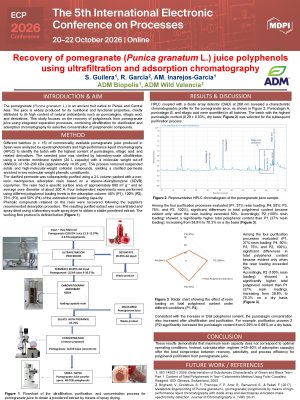
Ultrafiltration and adsorption chromatography enabled efficient recovery of polyphenols from pomegranate juice. Ultrafiltration provided a clarified feed with reduced dissolved solids for adsorption processing. Resin loading strongly affected performance: high loading (near saturation) resulted in polyphenol losses of ~30–40% due to breakthrough, while intermediate conditions showed variable efficiency. The best results were obtained at partial loading (~50% capacity), achieving 90–95% polyphenol recovery, <10% losses in the effluent, and extract purity of ~80–85% Total polyphenols (dry basis). Overall, sub-saturation operation improved selectivity, mass transfer, and process stability compared to resin overloading.
The finished powdered native extract obtained by spray drying showed a characteristic chromatographic profile of Punica granatum fruit. Compared with the initial pomegranate juice, the extract showed an approximately 13-fold increase in punicalagin content, rising from 0.29% to 3.69% on a dry basis.
Conclusions
Partial loading of the adsorption column (~50% capacity) provided optimal performance for pomegranate polyphenol recovery, achieving 90–95% recovery, low losses, and high-purity extracts. Full loading reduced efficiency due to resin saturation and breakthrough.
Keywords
pomegranate
ultrafiltration
adsorption chromatography
ellagic acid
punicalagins
HPLC
Poster
Sciforum-189367 Poster.pdf
Cryostructuring as a Strategy to Enhance the Water and Oil Absorption Capacities of Chayotextle (Sechium edule) Starch
The effect of hybrid preservation method using flow microwave pasteurization on the content of phenolic compounds in chokeberry nectar