Event submissions
Published
This submission belongs to the session S3. Food Process Engineering of the event The 5th International Electronic Conference on Processes
Published date
15 Oct, 2026
Academic Editor
'%3e%3cpath%20d='M12.6657%2010.9104C12.4185%2010.325%2012.0599%209.79327%2011.6097%209.34482C11.1609%208.89508%2010.6293%208.5365%2010.0442%208.28888C10.0389%208.28626%2010.0337%208.28495%2010.0285%208.28233C10.8446%207.69279%2011.3752%206.73249%2011.3752%205.64904C11.3752%203.8542%209.92103%202.39999%208.1262%202.39999C6.33136%202.39999%204.87715%203.8542%204.87715%205.64904C4.87715%206.73249%205.40774%207.69279%206.22393%208.28364C6.21869%208.28626%206.21345%208.28757%206.20821%208.29019C5.62129%208.5378%205.09463%208.89284%204.64265%209.34613C4.1929%209.79493%203.83432%2010.3266%203.58671%2010.9117C3.34345%2011.4845%203.21226%2012.0987%203.20023%2012.7209C3.19988%2012.7349%203.20233%2012.7488%203.20744%2012.7619C3.21255%2012.7749%203.22022%2012.7867%203.22998%2012.7968C3.23975%2012.8068%203.25142%2012.8147%203.26431%2012.8202C3.2772%2012.8256%203.29105%2012.8284%203.30504%2012.8284H4.09109C4.14874%2012.8284%204.19459%2012.7825%204.1959%2012.7262C4.2221%2011.7148%204.62823%2010.7676%205.34617%2010.0497C6.08899%209.30683%207.0755%208.89808%208.1262%208.89808C9.17689%208.89808%2010.1634%209.30683%2010.9062%2010.0497C11.6242%2010.7676%2012.0303%2011.7148%2012.0565%2012.7262C12.0578%2012.7838%2012.1037%2012.8284%2012.1613%2012.8284H12.9474C12.9613%2012.8284%2012.9752%2012.8256%2012.9881%2012.8202C13.001%2012.8147%2013.0126%2012.8068%2013.0224%2012.7968C13.0322%2012.7867%2013.0398%2012.7749%2013.0449%2012.7619C13.0501%2012.7488%2013.0525%2012.7349%2013.0522%2012.7209C13.0391%2012.0947%2012.9094%2011.4855%2012.6657%2010.9104ZM8.1262%207.9024C7.52486%207.9024%206.9589%207.6679%206.53312%207.24211C6.10733%206.81633%205.87283%206.25037%205.87283%205.64904C5.87283%205.0477%206.10733%204.48174%206.53312%204.05596C6.9589%203.63018%207.52486%203.39567%208.1262%203.39567C8.72753%203.39567%209.29349%203.63018%209.71927%204.05596C10.1451%204.48174%2010.3796%205.0477%2010.3796%205.64904C10.3796%206.25037%2010.1451%206.81633%209.71927%207.24211C9.29349%207.6679%208.72753%207.9024%208.1262%207.9024Z'%20fill='%235D1EE1'/%3e%3c/g%3e%3c/svg%3e) Dariusz Dziki
Dariusz DzikiCitation
Natalia Polak, Stanisław Kalisz, Bartosz Kruszewski, Joanna Kolniak-Ostek, Tomasz Florowski, The effect of hybrid preservation method using flow microwave pasteurization on the content of phenolic compounds in chokeberry nectar, in Proceedings of The 5th International Electronic Conference on Processes, 20 October–22 October 2026, MDPI: Basel, Switzerland
Share
Email
Facebook
Twitter
LinkedIn
The effect of hybrid preservation method using flow microwave pasteurization on the content of phenolic compounds in chokeberry nectar
'%3e%3cpath%20d='M12.6647%2010.9104C12.4176%2010.325%2012.0589%209.7933%2011.6088%209.34485C11.16%208.89511%2010.6283%208.53653%2010.0432%208.28891C10.038%208.28629%2010.0327%208.28498%2010.0275%208.28236C10.8437%207.69282%2011.3743%206.73252%2011.3743%205.64907C11.3743%203.85423%209.92005%202.40002%208.12522%202.40002C6.33038%202.40002%204.87618%203.85423%204.87618%205.64907C4.87618%206.73252%205.40677%207.69282%206.22296%208.28367C6.21772%208.28629%206.21248%208.2876%206.20724%208.29022C5.62031%208.53783%205.09365%208.89287%204.64167%209.34616C4.19192%209.79496%203.83334%2010.3266%203.58573%2010.9117C3.34247%2011.4846%203.21128%2012.0987%203.19925%2012.721C3.1989%2012.735%203.20135%2012.7489%203.20646%2012.7619C3.21157%2012.7749%203.21924%2012.7868%203.22901%2012.7968C3.23877%2012.8068%203.25045%2012.8148%203.26334%2012.8202C3.27623%2012.8256%203.29007%2012.8284%203.30406%2012.8284H4.09012C4.14776%2012.8284%204.19362%2012.7825%204.19493%2012.7262C4.22113%2011.7148%204.62726%2010.7676%205.34519%2010.0497C6.08802%209.30686%207.07452%208.89811%208.12522%208.89811C9.17592%208.89811%2010.1624%209.30686%2010.9052%2010.0497C11.6232%2010.7676%2012.0293%2011.7148%2012.0555%2012.7262C12.0568%2012.7839%2012.1027%2012.8284%2012.1603%2012.8284H12.9464C12.9604%2012.8284%2012.9742%2012.8256%2012.9871%2012.8202C13%2012.8148%2013.0117%2012.8068%2013.0214%2012.7968C13.0312%2012.7868%2013.0389%2012.7749%2013.044%2012.7619C13.0491%2012.7489%2013.0515%2012.735%2013.0512%2012.721C13.0381%2012.0947%2012.9084%2011.4856%2012.6647%2010.9104ZM8.12522%207.90243C7.52388%207.90243%206.95792%207.66793%206.53214%207.24215C6.10636%206.81636%205.87185%206.2504%205.87185%205.64907C5.87185%205.04773%206.10636%204.48177%206.53214%204.05599C6.95792%203.63021%207.52388%203.3957%208.12522%203.3957C8.72655%203.3957%209.29252%203.63021%209.7183%204.05599C10.1441%204.48177%2010.3786%205.04773%2010.3786%205.64907C10.3786%206.2504%2010.1441%206.81636%209.7183%207.24215C9.29252%207.66793%208.72655%207.90243%208.12522%207.90243Z'%20fill='%235D1EE1'/%3e%3c/g%3e%3c/svg%3e)
Natalia Polak 1
Stanisław Kalisz 1
Bartosz Kruszewski 1

Joanna Kolniak-Ostek 2

Tomasz Florowski 1
1. Department of Food Technology and Assessment, Institute of Food Sciences, Warsaw University of Life Sciences—SGGW, 02-776 Warsaw, Poland
2. Department of Fruit, Vegetable and Plant Nutraceutical Technology, Wrocław University of Environmental and Life Sciences – Wrocław, 51-630, Poland
Abstract
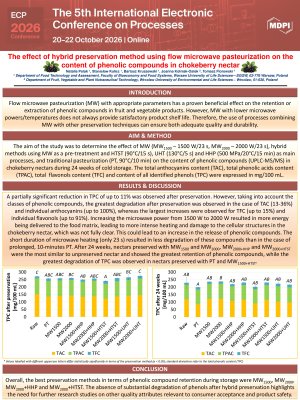
Flow microwave pasteurization (MW) has a proven beneficial effect on the retention or extraction of phenolic compounds when appropriate parameters are used. However, at lower microwave powers/ temperatures MW does not always provide satisfactory product shelf life. Therefore, the use of processes combining MW with other preservation techniques can ensure both adequate quality and durability. The aim of the study was to determine the effect of flow microwave pasteurization (MW1500 – 1500 W/23 s, MW2000 – 2000 W/23 s), hybrid methods using MW as a pre-treatment and HTST (90 °C/15 s), UHT (130 °C/5 s) and HHP (500 MPa/20 °C/15 min) as main processes, and traditional pasteurization (PT, 90 °C/10 min) on the content of phenolic compounds (UPLC-MS/MS) in chokeberry nectars during 24 weeks of cold storage. 20 phenolic compounds were identified – 6 anthocyanins, 2 phenolic acids and 12 flavonols. In most cases, a decreasing trend in the content of individual phenolic compounds was observed. The greatest degradation was observed in the case of total anthocyanins content (13-36%) and individual anthocyanins (up to 100% for free cyanidin), whereas the largest increases were observed for total flavonol content (up to 15%) and individual flavonols (up to 91% - for quercetin-O-deoxyhexose-O-deoxyhexoside). After 24 weeks, nectars preserved with MW1500 and MW2000 were the most similar to unpreserved nectar and showed the greatest retention of phenolic compounds, while considering only hybrid techniques - MW2000+HHP and MW2000+HTST. The greatest degradation of total phenolic compounds content was observed in nectars preserved with PT and MW1500+HTST. Overall, the best preservation methods in terms of phenolic compound retention were MW1500, MW2000, MW2000+HHP and MW2000+HTST. The absence of substantial degradation of phenols after hybrid preservation highlights the need for further research studies on other quality attributs relevant to consumer acceptance and product safety.
Keywords
flow microwave pasteurization
phenolic compounds
chokeberry
hybrid preservation techniques
Poster
Poster Natalia Polak.pdf
Recovery of pomegranate (Punica granatum L.) juice polyphenols using ultrafiltration and adsorption chromatography
Obtaining bio-based nutraceutical matrices through bioencapsulation of natural antioxidants in spent yeast