Event submissions
Published
This submission belongs to the session S6. Energy Systems of the event The 5th International Electronic Conference on Processes
Published date
15 Oct, 2026
Academic Editor
'%3e%3cpath%20d='M12.6657%2010.9104C12.4185%2010.325%2012.0599%209.79327%2011.6097%209.34482C11.1609%208.89508%2010.6293%208.5365%2010.0442%208.28888C10.0389%208.28626%2010.0337%208.28495%2010.0285%208.28233C10.8446%207.69279%2011.3752%206.73249%2011.3752%205.64904C11.3752%203.8542%209.92103%202.39999%208.1262%202.39999C6.33136%202.39999%204.87715%203.8542%204.87715%205.64904C4.87715%206.73249%205.40774%207.69279%206.22393%208.28364C6.21869%208.28626%206.21345%208.28757%206.20821%208.29019C5.62129%208.5378%205.09463%208.89284%204.64265%209.34613C4.1929%209.79493%203.83432%2010.3266%203.58671%2010.9117C3.34345%2011.4845%203.21226%2012.0987%203.20023%2012.7209C3.19988%2012.7349%203.20233%2012.7488%203.20744%2012.7619C3.21255%2012.7749%203.22022%2012.7867%203.22998%2012.7968C3.23975%2012.8068%203.25142%2012.8147%203.26431%2012.8202C3.2772%2012.8256%203.29105%2012.8284%203.30504%2012.8284H4.09109C4.14874%2012.8284%204.19459%2012.7825%204.1959%2012.7262C4.2221%2011.7148%204.62823%2010.7676%205.34617%2010.0497C6.08899%209.30683%207.0755%208.89808%208.1262%208.89808C9.17689%208.89808%2010.1634%209.30683%2010.9062%2010.0497C11.6242%2010.7676%2012.0303%2011.7148%2012.0565%2012.7262C12.0578%2012.7838%2012.1037%2012.8284%2012.1613%2012.8284H12.9474C12.9613%2012.8284%2012.9752%2012.8256%2012.9881%2012.8202C13.001%2012.8147%2013.0126%2012.8068%2013.0224%2012.7968C13.0322%2012.7867%2013.0398%2012.7749%2013.0449%2012.7619C13.0501%2012.7488%2013.0525%2012.7349%2013.0522%2012.7209C13.0391%2012.0947%2012.9094%2011.4855%2012.6657%2010.9104ZM8.1262%207.9024C7.52486%207.9024%206.9589%207.6679%206.53312%207.24211C6.10733%206.81633%205.87283%206.25037%205.87283%205.64904C5.87283%205.0477%206.10733%204.48174%206.53312%204.05596C6.9589%203.63018%207.52486%203.39567%208.1262%203.39567C8.72753%203.39567%209.29349%203.63018%209.71927%204.05596C10.1451%204.48174%2010.3796%205.0477%2010.3796%205.64904C10.3796%206.25037%2010.1451%206.81633%209.71927%207.24211C9.29349%207.6679%208.72753%207.9024%208.1262%207.9024Z'%20fill='%235D1EE1'/%3e%3c/g%3e%3c/svg%3e) Blaž Likozar
Blaž LikozarContribution&Funding
Conceptualization,
[Abida TOUMI]
Methodology,
[Abir Betka]
Software,
[Abir Betka]
Validation,
[Naima Rahoua]
Formal analysis,
[Naima Rahoua]
Resources,
[Nassima Bekhoucha]
Data curation,
[Nassima Bekhoucha]
Writing - original draft,
[Abida TOUMI]
Project administration,
[Abida TOUMI]
Funding: --
Citation
Abida TOUMI, Abir Betka, Naima Rahoua, Nassima Bekhoucha, Adaptive Fossa Search with Tiered Surrogates for Wind Blade Aerodynamics, in Proceedings of The 5th International Electronic Conference on Processes, 20 October–22 October 2026, MDPI: Basel, Switzerland
Share
Email
Facebook
Twitter
LinkedIn
Adaptive Fossa Search with Tiered Surrogates for Wind Blade Aerodynamics
'%3e%3cpath%20d='M12.6647%2010.9104C12.4176%2010.325%2012.0589%209.7933%2011.6088%209.34485C11.16%208.89511%2010.6283%208.53653%2010.0432%208.28891C10.038%208.28629%2010.0327%208.28498%2010.0275%208.28236C10.8437%207.69282%2011.3743%206.73252%2011.3743%205.64907C11.3743%203.85423%209.92005%202.40002%208.12522%202.40002C6.33038%202.40002%204.87618%203.85423%204.87618%205.64907C4.87618%206.73252%205.40677%207.69282%206.22296%208.28367C6.21772%208.28629%206.21248%208.2876%206.20724%208.29022C5.62031%208.53783%205.09365%208.89287%204.64167%209.34616C4.19192%209.79496%203.83334%2010.3266%203.58573%2010.9117C3.34247%2011.4846%203.21128%2012.0987%203.19925%2012.721C3.1989%2012.735%203.20135%2012.7489%203.20646%2012.7619C3.21157%2012.7749%203.21924%2012.7868%203.22901%2012.7968C3.23877%2012.8068%203.25045%2012.8148%203.26334%2012.8202C3.27623%2012.8256%203.29007%2012.8284%203.30406%2012.8284H4.09012C4.14776%2012.8284%204.19362%2012.7825%204.19493%2012.7262C4.22113%2011.7148%204.62726%2010.7676%205.34519%2010.0497C6.08802%209.30686%207.07452%208.89811%208.12522%208.89811C9.17592%208.89811%2010.1624%209.30686%2010.9052%2010.0497C11.6232%2010.7676%2012.0293%2011.7148%2012.0555%2012.7262C12.0568%2012.7839%2012.1027%2012.8284%2012.1603%2012.8284H12.9464C12.9604%2012.8284%2012.9742%2012.8256%2012.9871%2012.8202C13%2012.8148%2013.0117%2012.8068%2013.0214%2012.7968C13.0312%2012.7868%2013.0389%2012.7749%2013.044%2012.7619C13.0491%2012.7489%2013.0515%2012.735%2013.0512%2012.721C13.0381%2012.0947%2012.9084%2011.4856%2012.6647%2010.9104ZM8.12522%207.90243C7.52388%207.90243%206.95792%207.66793%206.53214%207.24215C6.10636%206.81636%205.87185%206.2504%205.87185%205.64907C5.87185%205.04773%206.10636%204.48177%206.53214%204.05599C6.95792%203.63021%207.52388%203.3957%208.12522%203.3957C8.72655%203.3957%209.29252%203.63021%209.7183%204.05599C10.1441%204.48177%2010.3786%205.04773%2010.3786%205.64907C10.3786%206.2504%2010.1441%206.81636%209.7183%207.24215C9.29252%207.66793%208.72655%207.90243%208.12522%207.90243Z'%20fill='%235D1EE1'/%3e%3c/g%3e%3c/svg%3e)
Abida TOUMI 1

Abir Betka 2
Naima Rahoua 3
Nassima Bekhoucha 3
1. Electronics and Automation, University Mohamed Khider, Biskra, 07000, Algeria
2. Electrical Engineering, University of Hama Lakhdar, El Oued, 39000, Algeria
3. Electrical Engineering, University Mohamed Khider, Biskra, 07000, Algeria
Abstract
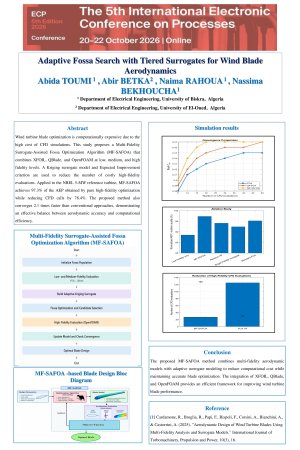
Wind turbine blade design requires expensive Computational Fluid Dynamics (CFD) simulations to evaluate aerodynamic performance, making conventional optimization prohibitively costly. Surrogate-assisted metaheuristics offer a promising alternative, yet most approaches rely on single-fidelity approximations that struggle to balance accuracy and computational efficiency. This study proposes a Multi-Fidelity Surrogate-Assisted Fossa Optimization Algorithm (MF-SAFOA) for wind blade aerodynamic design. The method integrates three fidelity levels: XFOIL for rapid 2D airfoil analysis (low-fidelity), QBlade for Blade Element Momentum evaluation (medium-fidelity), and OpenFOAM for 3D RANS simulation (high-fidelity). An adaptive Kriging surrogate model is constructed from low- and medium-fidelity samples, while an Expected Improvement infill criterion selectively triggers high-fidelity evaluations only in promising regions. The Fossa Optimization Algorithm explores the design space using opposition-based learning and a memory mechanism, with repair operators enforcing structural and geometric constraints. Validation on the NREL 5-MW reference turbine demonstrates that MF-SAFOA achieves 97.3% of the Annual Energy Production (AEP) obtained by pure high-fidelity optimization while reducing CFD calls by 78.4%. Compared to single-fidelity surrogate methods and standard FOA, the proposed approach converges 2.1× faster with superior solution quality. Ablation studies confirm that the multi-fidelity strategy outperforms both low-fidelity-only and random high-fidelity infill approaches. The MF-SAFOA framework provides an efficient, license-free pathway for high-dimensional wind blade optimization, making expensive CFD-based design accessible for academic and industrial applications.
Keywords
Wind turbine blade design; Multi-fidelity optimization; Surrogate-assisted metaheuristic; Fossa Optimization Algorithm; Computational Fluid Dynamics
Poster
poster_TOUMI.pdf
A Response Time Aware Extension of the Flying Duck Formation Energy Optimization Algorithm for Cluster Head Selection in Wireless Sensor Networks
Isolation And Identification of Probiotic Lactic Acid Bacteria from Local Cheese (Awara) in Zaria, Kaduna state, Nigeria