Event submissions
Published
This submission belongs to the session S6. Energy Systems of the event The 5th International Electronic Conference on Processes
Published date
15 Oct, 2026
Academic Editor
'%3e%3cpath%20d='M12.6657%2010.9104C12.4185%2010.325%2012.0599%209.79327%2011.6097%209.34482C11.1609%208.89508%2010.6293%208.5365%2010.0442%208.28888C10.0389%208.28626%2010.0337%208.28495%2010.0285%208.28233C10.8446%207.69279%2011.3752%206.73249%2011.3752%205.64904C11.3752%203.8542%209.92103%202.39999%208.1262%202.39999C6.33136%202.39999%204.87715%203.8542%204.87715%205.64904C4.87715%206.73249%205.40774%207.69279%206.22393%208.28364C6.21869%208.28626%206.21345%208.28757%206.20821%208.29019C5.62129%208.5378%205.09463%208.89284%204.64265%209.34613C4.1929%209.79493%203.83432%2010.3266%203.58671%2010.9117C3.34345%2011.4845%203.21226%2012.0987%203.20023%2012.7209C3.19988%2012.7349%203.20233%2012.7488%203.20744%2012.7619C3.21255%2012.7749%203.22022%2012.7867%203.22998%2012.7968C3.23975%2012.8068%203.25142%2012.8147%203.26431%2012.8202C3.2772%2012.8256%203.29105%2012.8284%203.30504%2012.8284H4.09109C4.14874%2012.8284%204.19459%2012.7825%204.1959%2012.7262C4.2221%2011.7148%204.62823%2010.7676%205.34617%2010.0497C6.08899%209.30683%207.0755%208.89808%208.1262%208.89808C9.17689%208.89808%2010.1634%209.30683%2010.9062%2010.0497C11.6242%2010.7676%2012.0303%2011.7148%2012.0565%2012.7262C12.0578%2012.7838%2012.1037%2012.8284%2012.1613%2012.8284H12.9474C12.9613%2012.8284%2012.9752%2012.8256%2012.9881%2012.8202C13.001%2012.8147%2013.0126%2012.8068%2013.0224%2012.7968C13.0322%2012.7867%2013.0398%2012.7749%2013.0449%2012.7619C13.0501%2012.7488%2013.0525%2012.7349%2013.0522%2012.7209C13.0391%2012.0947%2012.9094%2011.4855%2012.6657%2010.9104ZM8.1262%207.9024C7.52486%207.9024%206.9589%207.6679%206.53312%207.24211C6.10733%206.81633%205.87283%206.25037%205.87283%205.64904C5.87283%205.0477%206.10733%204.48174%206.53312%204.05596C6.9589%203.63018%207.52486%203.39567%208.1262%203.39567C8.72753%203.39567%209.29349%203.63018%209.71927%204.05596C10.1451%204.48174%2010.3796%205.0477%2010.3796%205.64904C10.3796%206.25037%2010.1451%206.81633%209.71927%207.24211C9.29349%207.6679%208.72753%207.9024%208.1262%207.9024Z'%20fill='%235D1EE1'/%3e%3c/g%3e%3c/svg%3e) Blaž Likozar
Blaž LikozarCitation
DJEMA OUSSAMA, Rahma ZAKAR, Samia LEMBOUB, Boutaleb Labdelli, Abbes Marref, Abdelghani Boucheham, Kheira Bekhedda, Amar Manseri, Liamine Kaba, Ridha Badi, Ghulam Abbas, Hugo Águas, Effect of Laser Scanning Speed on the Ablation of SiNₓ/ SiO₂ Passivation Stacks for realization of Al local rear contacts in n-PERT RJ Si solar cells, in Proceedings of The 5th International Electronic Conference on Processes, 20 October–22 October 2026, MDPI: Basel, Switzerland
Share
Email
Facebook
Twitter
LinkedIn
Effect of Laser Scanning Speed on the Ablation of SiNₓ/ SiO₂ Passivation Stacks for realization of Al local rear contacts in n-PERT RJ Si solar cells
'%3e%3cpath%20d='M12.6647%2010.9104C12.4176%2010.325%2012.0589%209.7933%2011.6088%209.34485C11.16%208.89511%2010.6283%208.53653%2010.0432%208.28891C10.038%208.28629%2010.0327%208.28498%2010.0275%208.28236C10.8437%207.69282%2011.3743%206.73252%2011.3743%205.64907C11.3743%203.85423%209.92005%202.40002%208.12522%202.40002C6.33038%202.40002%204.87618%203.85423%204.87618%205.64907C4.87618%206.73252%205.40677%207.69282%206.22296%208.28367C6.21772%208.28629%206.21248%208.2876%206.20724%208.29022C5.62031%208.53783%205.09365%208.89287%204.64167%209.34616C4.19192%209.79496%203.83334%2010.3266%203.58573%2010.9117C3.34247%2011.4846%203.21128%2012.0987%203.19925%2012.721C3.1989%2012.735%203.20135%2012.7489%203.20646%2012.7619C3.21157%2012.7749%203.21924%2012.7868%203.22901%2012.7968C3.23877%2012.8068%203.25045%2012.8148%203.26334%2012.8202C3.27623%2012.8256%203.29007%2012.8284%203.30406%2012.8284H4.09012C4.14776%2012.8284%204.19362%2012.7825%204.19493%2012.7262C4.22113%2011.7148%204.62726%2010.7676%205.34519%2010.0497C6.08802%209.30686%207.07452%208.89811%208.12522%208.89811C9.17592%208.89811%2010.1624%209.30686%2010.9052%2010.0497C11.6232%2010.7676%2012.0293%2011.7148%2012.0555%2012.7262C12.0568%2012.7839%2012.1027%2012.8284%2012.1603%2012.8284H12.9464C12.9604%2012.8284%2012.9742%2012.8256%2012.9871%2012.8202C13%2012.8148%2013.0117%2012.8068%2013.0214%2012.7968C13.0312%2012.7868%2013.0389%2012.7749%2013.044%2012.7619C13.0491%2012.7489%2013.0515%2012.735%2013.0512%2012.721C13.0381%2012.0947%2012.9084%2011.4856%2012.6647%2010.9104ZM8.12522%207.90243C7.52388%207.90243%206.95792%207.66793%206.53214%207.24215C6.10636%206.81636%205.87185%206.2504%205.87185%205.64907C5.87185%205.04773%206.10636%204.48177%206.53214%204.05599C6.95792%203.63021%207.52388%203.3957%208.12522%203.3957C8.72655%203.3957%209.29252%203.63021%209.7183%204.05599C10.1441%204.48177%2010.3786%205.04773%2010.3786%205.64907C10.3786%206.2504%2010.1441%206.81636%209.7183%207.24215C9.29252%207.66793%208.72655%207.90243%208.12522%207.90243Z'%20fill='%235D1EE1'/%3e%3c/g%3e%3c/svg%3e)
DJEMA OUSSAMA 1
Rahma ZAKAR 2
Samia LEMBOUB 2
Boutaleb Labdelli 1
Abbes Marref 1
Abdelghani Boucheham 1
Kheira Bekhedda 1
Amar Manseri 1
Liamine Kaba 3
Ridha Badi 4
Ghulam Abbas 5

Hugo Águas 5
1. Semiconductor Conversion Devices Development Division (DDCS). Research Center in Semi-conductors Technology for Energetic (CRTSE). 02 Dr. Frantz Fanon Boulevard, P.O. Box 140, Algiers 16038, Algeria.
2. Department of Mining Engineering, Metallurgy and Materials. National Higher School of Technology and Engineering (ENSI). 2000-Seat Pedagogical Campus, Sidi Amar, Annaba 23000, Algeria.
3. DIVISION OF WELDING AND ASSEMBLY TECHNIQUES. Research Centre in Industrial Technologies (CRTI). P.O. Box 64, Dely Brahim Road, Chéraga, Algiers 16014, Algeria.
4. MECHANICS AND MATERIALS DEVELOPMENT DIVISION. Research Centre in Industrial Technologies (CRTI). P.O. Box 64, Dely Brahim Road, Chéraga, Algiers 16014, Algeria.
5. fi3N/CENIMAT, Department of Materials Science, NOVA School of Science and Technology and CEMOP/UNINOVA, Campus de Caparica, 2829-516 Caparica, Portugal.
Abstract
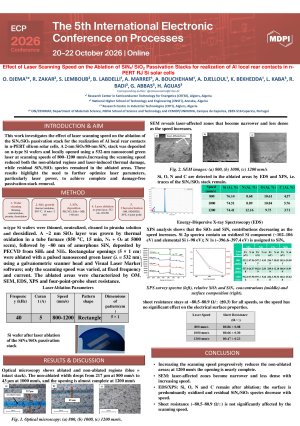
This work investigates the effect of laser scanning speed on the ablation of the SiNₓ/SiO₂ passivation stack for the realization of Al local rear contacts in n-PERT silicon solar cells. For this, SiNₓ/SiO₂ passivation stack was realized on n-type Si wafer. The SiNₓ/SiO₂ passivation stack consisted of a 2-nm-thick SiO₂ layer formed by thermal oxidation in a tube furnace and an 80-nm-thick SiNₓ layer deposited by plasma-enhanced chemical vapor deposition (PECVD). Local openings of the SiNₓ/SiO₂ passivation stack were then performed by laser ablation using a nanosecond (ns) green laser with a wavelength of 532 nm and varying the scanning speed from 800 to 1400 mm/s in increments of 200 mm/s. Optical microscopy showed that the laser-treated surface consisted of both ablated and non-ablated regions. The width of the non-ablated SiNₓ/SiO₂ passivation stack decreases with increasing the laser scanning speed. Scanning electron microscopy (SEM) analysis revealed that laser-induced thermal damage in the ablated regions decreased with increasing the laser scanning speed. Energy-dispersive X-ray spectroscopy (EDS) indicated the presence of traces of residual SiNₓ/SiO₂ passivation stack in the ablated areas. X-ray photoelectron spectroscopy (XPS) analysis showed that the amount of these residual species decreased with increasing laser scanning speed. These results indicate that a complete removal of the SiNₓ/SiO₂ passivation stack requires optimization of additional laser-processing parameters, such as laser power, which will be investigated in future work
Keywords
n-PERT Si solar cells
SiNₓ/SiO₂ passivation stack
Laser Speed
Al local rear contacts
Poster
Oussama DJEMA-Poster-The 5th International Electronic Conference on Processe.pdf
Production of High-Efficiency Bio-Briquettes via Carbonization of Coconut Shells and Comparative FTIR Spectroscopic Analysis
Computational Screening of Metal Oxide Support Materials for CO2 Conversion Catalysts: Stability and Interaction Analysis