Event submissions
Published
This submission belongs to the session S5. Materials Manufacturing and Sustainable Packaging of the event The 5th International Electronic Conference on Processes
Published date
15 Oct, 2026
Academic Editor
'%3e%3cpath%20d='M12.6657%2010.9104C12.4185%2010.325%2012.0599%209.79327%2011.6097%209.34482C11.1609%208.89508%2010.6293%208.5365%2010.0442%208.28888C10.0389%208.28626%2010.0337%208.28495%2010.0285%208.28233C10.8446%207.69279%2011.3752%206.73249%2011.3752%205.64904C11.3752%203.8542%209.92103%202.39999%208.1262%202.39999C6.33136%202.39999%204.87715%203.8542%204.87715%205.64904C4.87715%206.73249%205.40774%207.69279%206.22393%208.28364C6.21869%208.28626%206.21345%208.28757%206.20821%208.29019C5.62129%208.5378%205.09463%208.89284%204.64265%209.34613C4.1929%209.79493%203.83432%2010.3266%203.58671%2010.9117C3.34345%2011.4845%203.21226%2012.0987%203.20023%2012.7209C3.19988%2012.7349%203.20233%2012.7488%203.20744%2012.7619C3.21255%2012.7749%203.22022%2012.7867%203.22998%2012.7968C3.23975%2012.8068%203.25142%2012.8147%203.26431%2012.8202C3.2772%2012.8256%203.29105%2012.8284%203.30504%2012.8284H4.09109C4.14874%2012.8284%204.19459%2012.7825%204.1959%2012.7262C4.2221%2011.7148%204.62823%2010.7676%205.34617%2010.0497C6.08899%209.30683%207.0755%208.89808%208.1262%208.89808C9.17689%208.89808%2010.1634%209.30683%2010.9062%2010.0497C11.6242%2010.7676%2012.0303%2011.7148%2012.0565%2012.7262C12.0578%2012.7838%2012.1037%2012.8284%2012.1613%2012.8284H12.9474C12.9613%2012.8284%2012.9752%2012.8256%2012.9881%2012.8202C13.001%2012.8147%2013.0126%2012.8068%2013.0224%2012.7968C13.0322%2012.7867%2013.0398%2012.7749%2013.0449%2012.7619C13.0501%2012.7488%2013.0525%2012.7349%2013.0522%2012.7209C13.0391%2012.0947%2012.9094%2011.4855%2012.6657%2010.9104ZM8.1262%207.9024C7.52486%207.9024%206.9589%207.6679%206.53312%207.24211C6.10733%206.81633%205.87283%206.25037%205.87283%205.64904C5.87283%205.0477%206.10733%204.48174%206.53312%204.05596C6.9589%203.63018%207.52486%203.39567%208.1262%203.39567C8.72753%203.39567%209.29349%203.63018%209.71927%204.05596C10.1451%204.48174%2010.3796%205.0477%2010.3796%205.64904C10.3796%206.25037%2010.1451%206.81633%209.71927%207.24211C9.29349%207.6679%208.72753%207.9024%208.1262%207.9024Z'%20fill='%235D1EE1'/%3e%3c/g%3e%3c/svg%3e) Adina Magdalena Musuc
Adina Magdalena MusucCitation
Amina AICHOUR, Hakim Djafer Khodja, Development and Characterization of Biodegradable Alginate Films for Sustainable Packaging Applications: A Case Study on Strawberry Preservation, in Proceedings of The 5th International Electronic Conference on Processes, 20 October–22 October 2026, MDPI: Basel, Switzerland
Share
Email
Facebook
Twitter
LinkedIn
Development and Characterization of Biodegradable Alginate Films for Sustainable Packaging Applications: A Case Study on Strawberry Preservation
'%3e%3cpath%20d='M12.6647%2010.9104C12.4176%2010.325%2012.0589%209.7933%2011.6088%209.34485C11.16%208.89511%2010.6283%208.53653%2010.0432%208.28891C10.038%208.28629%2010.0327%208.28498%2010.0275%208.28236C10.8437%207.69282%2011.3743%206.73252%2011.3743%205.64907C11.3743%203.85423%209.92005%202.40002%208.12522%202.40002C6.33038%202.40002%204.87618%203.85423%204.87618%205.64907C4.87618%206.73252%205.40677%207.69282%206.22296%208.28367C6.21772%208.28629%206.21248%208.2876%206.20724%208.29022C5.62031%208.53783%205.09365%208.89287%204.64167%209.34616C4.19192%209.79496%203.83334%2010.3266%203.58573%2010.9117C3.34247%2011.4846%203.21128%2012.0987%203.19925%2012.721C3.1989%2012.735%203.20135%2012.7489%203.20646%2012.7619C3.21157%2012.7749%203.21924%2012.7868%203.22901%2012.7968C3.23877%2012.8068%203.25045%2012.8148%203.26334%2012.8202C3.27623%2012.8256%203.29007%2012.8284%203.30406%2012.8284H4.09012C4.14776%2012.8284%204.19362%2012.7825%204.19493%2012.7262C4.22113%2011.7148%204.62726%2010.7676%205.34519%2010.0497C6.08802%209.30686%207.07452%208.89811%208.12522%208.89811C9.17592%208.89811%2010.1624%209.30686%2010.9052%2010.0497C11.6232%2010.7676%2012.0293%2011.7148%2012.0555%2012.7262C12.0568%2012.7839%2012.1027%2012.8284%2012.1603%2012.8284H12.9464C12.9604%2012.8284%2012.9742%2012.8256%2012.9871%2012.8202C13%2012.8148%2013.0117%2012.8068%2013.0214%2012.7968C13.0312%2012.7868%2013.0389%2012.7749%2013.044%2012.7619C13.0491%2012.7489%2013.0515%2012.735%2013.0512%2012.721C13.0381%2012.0947%2012.9084%2011.4856%2012.6647%2010.9104ZM8.12522%207.90243C7.52388%207.90243%206.95792%207.66793%206.53214%207.24215C6.10636%206.81636%205.87185%206.2504%205.87185%205.64907C5.87185%205.04773%206.10636%204.48177%206.53214%204.05599C6.95792%203.63021%207.52388%203.3957%208.12522%203.3957C8.72655%203.3957%209.29252%203.63021%209.7183%204.05599C10.1441%204.48177%2010.3786%205.04773%2010.3786%205.64907C10.3786%206.2504%2010.1441%206.81636%209.7183%207.24215C9.29252%207.66793%208.72655%207.90243%208.12522%207.90243Z'%20fill='%235D1EE1'/%3e%3c/g%3e%3c/svg%3e)
Amina AICHOUR 1,2
Hakim Djafer Khodja 2,3
1. Department of Industrial Chemical Technology, Institute of Technology, University of Akli Mohand Oulhadj Bouira, Algeria
2. Laboratory of Processes for Materials, Energy, Water and Environment. Faculty of Science and Technology, University of Bouira, Bouira, 10000, Algeria
3. Department of Water Engineering, Institute of Technology, University of Akli Mohand Oulhadj Bouira, Algeria
Abstract
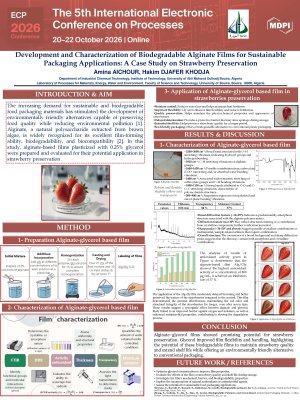
The increasing demand for sustainable and biodegradable food packaging materials has stimulated the development of environmentally friendly alternatives capable of preserving food quality while reducing environmental pollution. Alginate, a natural polysaccharide extracted from brown algae, is widely recognized for its excellent film-forming ability, biodegradability, and biocompatibility. In this study, alginate-based films plasticized with 0.25% glycerol were prepared and evaluated for their potential application in strawberry preservation.
The developed films were characterized by organoleptic evaluation, thickness measurement, moisture content, swelling index, transparency, water vapor permeability (WVP), antioxidant activity, and mechanical properties. Their structural and morphological characteristics were investigated using Fourier Transform Infrared Spectroscopy (FTIR), X-ray Diffraction (XRD), and Scanning Electron Microscopy (SEM).
FTIR analysis confirmed intermolecular interactions between alginate and glycerol through characteristic shifts in absorption bands, while XRD patterns revealed the predominantly amorphous nature of the films. SEM images showed relatively smooth and homogeneous surfaces with only minor imperfections. Mechanical analysis demonstrated that the films possessed a high Young's modulus (32.8 MPa) and tensile strength (10.2 MPa), together with a low elongation at break (3.5%), indicating a rigid and cohesive polymer network with limited flexibility. The films exhibited a swelling index of 43.98% and a water vapor permeability of 0.365 g•m/(m²•s•Pa), reflecting moderate moisture barrier properties suitable for food packaging applications. In addition, films exhibit modest and relatively stable activity, around 23–28 %, with no significant increase with concentration, suggesting low antioxidant capacity. When applied as packaging for fresh strawberries, the alginate films effectively maintained fruit quality and delayed visible spoilage during storage compared with uncoated samples.
Overall, these findings demonstrate that glycerol-plasticized alginate films are promising biodegradable packaging materials with suitable physicochemical, mechanical, and antioxidant properties for extending the shelf life of fresh fruits. The developed films offer a sustainable alternative to conventional petroleum-based food packaging.
Keywords
Alginate
biodegradable films
food packaging
physicochemical characterization
antioxidant activity
strawberry preservation.
Poster
Poster AICHOUR and DJAFER KHODJA.pdf
Integration of polymer optical fibers in textiles by sewing
Design and Implementation of a Smart IoT-Based Energy Management System for Photovoltaic Systems with Micro-Inverters