Event submissions
Published
This submission belongs to the session S5. Materials Manufacturing and Sustainable Packaging of the event The 5th International Electronic Conference on Processes
Published date
15 Oct, 2026
Academic Editor
'%3e%3cpath%20d='M12.6657%2010.9104C12.4185%2010.325%2012.0599%209.79327%2011.6097%209.34482C11.1609%208.89508%2010.6293%208.5365%2010.0442%208.28888C10.0389%208.28626%2010.0337%208.28495%2010.0285%208.28233C10.8446%207.69279%2011.3752%206.73249%2011.3752%205.64904C11.3752%203.8542%209.92103%202.39999%208.1262%202.39999C6.33136%202.39999%204.87715%203.8542%204.87715%205.64904C4.87715%206.73249%205.40774%207.69279%206.22393%208.28364C6.21869%208.28626%206.21345%208.28757%206.20821%208.29019C5.62129%208.5378%205.09463%208.89284%204.64265%209.34613C4.1929%209.79493%203.83432%2010.3266%203.58671%2010.9117C3.34345%2011.4845%203.21226%2012.0987%203.20023%2012.7209C3.19988%2012.7349%203.20233%2012.7488%203.20744%2012.7619C3.21255%2012.7749%203.22022%2012.7867%203.22998%2012.7968C3.23975%2012.8068%203.25142%2012.8147%203.26431%2012.8202C3.2772%2012.8256%203.29105%2012.8284%203.30504%2012.8284H4.09109C4.14874%2012.8284%204.19459%2012.7825%204.1959%2012.7262C4.2221%2011.7148%204.62823%2010.7676%205.34617%2010.0497C6.08899%209.30683%207.0755%208.89808%208.1262%208.89808C9.17689%208.89808%2010.1634%209.30683%2010.9062%2010.0497C11.6242%2010.7676%2012.0303%2011.7148%2012.0565%2012.7262C12.0578%2012.7838%2012.1037%2012.8284%2012.1613%2012.8284H12.9474C12.9613%2012.8284%2012.9752%2012.8256%2012.9881%2012.8202C13.001%2012.8147%2013.0126%2012.8068%2013.0224%2012.7968C13.0322%2012.7867%2013.0398%2012.7749%2013.0449%2012.7619C13.0501%2012.7488%2013.0525%2012.7349%2013.0522%2012.7209C13.0391%2012.0947%2012.9094%2011.4855%2012.6657%2010.9104ZM8.1262%207.9024C7.52486%207.9024%206.9589%207.6679%206.53312%207.24211C6.10733%206.81633%205.87283%206.25037%205.87283%205.64904C5.87283%205.0477%206.10733%204.48174%206.53312%204.05596C6.9589%203.63018%207.52486%203.39567%208.1262%203.39567C8.72753%203.39567%209.29349%203.63018%209.71927%204.05596C10.1451%204.48174%2010.3796%205.0477%2010.3796%205.64904C10.3796%206.25037%2010.1451%206.81633%209.71927%207.24211C9.29349%207.6679%208.72753%207.9024%208.1262%207.9024Z'%20fill='%235D1EE1'/%3e%3c/g%3e%3c/svg%3e) Adina Magdalena Musuc
Adina Magdalena MusucCitation
Salem KRIM, Hind Houria BOUGHERRA, Lamia TAOUZINET, Salima ADJIRI, Sabiha BECHIR, Spent Bleaching Earth as a Renewable Filler for Sustainable HDPE Composite Manufacturing, in Proceedings of The 5th International Electronic Conference on Processes, 20 October–22 October 2026, MDPI: Basel, Switzerland
Share
Email
Facebook
Twitter
LinkedIn
Spent Bleaching Earth as a Renewable Filler for Sustainable HDPE Composite Manufacturing
'%3e%3cpath%20d='M12.6647%2010.9104C12.4176%2010.325%2012.0589%209.7933%2011.6088%209.34485C11.16%208.89511%2010.6283%208.53653%2010.0432%208.28891C10.038%208.28629%2010.0327%208.28498%2010.0275%208.28236C10.8437%207.69282%2011.3743%206.73252%2011.3743%205.64907C11.3743%203.85423%209.92005%202.40002%208.12522%202.40002C6.33038%202.40002%204.87618%203.85423%204.87618%205.64907C4.87618%206.73252%205.40677%207.69282%206.22296%208.28367C6.21772%208.28629%206.21248%208.2876%206.20724%208.29022C5.62031%208.53783%205.09365%208.89287%204.64167%209.34616C4.19192%209.79496%203.83334%2010.3266%203.58573%2010.9117C3.34247%2011.4846%203.21128%2012.0987%203.19925%2012.721C3.1989%2012.735%203.20135%2012.7489%203.20646%2012.7619C3.21157%2012.7749%203.21924%2012.7868%203.22901%2012.7968C3.23877%2012.8068%203.25045%2012.8148%203.26334%2012.8202C3.27623%2012.8256%203.29007%2012.8284%203.30406%2012.8284H4.09012C4.14776%2012.8284%204.19362%2012.7825%204.19493%2012.7262C4.22113%2011.7148%204.62726%2010.7676%205.34519%2010.0497C6.08802%209.30686%207.07452%208.89811%208.12522%208.89811C9.17592%208.89811%2010.1624%209.30686%2010.9052%2010.0497C11.6232%2010.7676%2012.0293%2011.7148%2012.0555%2012.7262C12.0568%2012.7839%2012.1027%2012.8284%2012.1603%2012.8284H12.9464C12.9604%2012.8284%2012.9742%2012.8256%2012.9871%2012.8202C13%2012.8148%2013.0117%2012.8068%2013.0214%2012.7968C13.0312%2012.7868%2013.0389%2012.7749%2013.044%2012.7619C13.0491%2012.7489%2013.0515%2012.735%2013.0512%2012.721C13.0381%2012.0947%2012.9084%2011.4856%2012.6647%2010.9104ZM8.12522%207.90243C7.52388%207.90243%206.95792%207.66793%206.53214%207.24215C6.10636%206.81636%205.87185%206.2504%205.87185%205.64907C5.87185%205.04773%206.10636%204.48177%206.53214%204.05599C6.95792%203.63021%207.52388%203.3957%208.12522%203.3957C8.72655%203.3957%209.29252%203.63021%209.7183%204.05599C10.1441%204.48177%2010.3786%205.04773%2010.3786%205.64907C10.3786%206.2504%2010.1441%206.81636%209.7183%207.24215C9.29252%207.66793%208.72655%207.90243%208.12522%207.90243Z'%20fill='%235D1EE1'/%3e%3c/g%3e%3c/svg%3e)
Salem KRIM 1
Hind Houria BOUGHERRA 1
Lamia TAOUZINET 1
Salima ADJIRI 1
Sabiha BECHIR 1
1. Centre de Recherche en Technologies Agro-Alimentaires, Route de Targa Ouzemmour, Campus Universitaire, Bejaia 06000, Algeria
Abstract
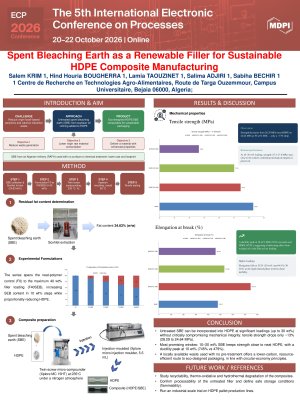
The transition toward sustainable manufacturing requires innovative strategies to reduce the consumption of virgin fossil-based polymers while valorizing industrial solid waste streams. This study addresses both challenges by investigating the incorporation of spent bleaching earth (SBE), a by-product of vegetable oil refining, as an untreated mineral filler into a high-density polyethylene (HDPE) matrix, with the aim of developing eco-designed composite materials suitable for sustainable packaging applications.
SBE was collected from an Algerian oil refinery (RAFH) processing soybean oil, without any prior surface treatment or chemical modification, thereby minimizing processing costs and environmental footprint. Physicochemical characterization of the filler included residual fat content determination by Soxhlet extraction (34.63 wt%), X-ray diffraction (XRD) analysis, and particle size distribution. The HDPE matrix (grade M40053S, MFI = 4 g/10 min at 190°C/2.16 kg, density = 953 kg/m³) was selected for its widespread use in rigid packaging manufacturing.
Composite formulations with SBE loadings of 10, 20, 30, and 40 wt% were processed using a twin-screw micro-compounder (Xplore MC 15HT) at 235°C and injection-moulded at identical barrel temperature with a mould temperature of 50°C. Tensile characterization revealed a gradual reduction in tensile strength from 28.29 MPa (neat HDPE) to 24.64 MPa at 30 wt% SBE, while specimen density increased proportionally with filler content. These results demonstrate that SBE can be integrated into HDPE at significant loading levels without critically compromising mechanical integrity.
This work contributes to the development of lower-carbon, resource-efficient composite materials for the packaging sector, by valorizing a locally available industrial waste with no required pre-treatment, in alignment with circular economy principles and sustainable manufacturing objectives.
Keywords
Spent bleaching earth
HDPE
Composite materials
Sustainable packaging
Waste valorization
Circular economy
Green manufacturing
Poster
Poster Krim et al ECP 2026.pdf
CFD Study on Improving RH Degasser Flow Using Combined Up-Snorkel and Side Gas Blowing
Barrier coating of grafted cellulose microfibers (CMF) presenting oleo- and hydrophobic properties for molded pulp trays