Event submissions
Published
This submission belongs to the session S5. Materials Manufacturing and Sustainable Packaging of the event The 5th International Electronic Conference on Processes
Published date
15 Oct, 2026
Academic Editor
'%3e%3cpath%20d='M12.6657%2010.9104C12.4185%2010.325%2012.0599%209.79327%2011.6097%209.34482C11.1609%208.89508%2010.6293%208.5365%2010.0442%208.28888C10.0389%208.28626%2010.0337%208.28495%2010.0285%208.28233C10.8446%207.69279%2011.3752%206.73249%2011.3752%205.64904C11.3752%203.8542%209.92103%202.39999%208.1262%202.39999C6.33136%202.39999%204.87715%203.8542%204.87715%205.64904C4.87715%206.73249%205.40774%207.69279%206.22393%208.28364C6.21869%208.28626%206.21345%208.28757%206.20821%208.29019C5.62129%208.5378%205.09463%208.89284%204.64265%209.34613C4.1929%209.79493%203.83432%2010.3266%203.58671%2010.9117C3.34345%2011.4845%203.21226%2012.0987%203.20023%2012.7209C3.19988%2012.7349%203.20233%2012.7488%203.20744%2012.7619C3.21255%2012.7749%203.22022%2012.7867%203.22998%2012.7968C3.23975%2012.8068%203.25142%2012.8147%203.26431%2012.8202C3.2772%2012.8256%203.29105%2012.8284%203.30504%2012.8284H4.09109C4.14874%2012.8284%204.19459%2012.7825%204.1959%2012.7262C4.2221%2011.7148%204.62823%2010.7676%205.34617%2010.0497C6.08899%209.30683%207.0755%208.89808%208.1262%208.89808C9.17689%208.89808%2010.1634%209.30683%2010.9062%2010.0497C11.6242%2010.7676%2012.0303%2011.7148%2012.0565%2012.7262C12.0578%2012.7838%2012.1037%2012.8284%2012.1613%2012.8284H12.9474C12.9613%2012.8284%2012.9752%2012.8256%2012.9881%2012.8202C13.001%2012.8147%2013.0126%2012.8068%2013.0224%2012.7968C13.0322%2012.7867%2013.0398%2012.7749%2013.0449%2012.7619C13.0501%2012.7488%2013.0525%2012.7349%2013.0522%2012.7209C13.0391%2012.0947%2012.9094%2011.4855%2012.6657%2010.9104ZM8.1262%207.9024C7.52486%207.9024%206.9589%207.6679%206.53312%207.24211C6.10733%206.81633%205.87283%206.25037%205.87283%205.64904C5.87283%205.0477%206.10733%204.48174%206.53312%204.05596C6.9589%203.63018%207.52486%203.39567%208.1262%203.39567C8.72753%203.39567%209.29349%203.63018%209.71927%204.05596C10.1451%204.48174%2010.3796%205.0477%2010.3796%205.64904C10.3796%206.25037%2010.1451%206.81633%209.71927%207.24211C9.29349%207.6679%208.72753%207.9024%208.1262%207.9024Z'%20fill='%235D1EE1'/%3e%3c/g%3e%3c/svg%3e) Adina Magdalena Musuc
Adina Magdalena MusucCitation
Pieter Samyn, Nicolas Lefèvre, Caroline Piffet, Jean-Michel Thomassin, Lara Gumusboga, Barrier coating of grafted cellulose microfibers (CMF) presenting oleo- and hydrophobic properties for molded pulp trays, in Proceedings of The 5th International Electronic Conference on Processes, 20 October–22 October 2026, MDPI: Basel, Switzerland
Share
Email
Facebook
Twitter
LinkedIn
Barrier coating of grafted cellulose microfibers (CMF) presenting oleo- and hydrophobic properties for molded pulp trays
'%3e%3cpath%20d='M12.6647%2010.9104C12.4176%2010.325%2012.0589%209.7933%2011.6088%209.34485C11.16%208.89511%2010.6283%208.53653%2010.0432%208.28891C10.038%208.28629%2010.0327%208.28498%2010.0275%208.28236C10.8437%207.69282%2011.3743%206.73252%2011.3743%205.64907C11.3743%203.85423%209.92005%202.40002%208.12522%202.40002C6.33038%202.40002%204.87618%203.85423%204.87618%205.64907C4.87618%206.73252%205.40677%207.69282%206.22296%208.28367C6.21772%208.28629%206.21248%208.2876%206.20724%208.29022C5.62031%208.53783%205.09365%208.89287%204.64167%209.34616C4.19192%209.79496%203.83334%2010.3266%203.58573%2010.9117C3.34247%2011.4846%203.21128%2012.0987%203.19925%2012.721C3.1989%2012.735%203.20135%2012.7489%203.20646%2012.7619C3.21157%2012.7749%203.21924%2012.7868%203.22901%2012.7968C3.23877%2012.8068%203.25045%2012.8148%203.26334%2012.8202C3.27623%2012.8256%203.29007%2012.8284%203.30406%2012.8284H4.09012C4.14776%2012.8284%204.19362%2012.7825%204.19493%2012.7262C4.22113%2011.7148%204.62726%2010.7676%205.34519%2010.0497C6.08802%209.30686%207.07452%208.89811%208.12522%208.89811C9.17592%208.89811%2010.1624%209.30686%2010.9052%2010.0497C11.6232%2010.7676%2012.0293%2011.7148%2012.0555%2012.7262C12.0568%2012.7839%2012.1027%2012.8284%2012.1603%2012.8284H12.9464C12.9604%2012.8284%2012.9742%2012.8256%2012.9871%2012.8202C13%2012.8148%2013.0117%2012.8068%2013.0214%2012.7968C13.0312%2012.7868%2013.0389%2012.7749%2013.044%2012.7619C13.0491%2012.7489%2013.0515%2012.735%2013.0512%2012.721C13.0381%2012.0947%2012.9084%2011.4856%2012.6647%2010.9104ZM8.12522%207.90243C7.52388%207.90243%206.95792%207.66793%206.53214%207.24215C6.10636%206.81636%205.87185%206.2504%205.87185%205.64907C5.87185%205.04773%206.10636%204.48177%206.53214%204.05599C6.95792%203.63021%207.52388%203.3957%208.12522%203.3957C8.72655%203.3957%209.29252%203.63021%209.7183%204.05599C10.1441%204.48177%2010.3786%205.04773%2010.3786%205.64907C10.3786%206.2504%2010.1441%206.81636%209.7183%207.24215C9.29252%207.66793%208.72655%207.90243%208.12522%207.90243Z'%20fill='%235D1EE1'/%3e%3c/g%3e%3c/svg%3e)
Pieter Samyn 1
Nicolas Lefèvre 1
Caroline Piffet 2
Jean-Michel Thomassin 2
Lara Gumusboga 2
1. Department of Innovations in Circular Economy, SIRRIS, Leuven, 3500, Belgium
2. Celabor, Herve, 4650, Belgium
Abstract
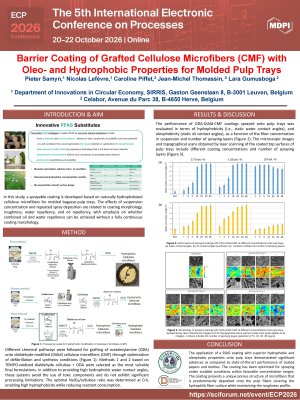
To replace per- and polyfluoroalkyl substances (PFAS) in packaging applications, alternative barrier coatings must be developed in accordance with safe-and-sustainable-by-design (SSbD) principles. Fiber-based packaging materials are currently a major source of PFAS as it provides excellent resistance to water, oil, and grease; however, the high potential for direct contact, environmental release, and persistence raises significant concerns. In this study, a sprayable and bio-based coating with combined hydrophobic and oleophobic properties was developed for molded pulp trays. The coating performance was tuned through the selection bio-based compounds with low surface energy in combination with the intrinsic microscale roughness of cellulose microfibers (CMF). Starting from cellulose pulp, the CMF were produced via sodium periodate oxidation followed by mechanical fibrillation using a Masuko grinder and/or high-pressure homogenizer to achieve different degrees of fibrillation. The process parameters for fibrillation, oxidation and subsequent grafting of octadecylamine (ODA) onto dialdehyde-modified cellulose microfibers (CMF) were optimized through design-of-experiments for best performance. The resulting aqueous suspensions were further optimized for spray processing with concentrations between 0.7 to 1.5 wt.-% and controlled application parameters (nozzle diameters 1.6 to 2.0 mm, pressure 1.5 to 2.0 bar) ensuring reproducible deposition and linear thickness growth of the coating. The coated pulp trays exhibited water contact angles exceeding 140° and oil contact angles above 100° with performance improving as coating thickness increases. Microscopic evaluation interestingly revealed that no continuous film layer was formed on the molded pulp trays, preserving intrinsic porosity of the fibrous network that enables better moisture regulation and enhances recyclability. The localized deposition of CMF on top of the fibrous network increases surface roughness, which contributes synergistically to the observed wetting resistance. Overall, the proposed approach provides a PFAS-free coating solution that is compliant with emerging regulations, while offering strong barrier performance and improved recyclability potential.
Keywords
packaging
fiber-based
coating
hydrophobic
oleophobic
Poster
Samyn - poster ECP2026.pdf
Spent Bleaching Earth as a Renewable Filler for Sustainable HDPE Composite Manufacturing
Laser Transmission Welding of Solid and Foam Thermoplastics: Parametric Analysis and Optimization