Event submissions
Published
This submission belongs to the session S5. Materials Manufacturing and Sustainable Packaging of the event The 5th International Electronic Conference on Processes
Published date
15 Oct, 2026
Academic Editor
'%3e%3cpath%20d='M12.6657%2010.9104C12.4185%2010.325%2012.0599%209.79327%2011.6097%209.34482C11.1609%208.89508%2010.6293%208.5365%2010.0442%208.28888C10.0389%208.28626%2010.0337%208.28495%2010.0285%208.28233C10.8446%207.69279%2011.3752%206.73249%2011.3752%205.64904C11.3752%203.8542%209.92103%202.39999%208.1262%202.39999C6.33136%202.39999%204.87715%203.8542%204.87715%205.64904C4.87715%206.73249%205.40774%207.69279%206.22393%208.28364C6.21869%208.28626%206.21345%208.28757%206.20821%208.29019C5.62129%208.5378%205.09463%208.89284%204.64265%209.34613C4.1929%209.79493%203.83432%2010.3266%203.58671%2010.9117C3.34345%2011.4845%203.21226%2012.0987%203.20023%2012.7209C3.19988%2012.7349%203.20233%2012.7488%203.20744%2012.7619C3.21255%2012.7749%203.22022%2012.7867%203.22998%2012.7968C3.23975%2012.8068%203.25142%2012.8147%203.26431%2012.8202C3.2772%2012.8256%203.29105%2012.8284%203.30504%2012.8284H4.09109C4.14874%2012.8284%204.19459%2012.7825%204.1959%2012.7262C4.2221%2011.7148%204.62823%2010.7676%205.34617%2010.0497C6.08899%209.30683%207.0755%208.89808%208.1262%208.89808C9.17689%208.89808%2010.1634%209.30683%2010.9062%2010.0497C11.6242%2010.7676%2012.0303%2011.7148%2012.0565%2012.7262C12.0578%2012.7838%2012.1037%2012.8284%2012.1613%2012.8284H12.9474C12.9613%2012.8284%2012.9752%2012.8256%2012.9881%2012.8202C13.001%2012.8147%2013.0126%2012.8068%2013.0224%2012.7968C13.0322%2012.7867%2013.0398%2012.7749%2013.0449%2012.7619C13.0501%2012.7488%2013.0525%2012.7349%2013.0522%2012.7209C13.0391%2012.0947%2012.9094%2011.4855%2012.6657%2010.9104ZM8.1262%207.9024C7.52486%207.9024%206.9589%207.6679%206.53312%207.24211C6.10733%206.81633%205.87283%206.25037%205.87283%205.64904C5.87283%205.0477%206.10733%204.48174%206.53312%204.05596C6.9589%203.63018%207.52486%203.39567%208.1262%203.39567C8.72753%203.39567%209.29349%203.63018%209.71927%204.05596C10.1451%204.48174%2010.3796%205.0477%2010.3796%205.64904C10.3796%206.25037%2010.1451%206.81633%209.71927%207.24211C9.29349%207.6679%208.72753%207.9024%208.1262%207.9024Z'%20fill='%235D1EE1'/%3e%3c/g%3e%3c/svg%3e) Adina Magdalena Musuc
Adina Magdalena MusucCitation
Victoria Suchkova, Alexandra Ivanova, Ekaterina Demirskaya, Artem Kuksin, Biodegradable Thin-Film Conductive Composites Based on Chitosan and Carbon Nanomaterials for Transdermal Bioimpedance Sensors, in Proceedings of The 5th International Electronic Conference on Processes, 20 October–22 October 2026, MDPI: Basel, Switzerland
Share
Email
Facebook
Twitter
LinkedIn
Biodegradable Thin-Film Conductive Composites Based on Chitosan and Carbon Nanomaterials for Transdermal Bioimpedance Sensors
Biodegradable Thin-Film Conductive Composites Based on Chitosan and Carbon Nanomaterials for Transdermal Bioimpedance Sensors

Victoria Suchkova 1,2
'%3e%3cpath%20d='M12.6647%2010.9104C12.4176%2010.325%2012.0589%209.7933%2011.6088%209.34485C11.16%208.89511%2010.6283%208.53653%2010.0432%208.28891C10.038%208.28629%2010.0327%208.28498%2010.0275%208.28236C10.8437%207.69282%2011.3743%206.73252%2011.3743%205.64907C11.3743%203.85423%209.92005%202.40002%208.12522%202.40002C6.33038%202.40002%204.87618%203.85423%204.87618%205.64907C4.87618%206.73252%205.40677%207.69282%206.22296%208.28367C6.21772%208.28629%206.21248%208.2876%206.20724%208.29022C5.62031%208.53783%205.09365%208.89287%204.64167%209.34616C4.19192%209.79496%203.83334%2010.3266%203.58573%2010.9117C3.34247%2011.4846%203.21128%2012.0987%203.19925%2012.721C3.1989%2012.735%203.20135%2012.7489%203.20646%2012.7619C3.21157%2012.7749%203.21924%2012.7868%203.22901%2012.7968C3.23877%2012.8068%203.25045%2012.8148%203.26334%2012.8202C3.27623%2012.8256%203.29007%2012.8284%203.30406%2012.8284H4.09012C4.14776%2012.8284%204.19362%2012.7825%204.19493%2012.7262C4.22113%2011.7148%204.62726%2010.7676%205.34519%2010.0497C6.08802%209.30686%207.07452%208.89811%208.12522%208.89811C9.17592%208.89811%2010.1624%209.30686%2010.9052%2010.0497C11.6232%2010.7676%2012.0293%2011.7148%2012.0555%2012.7262C12.0568%2012.7839%2012.1027%2012.8284%2012.1603%2012.8284H12.9464C12.9604%2012.8284%2012.9742%2012.8256%2012.9871%2012.8202C13%2012.8148%2013.0117%2012.8068%2013.0214%2012.7968C13.0312%2012.7868%2013.0389%2012.7749%2013.044%2012.7619C13.0491%2012.7489%2013.0515%2012.735%2013.0512%2012.721C13.0381%2012.0947%2012.9084%2011.4856%2012.6647%2010.9104ZM8.12522%207.90243C7.52388%207.90243%206.95792%207.66793%206.53214%207.24215C6.10636%206.81636%205.87185%206.2504%205.87185%205.64907C5.87185%205.04773%206.10636%204.48177%206.53214%204.05599C6.95792%203.63021%207.52388%203.3957%208.12522%203.3957C8.72655%203.3957%209.29252%203.63021%209.7183%204.05599C10.1441%204.48177%2010.3786%205.04773%2010.3786%205.64907C10.3786%206.2504%2010.1441%206.81636%209.7183%207.24215C9.29252%207.66793%208.72655%207.90243%208.12522%207.90243Z'%20fill='%235D1EE1'/%3e%3c/g%3e%3c/svg%3e)
Alexandra Ivanova 1
Ekaterina Demirskaya 1
Artem Kuksin 1
1. Institute of Biomedical Systems, National Research University of Electronic Technology (MIET),
124498, Zelenograd, Russia
2. Institute for Bionic Technologies and Engineering, I. M. Sechenov First Moscow State Medical
University (Sechenov University), 119991, Moscow, Russia
Abstract
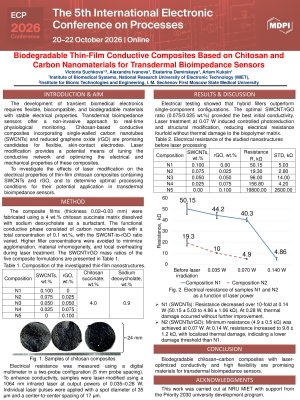
Introduction: The development of transient biomedical electronics requires flexible, biocompatible, and biodegradable materials capable of stable signal transduction. Transdermal bioimpedance sensors offer a non-invasive pathway for real-time physiological monitoring. This study focuses on synthesizing and laser-modifying thin-film electrically conductive biopolymer composites based on a chitosan matrix filled with single-walled carbon nanotubes (SWCNTs) and graphene oxide (GO) to optimize their electrophysical characteristics.
Materials and Methods: The composite films (thickness 0.02–0.03 mm) were fabricated using a 4 wt.% chitosan succinate matrix dissolved with sodium deoxycholate as a surfactant. The functional conductive phase consisted of carbon nanomaterials with a total concentration of 0.1 wt.%, with the SWCNT-to-GO ratio varied. Electrical conductivity was measured using the four-probe method and with a multimeter. To enhance conductivity, the samples were subjected to localized laser modification using an infrared laser with a wavelength of 1064 nm and output power ranging from 0.035 to 0.14 W.
Results: Electrophysical testing showed that the hybrid filler approach substantially outperforms single-component configurations. The optimal initial electrical conductivity was achieved at a ratio of 75% SWCNTs (0.075 wt.%) to 25% GO (0.025 wt.%). Following targeted laser exposure at 0.07 W, controlled photoreduction and structural modification occurred. This treatment led to a pronounced fourfold (4x) decrease in electrical resistance in the hybrid SWCNT/GO composite, markedly improving its sensitivity without inducing thermal degradation or burning of the biopolymer matrix.
Conclusion: The combination of a biodegradable chitosan matrix with a hybrid carbon network optimized by targeted laser processing provides a reliable platform for skin-interfaced bioelectronics. The achieved low electrical resistance and high flexibility make these thin-film materials highly promising for the creation of disposable, eco-friendly transdermal biometric sensors for continuous bioimpedance tracking.
The work was carried out at NRU MIET in the frame of government university support program “Priority-2030”
Keywords
chitosan
carbon nanotubes
graphene oxide
laser modification
bioimpedance
biodegradable electronics
Poster
Poster MDPI.pdf
IFSpray Coater: Development and Validation of a Low-Cost Open-Source Spray Coating Platform for Gas Diffusion Electrode Fabrication Using a Repurposed 3D Printer
2D SprayPath: An Open-Source Tool for Automated Spray-Coating of Gas Diffusion Electrodes for CO2 Electroreduction