Event submissions
Published
This submission belongs to the session S7. Applied Mathematics of the event The 1st International Online Conference on Symmetry
Published date
15 Oct, 2026
Academic Editor
'%3e%3cpath%20d='M12.6657%2010.9104C12.4185%2010.325%2012.0599%209.79327%2011.6097%209.34482C11.1609%208.89508%2010.6293%208.5365%2010.0442%208.28888C10.0389%208.28626%2010.0337%208.28495%2010.0285%208.28233C10.8446%207.69279%2011.3752%206.73249%2011.3752%205.64904C11.3752%203.8542%209.92103%202.39999%208.1262%202.39999C6.33136%202.39999%204.87715%203.8542%204.87715%205.64904C4.87715%206.73249%205.40774%207.69279%206.22393%208.28364C6.21869%208.28626%206.21345%208.28757%206.20821%208.29019C5.62129%208.5378%205.09463%208.89284%204.64265%209.34613C4.1929%209.79493%203.83432%2010.3266%203.58671%2010.9117C3.34345%2011.4845%203.21226%2012.0987%203.20023%2012.7209C3.19988%2012.7349%203.20233%2012.7488%203.20744%2012.7619C3.21255%2012.7749%203.22022%2012.7867%203.22998%2012.7968C3.23975%2012.8068%203.25142%2012.8147%203.26431%2012.8202C3.2772%2012.8256%203.29105%2012.8284%203.30504%2012.8284H4.09109C4.14874%2012.8284%204.19459%2012.7825%204.1959%2012.7262C4.2221%2011.7148%204.62823%2010.7676%205.34617%2010.0497C6.08899%209.30683%207.0755%208.89808%208.1262%208.89808C9.17689%208.89808%2010.1634%209.30683%2010.9062%2010.0497C11.6242%2010.7676%2012.0303%2011.7148%2012.0565%2012.7262C12.0578%2012.7838%2012.1037%2012.8284%2012.1613%2012.8284H12.9474C12.9613%2012.8284%2012.9752%2012.8256%2012.9881%2012.8202C13.001%2012.8147%2013.0126%2012.8068%2013.0224%2012.7968C13.0322%2012.7867%2013.0398%2012.7749%2013.0449%2012.7619C13.0501%2012.7488%2013.0525%2012.7349%2013.0522%2012.7209C13.0391%2012.0947%2012.9094%2011.4855%2012.6657%2010.9104ZM8.1262%207.9024C7.52486%207.9024%206.9589%207.6679%206.53312%207.24211C6.10733%206.81633%205.87283%206.25037%205.87283%205.64904C5.87283%205.0477%206.10733%204.48174%206.53312%204.05596C6.9589%203.63018%207.52486%203.39567%208.1262%203.39567C8.72753%203.39567%209.29349%203.63018%209.71927%204.05596C10.1451%204.48174%2010.3796%205.0477%2010.3796%205.64904C10.3796%206.25037%2010.1451%206.81633%209.71927%207.24211C9.29349%207.6679%208.72753%207.9024%208.1262%207.9024Z'%20fill='%235D1EE1'/%3e%3c/g%3e%3c/svg%3e) Yufeng Zhang
Yufeng ZhangCitation
Diego Restrepo-Leal, Miguel E. Iglesias-Martínez, Pedro Fernández-de-Córdoba, Advanced Differentiable Hybrid Frameworks for Time Series Reconstruction and Forecasting in Data-Scarce Regimes, in Proceedings of The 1st International Online Conference on Symmetry, 20 October–22 October 2026, MDPI: Basel, Switzerland
Share
Email
Facebook
Twitter
LinkedIn
Advanced Differentiable Hybrid Frameworks for Time Series Reconstruction and Forecasting in Data-Scarce Regimes
'%3e%3cpath%20d='M12.6647%2010.9104C12.4176%2010.325%2012.0589%209.7933%2011.6088%209.34485C11.16%208.89511%2010.6283%208.53653%2010.0432%208.28891C10.038%208.28629%2010.0327%208.28498%2010.0275%208.28236C10.8437%207.69282%2011.3743%206.73252%2011.3743%205.64907C11.3743%203.85423%209.92005%202.40002%208.12522%202.40002C6.33038%202.40002%204.87618%203.85423%204.87618%205.64907C4.87618%206.73252%205.40677%207.69282%206.22296%208.28367C6.21772%208.28629%206.21248%208.2876%206.20724%208.29022C5.62031%208.53783%205.09365%208.89287%204.64167%209.34616C4.19192%209.79496%203.83334%2010.3266%203.58573%2010.9117C3.34247%2011.4846%203.21128%2012.0987%203.19925%2012.721C3.1989%2012.735%203.20135%2012.7489%203.20646%2012.7619C3.21157%2012.7749%203.21924%2012.7868%203.22901%2012.7968C3.23877%2012.8068%203.25045%2012.8148%203.26334%2012.8202C3.27623%2012.8256%203.29007%2012.8284%203.30406%2012.8284H4.09012C4.14776%2012.8284%204.19362%2012.7825%204.19493%2012.7262C4.22113%2011.7148%204.62726%2010.7676%205.34519%2010.0497C6.08802%209.30686%207.07452%208.89811%208.12522%208.89811C9.17592%208.89811%2010.1624%209.30686%2010.9052%2010.0497C11.6232%2010.7676%2012.0293%2011.7148%2012.0555%2012.7262C12.0568%2012.7839%2012.1027%2012.8284%2012.1603%2012.8284H12.9464C12.9604%2012.8284%2012.9742%2012.8256%2012.9871%2012.8202C13%2012.8148%2013.0117%2012.8068%2013.0214%2012.7968C13.0312%2012.7868%2013.0389%2012.7749%2013.044%2012.7619C13.0491%2012.7489%2013.0515%2012.735%2013.0512%2012.721C13.0381%2012.0947%2012.9084%2011.4856%2012.6647%2010.9104ZM8.12522%207.90243C7.52388%207.90243%206.95792%207.66793%206.53214%207.24215C6.10636%206.81636%205.87185%206.2504%205.87185%205.64907C5.87185%205.04773%206.10636%204.48177%206.53214%204.05599C6.95792%203.63021%207.52388%203.3957%208.12522%203.3957C8.72655%203.3957%209.29252%203.63021%209.7183%204.05599C10.1441%204.48177%2010.3786%205.04773%2010.3786%205.64907C10.3786%206.2504%2010.1441%206.81636%209.7183%207.24215C9.29252%207.66793%208.72655%207.90243%208.12522%207.90243Z'%20fill='%235D1EE1'/%3e%3c/g%3e%3c/svg%3e)
Diego Restrepo-Leal 1,2
Miguel E. Iglesias-Martínez 3

Pedro Fernández-de-Córdoba 3
1. Faculty of Engineering, Santa Marta Campus, Universidad Cooperativa de Colombia, Santa Marta, 470001, Colombia
2. Doctoral Program in Design, Manufacture and Management of Industrial Projects, Universitat Politècnica de València, Camino de Vera s/n, València, 46022, Spain
3. University Institute of Pure and Applied Mathematics, Universitat Politècnica de València, Camino de Vera s/n, València, 46022, Spain
Abstract
Introduction
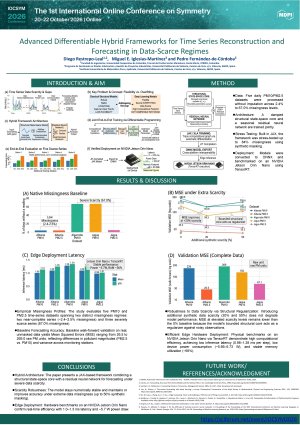
Classical time series models excel at capturing linear structural components, whereas deep learning architectures are more effective at modeling nonlinear dynamics. However, in data-scarce and resource-constrained edge computing environments, purely deep learning-based approaches are prone to severe overfitting, while statistical models often lack sufficient flexibility. This work addresses this gap by exploiting structural symmetries and inductive biases through a unified differentiable framework specifically designed for efficient edge deployment.
Methods
We propose a novel hybrid methodology that integrates structural state-space models with machine learning techniques through differentiable programming based on Wengert lists for automatic differentiation. The framework incorporates structural invariant constraints as regularization mechanisms to improve learning under severe data scarcity. To ensure suitability for edge computing, the computational graph is optimized using Just-In-Time (JIT) compilation and Accelerated Linear Algebra (XLA), reducing both latency and memory consumption. The proposed approach is evaluated using Walk-Forward validation on both synthetic and real-world datasets containing discontinuities.
Results
Anticipated experimental results demonstrate that embedding structural inductive biases significantly improves generalization and mitigates overfitting compared with standalone statistical and deep learning approaches. The proposed model achieves superior forecasting and data imputation accuracy under conditions of extreme data scarcity. Furthermore, JIT/XLA optimization substantially reduces computational latency, confirming an effective balance between predictive performance and computational efficiency for deployment on resource-constrained edge devices.
Conclusions
This research bridges the gap between structural mathematical modeling and deep learning by leveraging differentiable programming and the structural symmetries inherent in time-dependent processes. The proposed framework offers a robust, scalable, and computationally efficient solution for real-time time series forecasting and imputation in data-sparse edge computing environments.
Keywords
Data Scarcity
Differentiable Programming
Edge Computing
Hybrid Models
Time Series Forecasting
Poster
poster_final.pdf
Oscillation of the Ar2 Molecule using the LAMMPS Molecular Dynamics Simulation Tool
Symmetry-Guided Boundary Element Modeling of Microneedle-Delivered Nanoparticle Photothermal Hyperthermia in Multilayer Skin Tumors