Event submissions
Published
This submission belongs to the session S7. Applied Mathematics of the event The 1st International Online Conference on Symmetry
Published date
15 Oct, 2026
Academic Editor
'%3e%3cpath%20d='M12.6657%2010.9104C12.4185%2010.325%2012.0599%209.79327%2011.6097%209.34482C11.1609%208.89508%2010.6293%208.5365%2010.0442%208.28888C10.0389%208.28626%2010.0337%208.28495%2010.0285%208.28233C10.8446%207.69279%2011.3752%206.73249%2011.3752%205.64904C11.3752%203.8542%209.92103%202.39999%208.1262%202.39999C6.33136%202.39999%204.87715%203.8542%204.87715%205.64904C4.87715%206.73249%205.40774%207.69279%206.22393%208.28364C6.21869%208.28626%206.21345%208.28757%206.20821%208.29019C5.62129%208.5378%205.09463%208.89284%204.64265%209.34613C4.1929%209.79493%203.83432%2010.3266%203.58671%2010.9117C3.34345%2011.4845%203.21226%2012.0987%203.20023%2012.7209C3.19988%2012.7349%203.20233%2012.7488%203.20744%2012.7619C3.21255%2012.7749%203.22022%2012.7867%203.22998%2012.7968C3.23975%2012.8068%203.25142%2012.8147%203.26431%2012.8202C3.2772%2012.8256%203.29105%2012.8284%203.30504%2012.8284H4.09109C4.14874%2012.8284%204.19459%2012.7825%204.1959%2012.7262C4.2221%2011.7148%204.62823%2010.7676%205.34617%2010.0497C6.08899%209.30683%207.0755%208.89808%208.1262%208.89808C9.17689%208.89808%2010.1634%209.30683%2010.9062%2010.0497C11.6242%2010.7676%2012.0303%2011.7148%2012.0565%2012.7262C12.0578%2012.7838%2012.1037%2012.8284%2012.1613%2012.8284H12.9474C12.9613%2012.8284%2012.9752%2012.8256%2012.9881%2012.8202C13.001%2012.8147%2013.0126%2012.8068%2013.0224%2012.7968C13.0322%2012.7867%2013.0398%2012.7749%2013.0449%2012.7619C13.0501%2012.7488%2013.0525%2012.7349%2013.0522%2012.7209C13.0391%2012.0947%2012.9094%2011.4855%2012.6657%2010.9104ZM8.1262%207.9024C7.52486%207.9024%206.9589%207.6679%206.53312%207.24211C6.10733%206.81633%205.87283%206.25037%205.87283%205.64904C5.87283%205.0477%206.10733%204.48174%206.53312%204.05596C6.9589%203.63018%207.52486%203.39567%208.1262%203.39567C8.72753%203.39567%209.29349%203.63018%209.71927%204.05596C10.1451%204.48174%2010.3796%205.0477%2010.3796%205.64904C10.3796%206.25037%2010.1451%206.81633%209.71927%207.24211C9.29349%207.6679%208.72753%207.9024%208.1262%207.9024Z'%20fill='%235D1EE1'/%3e%3c/g%3e%3c/svg%3e) Dimitri Mugnai
Dimitri MugnaiCitation
Mohamed Abdelsabour Fahmy, Ahmad Almutlg, Symmetry-Guided Boundary Element Modeling of Microneedle-Delivered Nanoparticle Photothermal Hyperthermia in Multilayer Skin Tumors, in Proceedings of The 1st International Online Conference on Symmetry, 20 October–22 October 2026, MDPI: Basel, Switzerland
Share
Email
Facebook
Twitter
LinkedIn
Symmetry-Guided Boundary Element Modeling of Microneedle-Delivered Nanoparticle Photothermal Hyperthermia in Multilayer Skin Tumors

Mohamed Abdelsabour Fahmy 1

Ahmad Almutlg 2
1. Adham University College, Umm Al-Qura University, Adham 28653, Makkah, Saudi Arabia
2. Department of Mathematics, College of Science, Qassim University, Buraydah 51452, Saudi Arabia
Abstract
Introduction: Photothermal hyperthermia is a promising minimally invasive approach to treat surface skin cancers; however, for an effective therapeutic outcome, it is crucial to ensure adequate tumor heating without causing heat damage to the adjacent normal tissues. This paper presents a symmetry-based computational model to analyze microneedle-assisted photothermal cancer treatment using nanoparticles.
Methods: A Pennes-based bioheat equation that incorporates multiple layers in the biological tissues, tumor-dependent blood flow and metabolism, volumetric heat source due to lasers, localized heat generation due to nanoparticles, convective cooling on the surface, interface conditions, and the Arrhenius thermal damage function has been developed. The discretized time-dependent governing equation has been converted into an equivalent Helmholtz equation that is solved by a dual-reciprocity boundary element method. The localized deposition of nanoparticles due to dissolvable microneedles has been represented using Gaussian distribution functions.
Results: Numerical results have proven that factors such as the laser intensity, the concentration of the nanoparticles, the depth of the tumor, and the deposition profile play significant roles in affecting tumor-center temperature, heat dose accumulation, and the spatial selectivity. In contrast to traditional heating using the laser alone, the localized deposition of nanoparticles helps to destroy the thermal symmetry in the temperature distribution and achieve more selective tumor heating.
Conclusions: The newly introduced symmetry-based DRBEM approach serves as a very convenient and accurate instrument for prediction of temperature changes, assessment of thermal damage and parameter optimization for microneedle-based nanoparticle photothermal hyperthermia therapy. Symmetry breaking is found to play a crucial role in making tumors more selective to such therapy.
Keywords
thermal symmetry
symmetry breaking
asymmetric bioheat transfer
multilayer skin tumors
generalized Pennes bioheat equation
dual-reciprocity boundary element method
microneedle-mediated nanoparticle delivery
photothermal hyperthermia
localized laser
Poster
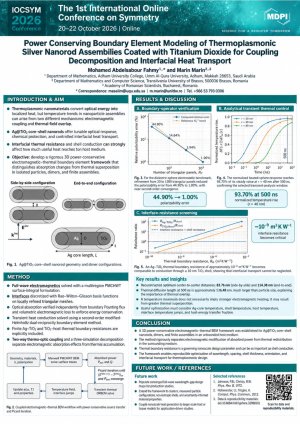
Poster.pdf
Advanced Differentiable Hybrid Frameworks for Time Series Reconstruction and Forecasting in Data-Scarce Regimes
Magnetohydrodynamic boundary-layer flow of a nanofluid over a stretching sheet with Dufour and Soret impact for non-isothermal and non-isosolutal conditions: A Chebyshev Collocation Approach