Event submissions
Published
This submission belongs to the session S4. Astronomy, Astrophysics and Cosmology of the event The 1st International Online Conference on Symmetry
Published date
15 Oct, 2026
Academic Editor
'%3e%3cpath%20d='M12.6657%2010.9104C12.4185%2010.325%2012.0599%209.79327%2011.6097%209.34482C11.1609%208.89508%2010.6293%208.5365%2010.0442%208.28888C10.0389%208.28626%2010.0337%208.28495%2010.0285%208.28233C10.8446%207.69279%2011.3752%206.73249%2011.3752%205.64904C11.3752%203.8542%209.92103%202.39999%208.1262%202.39999C6.33136%202.39999%204.87715%203.8542%204.87715%205.64904C4.87715%206.73249%205.40774%207.69279%206.22393%208.28364C6.21869%208.28626%206.21345%208.28757%206.20821%208.29019C5.62129%208.5378%205.09463%208.89284%204.64265%209.34613C4.1929%209.79493%203.83432%2010.3266%203.58671%2010.9117C3.34345%2011.4845%203.21226%2012.0987%203.20023%2012.7209C3.19988%2012.7349%203.20233%2012.7488%203.20744%2012.7619C3.21255%2012.7749%203.22022%2012.7867%203.22998%2012.7968C3.23975%2012.8068%203.25142%2012.8147%203.26431%2012.8202C3.2772%2012.8256%203.29105%2012.8284%203.30504%2012.8284H4.09109C4.14874%2012.8284%204.19459%2012.7825%204.1959%2012.7262C4.2221%2011.7148%204.62823%2010.7676%205.34617%2010.0497C6.08899%209.30683%207.0755%208.89808%208.1262%208.89808C9.17689%208.89808%2010.1634%209.30683%2010.9062%2010.0497C11.6242%2010.7676%2012.0303%2011.7148%2012.0565%2012.7262C12.0578%2012.7838%2012.1037%2012.8284%2012.1613%2012.8284H12.9474C12.9613%2012.8284%2012.9752%2012.8256%2012.9881%2012.8202C13.001%2012.8147%2013.0126%2012.8068%2013.0224%2012.7968C13.0322%2012.7867%2013.0398%2012.7749%2013.0449%2012.7619C13.0501%2012.7488%2013.0525%2012.7349%2013.0522%2012.7209C13.0391%2012.0947%2012.9094%2011.4855%2012.6657%2010.9104ZM8.1262%207.9024C7.52486%207.9024%206.9589%207.6679%206.53312%207.24211C6.10733%206.81633%205.87283%206.25037%205.87283%205.64904C5.87283%205.0477%206.10733%204.48174%206.53312%204.05596C6.9589%203.63018%207.52486%203.39567%208.1262%203.39567C8.72753%203.39567%209.29349%203.63018%209.71927%204.05596C10.1451%204.48174%2010.3796%205.0477%2010.3796%205.64904C10.3796%206.25037%2010.1451%206.81633%209.71927%207.24211C9.29349%207.6679%208.72753%207.9024%208.1262%207.9024Z'%20fill='%235D1EE1'/%3e%3c/g%3e%3c/svg%3e) Sándor Frey
Sándor FreyCitation
SAMPRITY DAS, Surajit Chattopadhyay, Aroonkumar Beesham, Study of anisotropic compact stars in modified gravity with Bose–Einstein dark matter density profile, in Proceedings of The 1st International Online Conference on Symmetry, 20 October–22 October 2026, MDPI: Basel, Switzerland
Share
Email
Facebook
Twitter
LinkedIn
Study of anisotropic compact stars in modified gravity with Bose–Einstein dark matter density profile
'%3e%3cpath%20d='M12.6647%2010.9104C12.4176%2010.325%2012.0589%209.7933%2011.6088%209.34485C11.16%208.89511%2010.6283%208.53653%2010.0432%208.28891C10.038%208.28629%2010.0327%208.28498%2010.0275%208.28236C10.8437%207.69282%2011.3743%206.73252%2011.3743%205.64907C11.3743%203.85423%209.92005%202.40002%208.12522%202.40002C6.33038%202.40002%204.87618%203.85423%204.87618%205.64907C4.87618%206.73252%205.40677%207.69282%206.22296%208.28367C6.21772%208.28629%206.21248%208.2876%206.20724%208.29022C5.62031%208.53783%205.09365%208.89287%204.64167%209.34616C4.19192%209.79496%203.83334%2010.3266%203.58573%2010.9117C3.34247%2011.4846%203.21128%2012.0987%203.19925%2012.721C3.1989%2012.735%203.20135%2012.7489%203.20646%2012.7619C3.21157%2012.7749%203.21924%2012.7868%203.22901%2012.7968C3.23877%2012.8068%203.25045%2012.8148%203.26334%2012.8202C3.27623%2012.8256%203.29007%2012.8284%203.30406%2012.8284H4.09012C4.14776%2012.8284%204.19362%2012.7825%204.19493%2012.7262C4.22113%2011.7148%204.62726%2010.7676%205.34519%2010.0497C6.08802%209.30686%207.07452%208.89811%208.12522%208.89811C9.17592%208.89811%2010.1624%209.30686%2010.9052%2010.0497C11.6232%2010.7676%2012.0293%2011.7148%2012.0555%2012.7262C12.0568%2012.7839%2012.1027%2012.8284%2012.1603%2012.8284H12.9464C12.9604%2012.8284%2012.9742%2012.8256%2012.9871%2012.8202C13%2012.8148%2013.0117%2012.8068%2013.0214%2012.7968C13.0312%2012.7868%2013.0389%2012.7749%2013.044%2012.7619C13.0491%2012.7489%2013.0515%2012.735%2013.0512%2012.721C13.0381%2012.0947%2012.9084%2011.4856%2012.6647%2010.9104ZM8.12522%207.90243C7.52388%207.90243%206.95792%207.66793%206.53214%207.24215C6.10636%206.81636%205.87185%206.2504%205.87185%205.64907C5.87185%205.04773%206.10636%204.48177%206.53214%204.05599C6.95792%203.63021%207.52388%203.3957%208.12522%203.3957C8.72655%203.3957%209.29252%203.63021%209.7183%204.05599C10.1441%204.48177%2010.3786%205.04773%2010.3786%205.64907C10.3786%206.2504%2010.1441%206.81636%209.7183%207.24215C9.29252%207.66793%208.72655%207.90243%208.12522%207.90243Z'%20fill='%235D1EE1'/%3e%3c/g%3e%3c/svg%3e)
SAMPRITY DAS 1,2

Surajit Chattopadhyay 1
Aroonkumar Beesham 3
1. Department of Mathematics, Amity University, Kolkata, Major Arterial Road, Action Area II, New Town, Rajarhat, Kolkata 700135, India
2. Department of Mathematics, Shibpur Dinobundhoo Institution (College), Howrah 711102, West Bengal, India
3. Department of Mathematical Sciences
University of Zululand, Private Bag X1001
Kwa-Dlangezwa 3886 South Africa
Abstract
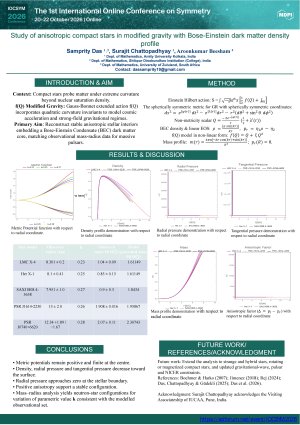
This work presents a novel anisotropic compact star model in the framework of modified f(Q) Gravity by incorporating a Bose–Einstein condensate dark matter density profile together with a bag-model-type equation of state. The stellar configuration is developed in a static spherically symmetric spacetime using the teleparallel formalism, where the gravitational interaction is governed by torsion instead of curvature. The interior spacetime is smoothly matched with the exterior Schwarzschild solution through the standard junction conditions, leading to well-behaved metric potentials throughout the stellar interior. The physical properties of the model are analyzed in detail for several realistic compact objects, namely LMC X-4, Her X-1, 4U 1538-52, SAX J1808.4-3658, and Cen X-3. It is observed that the energy density, radial pressure, and tangential pressure attain their maximum values at the stellar core and decrease monotonically toward the surface, ensuring regularity and physical acceptability of the solutions. The anisotropic factor remains positive inside the compact configuration, indicating the presence of a repulsive anisotropic force which enhances the stability and allows the existence of more massive stellar structures. Furthermore, the model satisfies the null and strong energy conditions, confirming the physically viable nature of the matter distribution. The equation-of-state parameters remain within acceptable bounds throughout the stellar interior. Stability analysis through the causality condition and adiabatic index demonstrates that the obtained stellar configurations are stable and free from physical singularities. The derived mass–radius relation and compactness factor also fall within observationally accepted limits, establishing that the proposed Bose–Einstein dark matter-inspired compact star model in modified gravity provides a realistic and stable description of ultra-dense astrophysical objects.
Keywords
Bose–Einstein condensate dark matter
Schwarzschild solution
Anisotropic force
Stability analysis
Adiabatic index
Poster
poster_samprity.pdf
Symmetric Circle Configurations from Regular Skeletal Polyhedra
Dark matter across scales: Ultralight fields, Bose-star signatures, massive compact composites, and giant resonance in dark matter–matter oscillations