Event submissions
Published
This submission belongs to the session S4. Astronomy, Astrophysics and Cosmology of the event The 1st International Online Conference on Symmetry
Published date
15 Oct, 2026
Academic Editor
'%3e%3cpath%20d='M12.6657%2010.9104C12.4185%2010.325%2012.0599%209.79327%2011.6097%209.34482C11.1609%208.89508%2010.6293%208.5365%2010.0442%208.28888C10.0389%208.28626%2010.0337%208.28495%2010.0285%208.28233C10.8446%207.69279%2011.3752%206.73249%2011.3752%205.64904C11.3752%203.8542%209.92103%202.39999%208.1262%202.39999C6.33136%202.39999%204.87715%203.8542%204.87715%205.64904C4.87715%206.73249%205.40774%207.69279%206.22393%208.28364C6.21869%208.28626%206.21345%208.28757%206.20821%208.29019C5.62129%208.5378%205.09463%208.89284%204.64265%209.34613C4.1929%209.79493%203.83432%2010.3266%203.58671%2010.9117C3.34345%2011.4845%203.21226%2012.0987%203.20023%2012.7209C3.19988%2012.7349%203.20233%2012.7488%203.20744%2012.7619C3.21255%2012.7749%203.22022%2012.7867%203.22998%2012.7968C3.23975%2012.8068%203.25142%2012.8147%203.26431%2012.8202C3.2772%2012.8256%203.29105%2012.8284%203.30504%2012.8284H4.09109C4.14874%2012.8284%204.19459%2012.7825%204.1959%2012.7262C4.2221%2011.7148%204.62823%2010.7676%205.34617%2010.0497C6.08899%209.30683%207.0755%208.89808%208.1262%208.89808C9.17689%208.89808%2010.1634%209.30683%2010.9062%2010.0497C11.6242%2010.7676%2012.0303%2011.7148%2012.0565%2012.7262C12.0578%2012.7838%2012.1037%2012.8284%2012.1613%2012.8284H12.9474C12.9613%2012.8284%2012.9752%2012.8256%2012.9881%2012.8202C13.001%2012.8147%2013.0126%2012.8068%2013.0224%2012.7968C13.0322%2012.7867%2013.0398%2012.7749%2013.0449%2012.7619C13.0501%2012.7488%2013.0525%2012.7349%2013.0522%2012.7209C13.0391%2012.0947%2012.9094%2011.4855%2012.6657%2010.9104ZM8.1262%207.9024C7.52486%207.9024%206.9589%207.6679%206.53312%207.24211C6.10733%206.81633%205.87283%206.25037%205.87283%205.64904C5.87283%205.0477%206.10733%204.48174%206.53312%204.05596C6.9589%203.63018%207.52486%203.39567%208.1262%203.39567C8.72753%203.39567%209.29349%203.63018%209.71927%204.05596C10.1451%204.48174%2010.3796%205.0477%2010.3796%205.64904C10.3796%206.25037%2010.1451%206.81633%209.71927%207.24211C9.29349%207.6679%208.72753%207.9024%208.1262%207.9024Z'%20fill='%235D1EE1'/%3e%3c/g%3e%3c/svg%3e) Sándor Frey
Sándor FreyCitation
Sonia Sharma, Kulwinder Singh, Rishi Kumar Tiwari, Aroonkumar Beesham, Anisotropic Transition Cosmology Driven by Bulk Viscosity and Gaussian Expansion Dynamics, in Proceedings of The 1st International Online Conference on Symmetry, 20 October–22 October 2026, MDPI: Basel, Switzerland
Share
Email
Facebook
Twitter
LinkedIn
Anisotropic Transition Cosmology Driven by Bulk Viscosity and Gaussian Expansion Dynamics
'%3e%3cpath%20d='M12.6647%2010.9104C12.4176%2010.325%2012.0589%209.7933%2011.6088%209.34485C11.16%208.89511%2010.6283%208.53653%2010.0432%208.28891C10.038%208.28629%2010.0327%208.28498%2010.0275%208.28236C10.8437%207.69282%2011.3743%206.73252%2011.3743%205.64907C11.3743%203.85423%209.92005%202.40002%208.12522%202.40002C6.33038%202.40002%204.87618%203.85423%204.87618%205.64907C4.87618%206.73252%205.40677%207.69282%206.22296%208.28367C6.21772%208.28629%206.21248%208.2876%206.20724%208.29022C5.62031%208.53783%205.09365%208.89287%204.64167%209.34616C4.19192%209.79496%203.83334%2010.3266%203.58573%2010.9117C3.34247%2011.4846%203.21128%2012.0987%203.19925%2012.721C3.1989%2012.735%203.20135%2012.7489%203.20646%2012.7619C3.21157%2012.7749%203.21924%2012.7868%203.22901%2012.7968C3.23877%2012.8068%203.25045%2012.8148%203.26334%2012.8202C3.27623%2012.8256%203.29007%2012.8284%203.30406%2012.8284H4.09012C4.14776%2012.8284%204.19362%2012.7825%204.19493%2012.7262C4.22113%2011.7148%204.62726%2010.7676%205.34519%2010.0497C6.08802%209.30686%207.07452%208.89811%208.12522%208.89811C9.17592%208.89811%2010.1624%209.30686%2010.9052%2010.0497C11.6232%2010.7676%2012.0293%2011.7148%2012.0555%2012.7262C12.0568%2012.7839%2012.1027%2012.8284%2012.1603%2012.8284H12.9464C12.9604%2012.8284%2012.9742%2012.8256%2012.9871%2012.8202C13%2012.8148%2013.0117%2012.8068%2013.0214%2012.7968C13.0312%2012.7868%2013.0389%2012.7749%2013.044%2012.7619C13.0491%2012.7489%2013.0515%2012.735%2013.0512%2012.721C13.0381%2012.0947%2012.9084%2011.4856%2012.6647%2010.9104ZM8.12522%207.90243C7.52388%207.90243%206.95792%207.66793%206.53214%207.24215C6.10636%206.81636%205.87185%206.2504%205.87185%205.64907C5.87185%205.04773%206.10636%204.48177%206.53214%204.05599C6.95792%203.63021%207.52388%203.3957%208.12522%203.3957C8.72655%203.3957%209.29252%203.63021%209.7183%204.05599C10.1441%204.48177%2010.3786%205.04773%2010.3786%205.64907C10.3786%206.2504%2010.1441%206.81636%209.7183%207.24215C9.29252%207.66793%208.72655%207.90243%208.12522%207.90243Z'%20fill='%235D1EE1'/%3e%3c/g%3e%3c/svg%3e)
Sonia Sharma 1
Kulwinder Singh 2
Rishi Kumar Tiwari 3
Aroonkumar Beesham 4
1. Department of Mathematics, Lovely Professional University, Phagwara, Punjab 144411, India
2. Department of Mathematics, School of Chemical Engineering and Physical sciences, Lovely Professional University, Phagwara, Punjab 144411, India
3. Department of Mathematics, Govt Model Science College, Rewa, M.P., 486001, India
4. Department of Mathematical Sciences, University of Zululand, KwaDlangezwa 3886, South Africa
Abstract
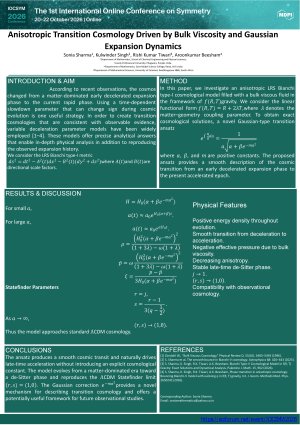
In this paper, we have investigated an anisotropic LRS Bianchi type-I cosmological model filled with a bulk viscous fluid in the framework of f(R, T) gravity. We have consider the linear functional form f(R, T)=R+2λT,
where λ denotes the matter–geometry coupling parameter. To obtain the exact cosmological model solutions, a novel Gaussian-type transition ansatz, e∫q/a da =1/[a√α+βe(-ma*2)],
where α, β, and m are positive constants, is introduced. The proposed ansatz provides a smooth description of the cosmic transition from an early decelerated expansion phase to the present accelerated epoch. Exact expressions for the deceleration parameter, Hubble parameter, expansion scalar, shear scalar, energy density, effective pressure, bulk viscosity coefficient, jerk parameter, and statefinder diagnostics and transition time are derived and analyzed. The physical behavior of the model shows that the energy density remains positive throughout the cosmic evolution, while the bulk viscous effects generate a negative effective pressure that drives late-time acceleration. The anisotropy decreases with cosmic time, indicating a gradual approach toward isotropy. Furthermore, the model evolves asymptotically toward a de-Sitter phase and reproduces the standard ΛCDM statefinder limit (r,s)=(1,0). Therefore, the obtained model provides a physically viable and observationally consistent framework for studying transition cosmology and accelerated expansion in modified gravity.
Keywords
f(R,T)gravity
bulk viscosity
LRS Bianchi-I universe
transition cosmology
anisotropic universe.
Poster
IOCSYM2026-154481.pdf
Ground-state properties of astrophysical waiting-point nuclei under extreme magnetic fields
Neural Network and Machine Learning Methods for Distinguishing Hadronic and Quark Compact Stars