Event submissions
Published

This submission belongs to the session B. Posters Session of the event 2nd International Electronic Conference on Medicinal Chemistry
Published date
01 Nov, 2016
Citation
Jeremy Schneider, Alexandra Dassonville-Klimpt, Pascal Sonnet, Synthesis of Fluorenes with Potential Bioactivities, in Proceedings of 2nd International Electronic Conference on Medicinal Chemistry, 1 November–30 November 2016, MDPI: Basel, Switzerland, doi: 10.3390/ecmc-2-B004
Share
Email
Facebook
Twitter
LinkedIn
Synthesis of Fluorenes with Potential Bioactivities
'%3e%3cpath%20d='M12.6647%2010.9104C12.4176%2010.325%2012.0589%209.7933%2011.6088%209.34485C11.16%208.89511%2010.6283%208.53653%2010.0432%208.28891C10.038%208.28629%2010.0327%208.28498%2010.0275%208.28236C10.8437%207.69282%2011.3743%206.73252%2011.3743%205.64907C11.3743%203.85423%209.92005%202.40002%208.12522%202.40002C6.33038%202.40002%204.87618%203.85423%204.87618%205.64907C4.87618%206.73252%205.40677%207.69282%206.22296%208.28367C6.21772%208.28629%206.21248%208.2876%206.20724%208.29022C5.62031%208.53783%205.09365%208.89287%204.64167%209.34616C4.19192%209.79496%203.83334%2010.3266%203.58573%2010.9117C3.34247%2011.4846%203.21128%2012.0987%203.19925%2012.721C3.1989%2012.735%203.20135%2012.7489%203.20646%2012.7619C3.21157%2012.7749%203.21924%2012.7868%203.22901%2012.7968C3.23877%2012.8068%203.25045%2012.8148%203.26334%2012.8202C3.27623%2012.8256%203.29007%2012.8284%203.30406%2012.8284H4.09012C4.14776%2012.8284%204.19362%2012.7825%204.19493%2012.7262C4.22113%2011.7148%204.62726%2010.7676%205.34519%2010.0497C6.08802%209.30686%207.07452%208.89811%208.12522%208.89811C9.17592%208.89811%2010.1624%209.30686%2010.9052%2010.0497C11.6232%2010.7676%2012.0293%2011.7148%2012.0555%2012.7262C12.0568%2012.7839%2012.1027%2012.8284%2012.1603%2012.8284H12.9464C12.9604%2012.8284%2012.9742%2012.8256%2012.9871%2012.8202C13%2012.8148%2013.0117%2012.8068%2013.0214%2012.7968C13.0312%2012.7868%2013.0389%2012.7749%2013.044%2012.7619C13.0491%2012.7489%2013.0515%2012.735%2013.0512%2012.721C13.0381%2012.0947%2012.9084%2011.4856%2012.6647%2010.9104ZM8.12522%207.90243C7.52388%207.90243%206.95792%207.66793%206.53214%207.24215C6.10636%206.81636%205.87185%206.2504%205.87185%205.64907C5.87185%205.04773%206.10636%204.48177%206.53214%204.05599C6.95792%203.63021%207.52388%203.3957%208.12522%203.3957C8.72655%203.3957%209.29252%203.63021%209.7183%204.05599C10.1441%204.48177%2010.3786%205.04773%2010.3786%205.64907C10.3786%206.2504%2010.1441%206.81636%209.7183%207.24215C9.29252%207.66793%208.72655%207.90243%208.12522%207.90243Z'%20fill='%235D1EE1'/%3e%3c/g%3e%3c/svg%3e)
Jeremy Schneider 1

Alexandra Dassonville-Klimpt 1
Pascal Sonnet 1
1. AGIR EA 4294, 1 Rue des Louvels, 80000 AMIENS (France)
Abstract
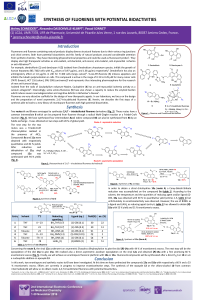
Aromatic compounds (aminopurine, pyridine, quinoline, fluorene…) are excellent building blocks for the development of new drugs. Fluorenone and Fluorene containing natural products display diverse structural features due to their various ring junctions and chiral centers. Together with potential bioactivities, this family of natural products aroused considerable attention from synthetic chemists. They have interesting physicochemical properties and could be used as fluorescent probes1. They display also high therapeutic activities as anti-oxidant, anti-bacterial, anti-cancer, anti-malarial, anti-myocardial or anti-Alzheimer2-7.
For example, Dendroflorin isolated from Dendrobium densiflorum, displays a high antioxidant activity. This compound is cytotoxic at 125.8 µg/mL and have an antimigratory effect at 1.0 µg/mL in 24h for H 460 cells (lungs cancer)3. Some 1,6-disubstituted fluorenones can also induce apoptosis and inhibited the tubulin polymerization in cells. They are active in the range of 0.15 to 0.29 µM for many cancer cells (T47D (breast), HCT 116 (colon), SNU 398 (carcinoma)) and represent thus interesting pharmacophore for the research of new anticancer drugs4. Isolated from the radix of Caulophyllum robustum Maxim, Caulophine has an anti-myocardial ischemia activity as a calcium antagonist5. Interestingly, some fluorenes have also shown a capacity to reduce the amyloid burden which induces severe neurodegeneration and cognitive deficits in Alzheimer’s disease6.
Thus, fluorenes are attractive scaffolds for the design of new therapeutic agents. In our laboratory, we focus in the design and the preparation of novel asymmetric 2,7,9-trisusbtituted fluorenes. Herein, we describe the first steps of a convergent synthesis able to lead to a new library of fluorene enantiopurs with high potential bioactivities.
References
- Kucherak O. A., Didier P., Mély Y., Klymchenko A. S., J. Phys. Chem. Lett. , 1, 2010, 616–620.
- Shi Y., Gao S., Tetrahedron 72, 2016, 1717-1735.
- Klongkumnuankarn P., Busaranon K., Chanvorachote P., Sritularak B., Jongbunpraset V., Likhitwitayawuid K., Hindawi Publishing Corporation, 2015, 1-10.
- Kemnitzer W., Sirisoma N., Jiang S., Kasibhatla S., Crogan-Grundy C., Tseng B., Drewe J., Xiong Cai S., Bioorg. & Med. Chem. Lett. 20, 2010, 1288-1292.
- Si K. W., Liu J. T., He L. C., Li X. K., Liu C. H. Li X. Q., Basic & Clinical Pharmacology & Toxicology, 107, 2010, 976-981.
- Hong H. S., Maezawa I., Budamagunta M., Rana S., Shi A., Vassar R., Liu R., Lam K. S., Cheng R. H., Hua D. H., Voss J. C., Jin L. W., Neurobiology of Aging 31, 2010, 1690-1699.
- Makanga M., Malaria Journal, 2014, 13:291.
Keywords
organic chemistry
enantioselectivity
fluorenes
Poster
ecmc-2-Poster2016-JS.pdf
Antimicrobial Activity of Various Hydantoin Derivatives
Antimicrobial Electrospun Cellulose Acetate Micro-fibers Loaded with Oregano and Rosemary Essential Oil