Event submissions
Published
This submission belongs to the session S1. Design and Characterization of Novel Metallic Materials of the event The 3rd International Online Conference on Metals
Published date
20 Oct, 2026
Academic Editor
 Eric Hug
Citation
Huma Amber, Dmytro Shyshkin, Loreta Tamašauskaitė-Tamašiūnaitė, Eugenijus Norkus, Development and Characterization of Novel Metallic Coatings on Copper Substrates for Sustainable Hydrogen Production, in Proceedings of The 3rd International Online Conference on Metals, 12 October–14 October 2026, MDPI: Basel, Switzerland
Share
Email
Facebook
Twitter
LinkedIn
Development and Characterization of Novel Metallic Coatings on Copper Substrates for Sustainable Hydrogen Production

Huma Amber 1
Dmytro Shyshkin 1

Loreta Tamašauskaitė-Tamašiūnaitė 1
Eugenijus Norkus 1
1. Department of Catalysis, Center for Physical Sciences and Technology (FTMC), Vilnius, Lithuania
Abstract
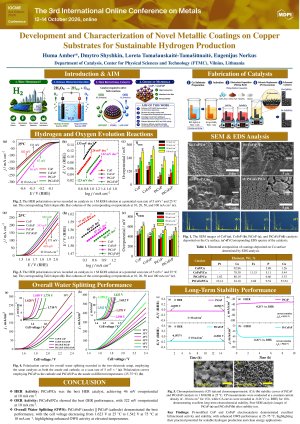
The design and characterization of novel metallic materials with tailored compositions and properties are essential for the development of efficient energy conversion systems. In particular, transition metal phosphides have gained attention due to their compositional flexibility, tunable structure, and favorable electrochemical properties. In this study, cobalt phosphide (CoP) and cobalt-iron phosphide (CoFeP) coatings were fabricated on copper substrates via electroless deposition. Before deposition, the copper substrates were cleaned with an HCl:H₂O (1:1, v/v) solution and activated with a 0.5 g/L PdCl₂ solution. Platinum (Pt) nanoparticles were then incorporated via a galvanic displacement method to modify the surface composition and performance of the developed materials.
The morphology, elemental distribution, crystal structure, phase composition, and surface chemical states of the synthesized materials were investigated using SEM, EDS, XRD, and XPS. The characterization revealed the structure-property relationships and showed how compositional design and surface engineering affect the structural and functional properties of the materials.
Electrochemical analysis for overall water splitting was performed in 1 M KOH electrolyte at temperatures ranging from 25 to 75 °C. Among the developed materials, Pt-CoFeP exhibited superior bifunctional performance, achieving 10 mA cm-2 at a low cell voltage of 1.62 V with only 1.4 μg cm-2 Pt loading. The enhanced activity is attributed to synergistic interactions among Pt, Co, Fe, and P, which improve charge transfer and optimize reaction kinetics for HER and OER.
Remarkably, the Pt-CoFeP (anode) || Pt-CoP (cathode) electrolyser exhibited enhanced activity with increasing temperature, as the cell voltage decreased from 1.623 V at 25 °C to 1.542 V at 75 °C. Achieving 10 mA cm-2 at 1.542 V under elevated temperature highlights improved reaction kinetics, stability, and efficiency under industrial operating conditions. The developed materials exhibit excellent durability and performance, highlighting their potential for sustainable hydrogen production and advanced energy conversion applications.
Keywords
Novel metallic materials
electroless deposition
surface engineering
material characterization
structure-property relationships
sustainable hydrogen production
overall water splitting
Poster
Metal Poster_HUMA 2026.pdf
Effect of Tantalum Content on Structural Evolution and Nanomechanical Properties of TiZrVNb1-xTax (x= 0.1; 0.15; 0.2) High-Entropy Alloys