Event submissions
Published

This submission belongs to the session c. Symposium on Microwave Assisted Synthesis of the event The 20th International Electronic Conference on Synthetic Organic Chemistry
Published date
01 Nov, 2016
Citation
Andrea Defant, Michele Demozzi, Ines Mancini, Efficient TBD-Catalyzed Synthesis of Capsaicin-like Molecules , in Proceedings of The 20th International Electronic Conference on Synthetic Organic Chemistry, 1 November–30 November 2016, MDPI: Basel, Switzerland, doi: 10.3390/ecsoc-20-c003
Share
Email
Facebook
Twitter
LinkedIn
Efficient TBD-Catalyzed Synthesis of Capsaicin-like Molecules
'%3e%3cpath%20d='M12.6647%2010.9104C12.4176%2010.325%2012.0589%209.7933%2011.6088%209.34485C11.16%208.89511%2010.6283%208.53653%2010.0432%208.28891C10.038%208.28629%2010.0327%208.28498%2010.0275%208.28236C10.8437%207.69282%2011.3743%206.73252%2011.3743%205.64907C11.3743%203.85423%209.92005%202.40002%208.12522%202.40002C6.33038%202.40002%204.87618%203.85423%204.87618%205.64907C4.87618%206.73252%205.40677%207.69282%206.22296%208.28367C6.21772%208.28629%206.21248%208.2876%206.20724%208.29022C5.62031%208.53783%205.09365%208.89287%204.64167%209.34616C4.19192%209.79496%203.83334%2010.3266%203.58573%2010.9117C3.34247%2011.4846%203.21128%2012.0987%203.19925%2012.721C3.1989%2012.735%203.20135%2012.7489%203.20646%2012.7619C3.21157%2012.7749%203.21924%2012.7868%203.22901%2012.7968C3.23877%2012.8068%203.25045%2012.8148%203.26334%2012.8202C3.27623%2012.8256%203.29007%2012.8284%203.30406%2012.8284H4.09012C4.14776%2012.8284%204.19362%2012.7825%204.19493%2012.7262C4.22113%2011.7148%204.62726%2010.7676%205.34519%2010.0497C6.08802%209.30686%207.07452%208.89811%208.12522%208.89811C9.17592%208.89811%2010.1624%209.30686%2010.9052%2010.0497C11.6232%2010.7676%2012.0293%2011.7148%2012.0555%2012.7262C12.0568%2012.7839%2012.1027%2012.8284%2012.1603%2012.8284H12.9464C12.9604%2012.8284%2012.9742%2012.8256%2012.9871%2012.8202C13%2012.8148%2013.0117%2012.8068%2013.0214%2012.7968C13.0312%2012.7868%2013.0389%2012.7749%2013.044%2012.7619C13.0491%2012.7489%2013.0515%2012.735%2013.0512%2012.721C13.0381%2012.0947%2012.9084%2011.4856%2012.6647%2010.9104ZM8.12522%207.90243C7.52388%207.90243%206.95792%207.66793%206.53214%207.24215C6.10636%206.81636%205.87185%206.2504%205.87185%205.64907C5.87185%205.04773%206.10636%204.48177%206.53214%204.05599C6.95792%203.63021%207.52388%203.3957%208.12522%203.3957C8.72655%203.3957%209.29252%203.63021%209.7183%204.05599C10.1441%204.48177%2010.3786%205.04773%2010.3786%205.64907C10.3786%206.2504%2010.1441%206.81636%209.7183%207.24215C9.29252%207.66793%208.72655%207.90243%208.12522%207.90243Z'%20fill='%235D1EE1'/%3e%3c/g%3e%3c/svg%3e)
Andrea Defant 1
Michele Demozzi 1

Ines Mancini 1
1. Laboratory of Bioorganic Chemistry, Department of Physics, University of Trento, Via Sommarive 14, 38123 Trento, Italy
Abstract
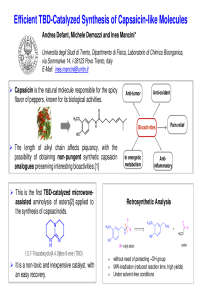
Capsaicin (= (E)-N-(4-hydroxy‐3‐methoxybenzyl)‐8‐methyl‐6‐nonenamide), the natural compound responsible for the spicy flavor in pepper fruits, has shown antioxidant and weight-reductive properties, cardiovascular benefits, anti-carcinogenic activity and recently pain relief effects. Studies on a series of synthetic capsacinoids indicated that the length of alkyl chain affected piquancy, with the possibility of obtaining non‐pungent capsaicin analogues with interesting bioactivieties.1
We report here on a new efficient procedure for the synthesis of capsaicin analogues, based on the aminolysis of vanillylamine with methyl esters showing structural changes in alkyl chain, catalyzed by the inexpensive and non-toxic triazabicyclo[4.4.0]dec‐5‐ene (TBD).2 The procedure is improved by microwave irradiation, which allows to carry out the reaction under solvent-free conditions and to obtain high yields of products. This is an effective and fast procedure for the access to a wide library of capsaicinoids for further biological evaluations, as well as for a large-scale production.
References
- M.L.Reyes‐Escogido, E. G.Gonzalez‐Mondragon, E.Vazquez‐Tzompantzi, Molecules 2011,16,1253.
- C. Sabot, K. A. Kumar, S. Meunier, C. Mioskowski, Tetrahedron Lett. 2007, 48, 3863.
Keywords
capsacinois
MW-assisted synthesis
TBD-catalyst
Manuscript
Capsaicin manuscript.pdf
Poster
Mancini_ID sciforum-009184.pdf
Synthesis of triazoloquinazolinone derivatives employing Silica-based sulfonic acid (MCM- 41-SO3H): A mild, reusable and highly efficient heterogeneous catalyst
Design, synthesis and characterization of novel thienylpyridazine derivatives for optical applications