Event submissions
Published
This submission belongs to the session D. Food Microbiology & Biotechnologies of the event The 7th International Electronic Conference on Foods
Published date
23 Oct, 2026
Academic Editor
 Efstathios Giaouris
Citation
Sónia Eduarda Ferrás Soares, André Silva, Marisa Freitas, Andreia Rebelo, Fátima Barroso, Manuela Vieira da Silva, Cristina Delerue-Matos, Towards Future Honey Microbiome Studies: Optimization of Molecular Approaches for Bacterial DNA Detection in Portuguese Honey, in Proceedings of The 7th International Electronic Conference on Foods, 28 October–30 October 2026, MDPI: Basel, Switzerland
Share
Email
Facebook
Twitter
LinkedIn
Towards Future Honey Microbiome Studies: Optimization of Molecular Approaches for Bacterial DNA Detection in Portuguese Honey

Sónia Eduarda Ferrás Soares 1
André Silva 2

Marisa Freitas 2,3
Andreia Rebelo 4

Fátima Barroso 1
Manuela Vieira da Silva 4

Cristina Delerue-Matos 1
1. REQUIMTE/LAQV, ISEP, Polytechnic of Porto, Rua Dr. António Bernardino de Almeida 431, 4249-015 Porto, Portugal
2. ESS, Polytechnic of Porto, Rua Dr. António Bernardino de Almeida 400, 4200-072 Porto, Portugal
3. CIIMAR/CIMAR LA - Interdisciplinary Centre of Marine and Environmental Research, University of Porto, Terminal de Cruzeiros do Porto de Leixões, Avenida General Norton de Matos, 4450-208 Matosinhos, Portugal
4. REQUIMTE/LAQV, ESS, Polytechnic of Porto, R. Dr. António Bernardino de Almeida 400, 4200-072 Porto, Portugal
Abstract
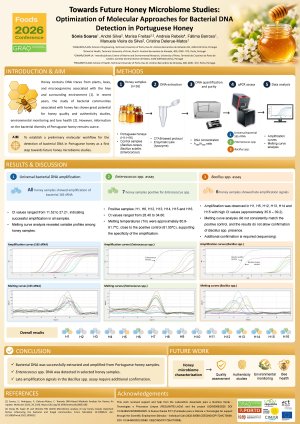
Introduction: Honey contains DNA traces from plants, bees, and microorganisms associated with the hive and surrounding environment [1]. In recent years, the study of bacterial communities associated with honey has gained increasing attention due to its potential applications in honey quality assessment, authenticity studies, environmental monitoring, and bee health [2]. However, information regarding the bacterial diversity associated with Portuguese honey remains scarce. This study aimed to establish a preliminary molecular workflow for the detection of bacterial DNA in Portuguese honey as a first step towards future honey microbiome studies.
Methods: DNA was extracted from Portuguese honey samples using a CTAB-based protocol adapted for bacterial DNA extraction, including an enzymatic lysis step with lysozyme. The presence of bacterial DNA was evaluated by real-time PCR (qPCR) targeting the bacterial 16S rRNA gene using universal primers. In addition, qPCR assays targeting Enterococcus spp. and Bacillus spp. were evaluated and optimized. Negative controls and positive controls consisting of DNA extracted from cultured bacterial isolates were included to monitor contamination and amplification performance. Melting curve analysis was used to assess amplification specificity.
Results: Universal bacterial primers successfully amplified bacterial DNA in all analysed samples, confirming both the suitability of the extraction protocol and the presence of amplifiable bacterial DNA. The Enterococcus-targeted assay detected amplification in selected samples, while other samples remained negative. Amplification of Bacillus targets was observed in positive controls, while only late amplification signals were detected in some honey samples. Additional analyses are required to confirm the presence of Bacillus DNA in these samples.
Conclusions: The results demonstrate the feasibility of extracting and amplifying bacterial DNA directly from Portuguese honey. This work provides a methodological foundation for future culture-dependent and -independent studies aimed at characterizing the bacterial communities associated with Portuguese honey and exploring their relationship with honey quality, authenticity, environmental conditions, and bee health.
Keywords
Portuguese honey
bacterial DNA
qPCR
honey microbiome
Enterococcus
Bacillus
Poster
Foods_2026_Sónia Soares.pdf
Cronobacter turicensis within the Cronobacter genus (Enterobacteriaceae): genomic architecture and evolutionary stability