Event submissions
Published
This submission belongs to the session D. Food Microbiology & Biotechnologies of the event The 7th International Electronic Conference on Foods
Published date
23 Oct, 2026
Academic Editor
 Efstathios Giaouris
Citation
Zofia Owczarzak, Kamil Krakowski, Agnieszka Wyszyńska, Anastazja Tasinkiewicz, Magdalena Szuplewska, Ewa Pszczoła, Paweł Wawrzyniak, Dorota Korsak, Dariusz Bartosik, Cronobacter turicensis within the Cronobacter genus (Enterobacteriaceae): genomic architecture and evolutionary stability, in Proceedings of The 7th International Electronic Conference on Foods, 28 October–30 October 2026, MDPI: Basel, Switzerland
Share
Email
Facebook
Twitter
LinkedIn
Cronobacter turicensis within the Cronobacter genus (Enterobacteriaceae): genomic architecture and evolutionary stability

Zofia Owczarzak 1
Kamil Krakowski 2
Agnieszka Wyszyńska 1
Anastazja Tasinkiewicz 1
Magdalena Szuplewska 1
Ewa Pszczoła 1
Paweł Wawrzyniak 1
Dorota Korsak 1
Dariusz Bartosik 1
1. Institute of Microbiology, Faculty of Biology, University of Warsaw, Warsaw 02-096, Poland
2. Institute of Evolutionary Biology, Faculty of Biology, University of Warsaw, Warsaw 02-096, Poland
Abstract
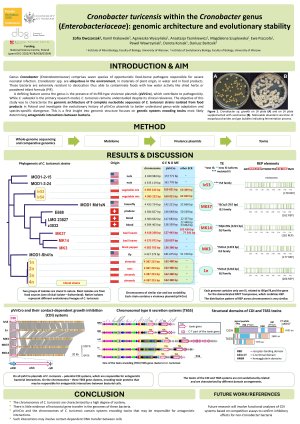
The genus Cronobacter comprises seven species of opportunistic food-borne pathogens responsible for severe neonatal infections. A defining feature across the genus is the presence of IncFIB-type virulence plasmids (pVirCro), which contribute to pathogenicity. While C. sakazakii is the primary research model, C. turicensis remains understudied despite its clinical relevance. The objective of this study was to characterize the genomic architecture of C. turicensis and investigate the evolutionary history of pVirCro plasmids to better understand genus-wide adaptation and species-specific divergence.
Whole-genome sequencing and comparative genomic analyses were performed on 47 Cronobacter strains, including nine C. turicensis isolates from nuts, herbs, and spices collected in Poland. Genome synteny, mobile genetic elements, the pVirCro core genome, and phylogenetic relationships between plasmids and host chromosomes were analyzed.
Phylogenetic evidence indicates that pVirCro plasmids have co-evolved with their hosts for approximately 45–68 million years and retain a conserved core of about 40 genes involved in replication, partitioning, and contact-dependent growth inhibition (CDI). Although CDI systems are widespread within the genus, they are reduced in C. sakazakii. In contrast, C. turicensis maintains complete plasmid-borne CDI together with an expanded repertoire of antagonistic systems. The genomes also display high synteny and conserved ISKpn78-related sequences and a domesticated RAYT transposase.
This study provides new insights into the long-term evolution of pVirCro plasmids and identifies genomic features that distinguish C. turicensis from other Cronobacter species, including its exceptional genomic stability and preserved antagonistic potential. Future studies should determine how these plasmid-encoded systems contribute to persistence in low-moisture foods and virulence, supporting improved food safety surveillance and risk assessment.
Funding: National Science Centre, Poland (grant no: DEC-2022/47/B/NZ8/03264)
Keywords
Cronobacter spp.
Cronobacter turicensis
virulence plasmids
food-borne pathogens
Poster
FOODS_2026_ZO.pdf
Towards Future Honey Microbiome Studies: Optimization of Molecular Approaches for Bacterial DNA Detection in Portuguese Honey
Identification by MALDI-TOF MS and probiotic characterization of Enterococcus faecium strains isolated from equine milk